Loading...
This comparison has not been analyzed yet.
One-time AI generation (~1 minute). Scores and timeline are already available below.
Fa Ngum vs Intharacha
Fa Ngum leads by 8.0 pts · 2 figures compared
…
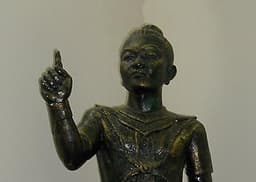
Fa Ngum
Emperor · Medieval
62.3Total

Intharacha
Emperor · Medieval
54.3Total
Basic Information
Born
1316
1359
Died
1393
1424
Era
Medieval
Medieval
Nationality
Laos
Thailand
Occupation
Emperor
Emperor
Civilization
Eastern
Eastern
Score Comparison
Military (10%)
70.0
55.0
Political (20%)
68.0
68.0
Influence (20%)
61.0
56.4
Legacy (20%)
54.0
50.0
Leadership (15%)
74.0
40.0
Strategy (15%)
52.5
60.0
TOTAL
62.3
54.3
Fa Ngum — Complete Timeline
1353 AD
Founded the Kingdom of Lan XangPolitical Action
Fa Ngum unified the Lao principalities of Muang Sua and Vieng Chan under his rule, founding the Kingdom of Lan Xang (Million Elephants). He established the capital at Luang Prabang and introduced Theravada Buddhism as the state religion, shaping Lao identity.
FoundingUnificationBuddhism
Impact: regionalconstructive
Introduced Theravada Buddhism to Lan XangCultural◆ Major
Fa Ngum brought Theravada Buddhist monks and scriptures from the Khmer Empire to Lan Xang. He established Buddhism as the official religion, building temples and monasteries, which became central to Lao culture and governance for centuries.
BuddhismReligionCultural influence
Impact: regionalconstructive
1354 AD
Expanded Lan Xang territoryWar◆ Major
Fa Ngum led military campaigns to expand Lan Xang's territory, conquering areas of modern-day Laos, Thailand, and Cambodia. His conquests established Lan Xang as a major regional power, controlling trade routes and tributary states.
ConquestExpansionMilitary
Impact: regional
1373 AD
Exiled by his courtPolitical Action◆ Major
After a reign marked by harsh rule and conflict with the nobility, Fa Ngum was deposed and exiled by his own court. He died in exile in 1393, leaving his son Samsenethai to succeed him. His exile ended the founding era of Lan Xang.
ExileDepositionCourt conflict
Impact: regionaltragic
Intharacha — Complete Timeline
1370 AD
Founding of the Suphannaphum DynastyPolitical Action◆ Major
Intharacha established the Suphannaphum dynasty after seizing the throne of Ayutthaya from the Uthong dynasty. This dynastic change initiated a new ruling line that would govern Ayutthaya for nearly two centuries, shaping the kingdom's political structure and succession practices.
Dynasty FoundationAyutthayaPolitical Change
Impact: nationalconstructive
1380 AD
Consolidation of Ayutthaya's Central AuthorityReform
Intharacha implemented administrative reforms to centralize royal power, reducing the influence of regional nobles and establishing a more unified governance structure. These measures strengthened the monarchy and improved tax collection, contributing to Ayutthaya's stability.
Administrative ReformCentralizationGovernance
Impact: nationalconstructive
1390 AD
Campaign Against the Khmer EmpireWar◆ Major
Intharacha led military campaigns into Khmer territory, capturing several provinces and weakening Khmer control over western regions. These actions expanded Ayutthaya's influence and reduced Khmer power, setting the stage for future conflicts between the two kingdoms.
Military CampaignKhmer ConflictTerritorial Expansion
Impact: regional
This comparison has not been analyzed yet.
One-time AI generation (~1 minute). Scores and timeline are already available below.
Rankings
🥇
Fa NgumLeader
Mil: 70.0Pol: 68.0Inf: 61.0
62.3
🥈
Intharacha
Mil: 55.0Pol: 68.0Inf: 56.4
54.3
+8.0 behind
How This Comparison Works
Algorithm
Each figure is scored on 6 dimensions (0—100 scale) based on structured historical data: Military (10%), Political (20%), Influence (20%), Legacy (20%), Leadership (15%), Strategy (15%). The weighted total produces the final ranking.
Data Sources
Scores are computed from structured sub-indicators in the database. Scale factors adjust for era (Ancient ×0.85, Modern ×1.0) and civilization size (Eastern ×1.05, Other ×0.80) to account for differences in population and military scale.
Maximum 3 Figures
Comparisons are limited to 2—3 figures to ensure readability and statistical meaningfulness.
Error Margins
±5 points per dimension — Sub-scores are derived from historical records with inherent uncertainty. Two figures within 5 points on a dimension should be considered roughly equivalent in that area.
Total Score Accuracy
±3 points overall — The weighted combination of 6 dimensions produces a total score with approximately ±3 points of uncertainty. Differences of less than 3 points are not statistically significant— the figures are effectively tied.
Known Limitations
- Historical records are incomplete and uneven across civilizations
- Figures from oral-tradition societies may be underrepresented
- Occupation labels can misclassify multi-role figures
- Scores measure capability and impact, not moral character
- Quantitative scoring is a comparison tool, not absolute truth
Capability Radar
Military (10%) — Battles & Warfare
Battles
55
45
Win Rate
60
50
Expansion
70
50
Political (20%) — Governance & Reform
Reform
55
55
Diplomacy
60
50
Economy
50
45
Influence (20%) — Cultural & Global Reach
Cultural
55
40
Global
40
30
Legacy (20%) — Historical Impact
Historical
60
50
Longevity
55
45
Leadership (15%) — Power & Stability
Tenure
60
60
Stability
45
55
Strategy (15%) — Tactics & Innovation
Strategy
65
45
Tactics
50
40
Reform
40
35
Similar Comparisons
Comments & Discussion
No comments yet. Be the first to share your thoughts!