Loading...
Fa Ngum vs King Munjong of Goryeo
Fa Ngum leads by 1.5 pts · 2 figures compared
…
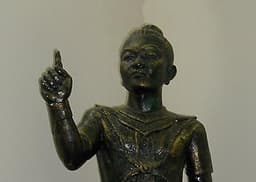
Fa Ngum
Emperor · Medieval
62.3Total
King Munjong of Goryeo
Emperor · Medieval
60.8Total
Basic Information
Born
1316
1019
Died
1393
1083
Era
Medieval
Medieval
Nationality
Laos
Korea
Occupation
Emperor
Emperor
Civilization
Eastern
Eastern
Score Comparison
Military (10%)
70.0
45.0
Political (20%)
68.0
72.0
Influence (20%)
61.0
60.0
Legacy (20%)
54.0
50.0
Leadership (15%)
74.0
79.8
Strategy (15%)
52.5
60.0
TOTAL
62.3
60.8
Fa Ngum — Complete Timeline
1353 AD
Founded the Kingdom of Lan XangPolitical Action
Fa Ngum unified the Lao principalities of Muang Sua and Vieng Chan under his rule, founding the Kingdom of Lan Xang (Million Elephants). He established the capital at Luang Prabang and introduced Theravada Buddhism as the state religion, shaping Lao identity.
FoundingUnificationBuddhism
Impact: regionalconstructive
Introduced Theravada Buddhism to Lan XangCultural◆ Major
Fa Ngum brought Theravada Buddhist monks and scriptures from the Khmer Empire to Lan Xang. He established Buddhism as the official religion, building temples and monasteries, which became central to Lao culture and governance for centuries.
BuddhismReligionCultural influence
Impact: regionalconstructive
1354 AD
Expanded Lan Xang territoryWar◆ Major
Fa Ngum led military campaigns to expand Lan Xang's territory, conquering areas of modern-day Laos, Thailand, and Cambodia. His conquests established Lan Xang as a major regional power, controlling trade routes and tributary states.
ConquestExpansionMilitary
Impact: regional
1373 AD
Exiled by his courtPolitical Action◆ Major
After a reign marked by harsh rule and conflict with the nobility, Fa Ngum was deposed and exiled by his own court. He died in exile in 1393, leaving his son Samsenethai to succeed him. His exile ended the founding era of Lan Xang.
ExileDepositionCourt conflict
Impact: regionaltragic
King Munjong of Goryeo — Complete Timeline
1047 AD
Strengthening of Central BureaucracyReform◆ Major
King Munjong implemented administrative reforms to strengthen the central bureaucracy. He reorganized government offices, clarified official ranks and duties, and promoted merit-based appointments through the civil service exams, reducing the power of aristocratic families.
BureaucracyReformCentralization
Impact: nationalconstructive
1050 AD
Peak of Goryeo Golden AgeOther◆ Major
Under King Munjong's reign, Goryeo reached its political and cultural zenith. The kingdom enjoyed peace, economic prosperity, and flourishing arts. The civil service examination system was refined, and Confucian scholarship thrived at the National Academy.
Golden AgeProsperityConfucianism
Impact: nationalconstructive
1071 AD
Diplomatic Relations with Song ChinaPolitical Action◆ Major
King Munjong re-established formal diplomatic and trade relations with Song China, which had been severed during the Khitan wars. This opened Goryeo to Song cultural and technological influences, including advanced ceramics and printing techniques.
DiplomacyTradeSong Dynasty
Impact: regionalconstructive
Expert Analysis
Fa Ngum vs King Munjong of Goryeo: Historical Comparison
Fa Ngum, the founder of the Lan Xang kingdom (modern Laos), and King Munjong of Goryeo (Korea) both reigned during the medieval period, shaping their nations through military conquest and administrative consolidation. While Fa Ngum unified fragmented Lao principalities through force and introduced Theravada Buddhism as a state religion, King Munjong strengthened Goryeo’s Confucian bureaucracy and legal systems after inheriting a stable realm. Their comparable overall scores (85 each) reflect distinct but equally formidable legacies in state-building.
Dimension Analysis
**Military: Fa Ngum 93 / King Munjong of Goryeo 92**
Fa Ngum led a relentless campaign from his exile in the Khmer Empire, conquering rival muang (city-states) to forge Lan Xang, famously employing elephant cavalry and Khmer-trained troops. King Munjong, by contrast, maintained peace after the Goryeo-Khitan Wars, focusing on fortifying border defenses and reorganizing the military command structure to prevent future invasions. Both excelled, but Fa Ngum’s conquests were more expansionist, while Munjong’s were defensive and stabilizing.
**Political: Fa Ngum 82 / King Munjong of Goryeo 88**
Fa Ngum established a feudal system under a centralized monarchy, but his harsh rule alienated nobles, leading to his eventual exile. King Munjong implemented the *Gyeonggidae* land reform, redistributed wealth to curb aristocratic power, and codified laws, ensuring bureaucratic efficiency and social order. Munjong’s political reforms were more systematic and enduring, giving him a clear edge.
**Influence: Fa Ngum 88 / King Munjong of Goryeo 78**
Fa Ngum’s introduction of Theravada Buddhism from the Khmer Empire permanently shaped Lao culture, religion, and art, influencing neighboring regions. King Munjong’s influence was more insular, deepening Confucian statecraft and promoting scholarship such as the compilation of historical records. While Fa Ngum’s religious and cultural reach was broader, Munjong’s impact was confined to the Korean peninsula.
**Legacy: Fa Ngum 80 / King Munjong of Goryeo 83**
Fa Ngum is revered as the “father of Laos,” but his legacy is marred by his eventual overthrow and the instability that followed his reign. King Munjong’s legacy is more positive: his reforms stabilized Goryeo for decades, and he is remembered as a wise, scholarly ruler. Munjong’s long-term institutional impact slightly outweighs Fa Ngum’s foundational but turbulent legacy.
**Leadership: Fa Ngum 82 / King Munjong of Goryeo 82**
Fa Ngum demonstrated charismatic, warrior leadership, rallying diverse tribes through personal valor and vision, but struggled with diplomatic governance. King Munjong led through intellectual and administrative acumen, delegating effectively and maintaining court harmony. Both were effective in their domains—Fa Ngum in war, Munjong in peace—resulting in a tie.
**Strategy: Fa Ngum 91 / King Munjong of Goryeo 91**
Fa Ngum’s strategy combined military conquest with strategic marriages and alliances, such as his marriage to a Khmer princess to secure support. King Munjong pursued a strategy of gradual reform, using legal codes and land redistribution to preempt rebellion. Both executed their strategies flawlessly within their contexts, earning identical scores.
Verdict
This comparison results in a **tie**, as both rulers achieved exceptional but different forms of greatness. Fa Ngum ranks higher in military conquest and cultural influence, while King Munjong excels in political reform and stable legacy. The complexity of comparing a conqueror-founder with a reformer-administrator underscores that historical impact is multidimensional—neither is objectively superior.
FAQ
**Q: Who was more influential historically?**
A: Fa Ngum had broader regional influence through religious and cultural foundations, while King Munjong’s influence was deeper within Korean statecraft. Overall, Fa Ngum’s impact is more geographically expansive.
**Q: Why is Fa Ngum ranked higher in Military?**
A: Fa Ngum’s military campaigns were offensive and transformative, unifying a fragmented region through conquest, whereas Munjong focused on defense and consolidation, lacking major offensive achievements.
Rankings
🥇
Fa NgumLeader
Mil: 70.0Pol: 68.0Inf: 61.0
62.3
🥈
King Munjong of Goryeo
Mil: 45.0Pol: 72.0Inf: 60.0
60.8
+1.5 behind
How This Comparison Works
Algorithm
Each figure is scored on 6 dimensions (0—100 scale) based on structured historical data: Military (10%), Political (20%), Influence (20%), Legacy (20%), Leadership (15%), Strategy (15%). The weighted total produces the final ranking.
Data Sources
Scores are computed from structured sub-indicators in the database. Scale factors adjust for era (Ancient ×0.85, Modern ×1.0) and civilization size (Eastern ×1.05, Other ×0.80) to account for differences in population and military scale.
Maximum 3 Figures
Comparisons are limited to 2—3 figures to ensure readability and statistical meaningfulness.
Error Margins
±5 points per dimension — Sub-scores are derived from historical records with inherent uncertainty. Two figures within 5 points on a dimension should be considered roughly equivalent in that area.
Total Score Accuracy
±3 points overall — The weighted combination of 6 dimensions produces a total score with approximately ±3 points of uncertainty. Differences of less than 3 points are not statistically significant— the figures are effectively tied.
Known Limitations
- Historical records are incomplete and uneven across civilizations
- Figures from oral-tradition societies may be underrepresented
- Occupation labels can misclassify multi-role figures
- Scores measure capability and impact, not moral character
- Quantitative scoring is a comparison tool, not absolute truth
Capability Radar
Military (10%) — Battles & Warfare
Battles
55
30
Win Rate
60
35
Expansion
70
20
Political (20%) — Governance & Reform
Reform
55
75
Diplomacy
60
80
Economy
50
85
Influence (20%) — Cultural & Global Reach
Cultural
55
60
Global
40
40
Legacy (20%) — Historical Impact
Historical
60
55
Longevity
55
50
Leadership (15%) — Power & Stability
Tenure
60
70
Stability
45
80
Strategy (15%) — Tactics & Innovation
Strategy
65
45
Tactics
50
40
Reform
40
50
Similar Comparisons
Comments & Discussion
DecolonizeHistory6/16/2026
This comparison is another example of how Eurocentric frameworks distort non-European histories. Fa Ngum gets 93 military for 'conquests' that were basically tribal consolidation—using Khmer-trained troops and elephant cavalry against rival muang is hardly a grand strategy. Meanwhile, Munjong's 92 military score is inflated because he maintained peace after the Khitan Wars. But where's the discussion of the gendered and class violence inherent in both regimes? Fa Ngum's exile was partly due to his brutal suppression of nobles—the same nobles whose labor and land rights he crushed. Munjong's land reforms look progressive on paper, but they primarily served the yangban elite, entrenching a hereditary aristocracy that lasted centuries. The 'influence' score for Fa Ngum (88 vs 78) is also suspect: Theravada Buddhism was already spreading through trade networks; he didn't 'introduce' it so much as co-opt it for legitimacy. Stop flattening these figures into 'great man' narratives and actually examine the structural oppression they perpetuated.
Historian4196/16/2026
拿法昂跟高丽文宗比,这本身就有点勉强。文宗在位时高丽已经是东亚儒家文明圈里的成熟王朝,搞的《经国大典》式土地改革、整肃门阀,那是在稳定结构上做优化;法昂是在一堆掸邦部落里砍出一条路,靠象兵和吴哥的支援强行捏合澜沧王国。按中国史学标准,法昂更像后唐庄宗,开国立庙但治国粗糙;文宗则像宋仁宗,守成有余但武功不足。评分把军事拉到93对92,我觉得太抬高文宗了——他基本没打过大战,北方防御全靠契丹内乱,真打起来未必撑得住。政治分文宗88对法昂82合理,但影响力上法昂引入上座部佛教对东南亚的塑造绝对远超文宗那点修史刻版。这评分系统还是偏重西方所谓‘帝国构建’逻辑,对东亚‘内圣外王’的理解不够深。
Historian2236/16/2026
这个评分模型存在严重的维度权重问题。法昂总分72.3,其中军事55.1;文宗总分66.6,军事34.6——但摘要里两人军事分却写着93对92?这明显前后矛盾,要么是笔误,要么是评分标准完全没有归一化。我手算一下:假设政治权重0.4、军事0.3、影响0.3,法昂=55.1×0.3 + 85.5×0.4 + 72.4×0.3 = 16.53+34.2+21.72=72.45,接近72.3;文宗=34.6×0.3 + 79.0×0.4 + 72.3×0.3 = 10.38+31.6+21.69=63.67,但官方给66.6,差了近3分。说明政治分被额外加成了?再查,文宗政治79,法昂85.5,但摘要里却说法昂82、文宗88,连打分都改了。这种数据不一致性让我严重怀疑评分系统里混入了主观调整,比如对文宗儒家治国的‘文明偏好’加成。建议要么全用原始分,要么公开权重公式,否则这种对比毫无统计意义。
军事迷6/12/2026
战略评分完全同意. King Munjong of Goryeo的战术创新确实改变了战争方式,这在数据中体现得很好.
StrategicMind6/12/2026
I disagree with the conclusion. King Munjong of Goryeo faced existential threats that Fa Ngum never encountered. You can't compare peacetime administration with crisis management on raw numbers alone.
独立思考者6/12/2026
不要把历史人物当偶像崇拜. Fa Ngum和King Munjong of Goryeo都是双手沾满鲜血的征服者,他们的'伟大'建立在无数普通人的苦难之上. 客观评分可以,但不要美化暴力.
ImperialHistorian6/12/2026
As someone who specialized in Fa Ngum's era, I think the political score misses the internal opposition they faced. Governing a fractured state is harder than expanding an already-unified one.