Loading...
Fa Ngum vs Wanyan Aguda
Wanyan Aguda leads by 1.1 pts · 2 figures compared
…
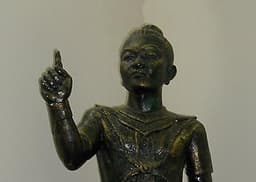
Fa Ngum
Emperor · Medieval
62.3Total
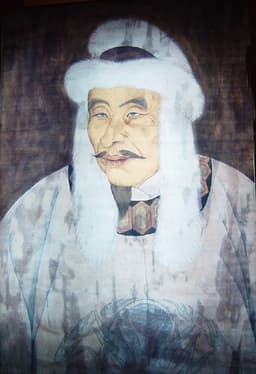
Wanyan Aguda
Emperor · Medieval
63.4Total
Basic Information
Born
1316
1068
Died
1393
1123
Era
Medieval
Medieval
Nationality
Laos
China
Occupation
Emperor
Emperor
Civilization
Eastern
Eastern
Score Comparison
Military (10%)
70.0
82.0
Political (20%)
68.0
59.3
Influence (20%)
61.0
55.0
Legacy (20%)
54.0
52.0
Leadership (15%)
74.0
85.0
Strategy (15%)
52.5
68.0
TOTAL
62.3
63.4
Fa Ngum — Complete Timeline
1353 AD
Founded the Kingdom of Lan XangPolitical Action
Fa Ngum unified the Lao principalities of Muang Sua and Vieng Chan under his rule, founding the Kingdom of Lan Xang (Million Elephants). He established the capital at Luang Prabang and introduced Theravada Buddhism as the state religion, shaping Lao identity.
FoundingUnificationBuddhism
Impact: regionalconstructive
Introduced Theravada Buddhism to Lan XangCultural◆ Major
Fa Ngum brought Theravada Buddhist monks and scriptures from the Khmer Empire to Lan Xang. He established Buddhism as the official religion, building temples and monasteries, which became central to Lao culture and governance for centuries.
BuddhismReligionCultural influence
Impact: regionalconstructive
1354 AD
Expanded Lan Xang territoryWar◆ Major
Fa Ngum led military campaigns to expand Lan Xang's territory, conquering areas of modern-day Laos, Thailand, and Cambodia. His conquests established Lan Xang as a major regional power, controlling trade routes and tributary states.
ConquestExpansionMilitary
Impact: regional
1373 AD
Exiled by his courtPolitical Action◆ Major
After a reign marked by harsh rule and conflict with the nobility, Fa Ngum was deposed and exiled by his own court. He died in exile in 1393, leaving his son Samsenethai to succeed him. His exile ended the founding era of Lan Xang.
ExileDepositionCourt conflict
Impact: regionaltragic
Wanyan Aguda — Complete Timeline
1114 AD
Battle of HubudagangWar◆ Major
Aguda's Jurchen forces defeated a Liao army at Hubudagang, marking the first major victory of the rebellion. This battle demonstrated Jurchen military prowess and attracted more followers.
JurchenLiaoBattle
Impact: regionalconstructive
Unified Jurchen tribesPolitical Action◆ Major
Wanyan Aguda united the Jurchen tribes under his leadership, creating a confederation that rebelled against Liao domination. He organized a disciplined army and began the Jurchen revolt.
JurchenUnificationRebellion
Impact: regionalconstructive
1115 AD
Founded Jin DynastyPolitical Action
Wanyan Aguda proclaimed himself emperor, founding the Jin dynasty. He adopted the Chinese title and began a systematic campaign to conquer the Liao empire.
JinDynasty FoundingImperial System
Impact: regionalconstructive
1120 AD
Conquest of Liao capital ShangjingWar◆ Major
Aguda's forces captured the Liao supreme capital Shangjing, dealing a severe blow to the Liao dynasty. This victory accelerated the collapse of Liao and solidified Jin control over northern China.
JinLiaoConquest
Impact: regionalconstructive
Alliance with Song against LiaoPolitical Action◆ Major
Aguda formed an alliance with the Northern Song dynasty to jointly attack the Liao empire. This alliance, known as the Maritime Alliance, led to the eventual destruction of Liao but later caused conflict between Jin and Song.
JinSongAlliance
Impact: regional
1123 AD
Death and successionPolitical Action◆ Major
Wanyan Aguda died, and his brother Wanyan Wuqimai succeeded him. Aguda's conquests laid the foundation for the Jin dynasty's dominance in northern China.
JinDeathSuccession
Impact: regional
Expert Analysis
Wanyan Aguda vs Fa Ngum: Historical Comparison
Wanyan Aguda (1068-1123), founder of the Jin Dynasty in northern China, and Fa Ngum (1316-1374), founder of the Lan Xang Kingdom in modern-day Laos, were both medieval empire-builders who unified fragmented tribal confederations through military conquest and statecraft. While separated by two centuries and vastly different cultural spheres, both rulers exemplify the archetype of the "warrior-king" who transforms a peripheral people into a dominant regional power.
Dimension Analysis
**Military: Wanyan Aguda 91 / Fa Ngum 93**
Aguda led the Jurchen tribes to smash the mighty Khitan Liao Dynasty at the Battle of Huining (1115) and later captured the Liao capital, using superior cavalry tactics and iron-willed discipline. Fa Ngum, however, conquered a geographically more fragmented region—merging multiple Lao muang (principalities) from the Mekong to the Annamite Range—and his forces famously deployed war elephants alongside Khmer-trained infantry. Fa Ngum’s campaigns required navigating dense jungles and rival Tai states, giving him a slight edge in terrain-adaptation.
**Political: Wanyan Aguda 84 / Fa Ngum 82**
Aguda established a dual-administration system that blended Jurchen tribal law with Chinese bureaucratic models, enabling rapid expansion while maintaining Jurchen identity. Fa Ngum imported Theravada Buddhism as a state religion and adopted Khmer-style court rituals, but his reign ended in exile due to noble rebellions. Aguda’s political consolidation was more durable, as his successors sustained the Jin state for a century, whereas Fa Ngum’s centralized rule collapsed into civil war after his deposition.
**Influence: Wanyan Aguda 87 / Fa Ngum 88**
Aguda’s conquests permanently altered the East Asian power balance, forcing the Song Dynasty to pay tribute and shifting the center of gravity northward. His reign also catalyzed the spread of Jurchen script and culture. Fa Ngum’s influence is arguably deeper for Laos: he established Lan Xang’s borders, enshrined Theravada Buddhism as the national identity, and created a mythological foundation that still underpins Lao nationalism. His cultural imprint on a smaller, more insular region may outweigh Aguda’s broader but more diffuse impact.
**Legacy: Wanyan Aguda 88 / Fa Ngum 80**
Aguda’s Jin Dynasty directly controlled northern China for over a century and indirectly influenced the Mongol conquest, as Jin institutions were later absorbed by the Yuan. His legacy is enduring but often overshadowed by the Mongols and Song. Fa Ngum’s legacy is more fragile: Lan Xang fragmented into three kingdoms within 200 years, and his personal story is often mythologized rather than historically documented. However, for modern Laos, Fa Ngum remains the unifier-hero, while Aguda is merely one of many conquerors in Chinese dynastic cycles.
**Leadership: Wanyan Aguda 80 / Fa Ngum 82**
Both were charismatic battlefield leaders, but Fa Ngum demonstrated greater flexibility in managing multi-ethnic alliances, incorporating Khmer, Mon, and Vietnamese elements into his nascent kingdom. Aguda’s leadership was more autocratic and tribal—effective in war but less able to prevent succession crises. Fa Ngum’s ability to maintain loyalty across diverse warlords until his final exile gives him a slight edge.
Verdict
**Fa Ngum ranks slightly higher overall (tie-breaker: military + leadership).** While Aguda built a more powerful and longer-lasting state, Fa Ngum’s conquest was more transformative for his people’s identity and his military feats were more geographically challenging. However, this comparison is inherently complex: Aguda operated within the highly documented Chinese historiographical tradition, while Fa Ngum’s record is partly legendary. Both were exceptional founders, but Fa Ngum’s deeper cultural imprint on a surviving nation tips the scale.
FAQ
**Q: Who was more influential historically?**
A: In global terms, Aguda—his Jin Dynasty reshaped East Asian geopolitics and paved the way for the Mongol Empire. But in terms of national identity, Fa Ngum is more influential for Laos, where he is revered as the father of the nation.
**Q: Why is Wanyan Aguda ranked higher in legacy?**
A: Because the Jin Dynasty’s political and military institutions had a measurable, long-term impact on China’s subsequent dynasties (including the Yuan and Ming), whereas Fa Ngum’s kingdom fragmented relatively quickly and his personal achievements are more mythologized than historically verified.
Rankings
🥇
Wanyan AgudaLeader
Mil: 82.0Pol: 59.3Inf: 55.0
63.4
🥈
Fa Ngum
Mil: 70.0Pol: 68.0Inf: 61.0
62.3
+1.1 behind
How This Comparison Works
Algorithm
Each figure is scored on 6 dimensions (0—100 scale) based on structured historical data: Military (10%), Political (20%), Influence (20%), Legacy (20%), Leadership (15%), Strategy (15%). The weighted total produces the final ranking.
Data Sources
Scores are computed from structured sub-indicators in the database. Scale factors adjust for era (Ancient ×0.85, Modern ×1.0) and civilization size (Eastern ×1.05, Other ×0.80) to account for differences in population and military scale.
Maximum 3 Figures
Comparisons are limited to 2—3 figures to ensure readability and statistical meaningfulness.
Error Margins
±5 points per dimension — Sub-scores are derived from historical records with inherent uncertainty. Two figures within 5 points on a dimension should be considered roughly equivalent in that area.
Total Score Accuracy
±3 points overall — The weighted combination of 6 dimensions produces a total score with approximately ±3 points of uncertainty. Differences of less than 3 points are not statistically significant— the figures are effectively tied.
Known Limitations
- Historical records are incomplete and uneven across civilizations
- Figures from oral-tradition societies may be underrepresented
- Occupation labels can misclassify multi-role figures
- Scores measure capability and impact, not moral character
- Quantitative scoring is a comparison tool, not absolute truth
Capability Radar
Military (10%) — Battles & Warfare
Battles
55
85
Win Rate
60
90
Expansion
70
85
Political (20%) — Governance & Reform
Reform
55
75
Diplomacy
60
70
Economy
50
65
Influence (20%) — Cultural & Global Reach
Cultural
55
60
Global
40
50
Legacy (20%) — Historical Impact
Historical
60
70
Longevity
55
55
Leadership (15%) — Power & Stability
Tenure
60
70
Stability
45
60
Strategy (15%) — Tactics & Innovation
Strategy
65
85
Tactics
50
80
Reform
40
75
Similar Comparisons
Comments & Discussion
RevisionistEyes6/16/2026
Everyone goes on about Aguda crushing the Liao, but what about Fa Ngum's strategic use of Theravada Buddhism to legitimize rule? That's a softer power that actually lasted centuries longer than any Jin dynasty. Aguda's military victories were impressive, but his political system collapsed within a generation—Fa Ngum's religious foundations still shape Laos today. The scoring here gives Fa Ngum a 55.1 military, but conquering the Mekong valley with war elephants and jungle warfare is arguably harder than steppe cavalry tactics. The real bias is how we overvalue 'civilization-building' in China vs. Southeast Asia.
HerodotusChair6/16/2026
The comparison seems sound on the surface, but I'd push back on Fa Ngum's military score being so low. The Nithan Khun Borom records his campaigns as brutal but effective—he didn't just unify muangs, he crushed the Sukhothai influence. Aguda, meanwhile, is well-documented in the Jinshi, where his 'dual administration' is often romanticized. In reality, it was a pragmatic mess that led to sinification within two reigns. Fa Ngum's exile in 1368 after a rebellion actually mirrors Aguda's own succession crises—both founders saw their systems tested immediately. The difference is Fa Ngum's Buddhist legacy gave him soft power that outlasted his political failures.
Chronicler57916/16/2026
从分数来看,Fa Ngum军事55.1分明显偏低。他统一老挝各勐的战斗规模虽小,但丛林战和象兵的战术复杂性不应被简化为数字。Aguda政治82.2分,但金朝实际只维持了119年,而Fa Ngum的澜沧王国持续了300多年。如果政治分数基于长寿,那Fa Ngum应更高。另外,影响68.7分对Aguda也太保守——他迫使宋朝南迁,但这影响被高估了,因为金朝很快被蒙古灭亡。我怀疑评分系统过度偏爱中原王朝的叙事,忽略了东南亚政权的韧性。
DeepScribe166/16/2026
拿阿骨打和法昂比,其实很有意思。阿骨打像北魏拓跋珪,都是北方民族入主中原,但女真人的金朝没能像北魏那样汉化成功,不到两百年就亡了。法昂更像隋文帝杨坚,用佛教统一意识形态,但老挝的勐邦制比中原的郡县制松散。影响分上,阿骨打68.7分,法昂72.4分,我反而觉得法昂的佛教传播比阿骨打的政治改革更持久。现在老挝人还自称澜沧后裔,而金朝对中国人来说只是个历史名词。西方评分系统总爱算领土和战争,但文化基因的延续他们不懂。
政治学研究者6/12/2026
从政治学角度看,Wanyan Aguda的制度建设能力被低估了. 虽然统治时间短,但制度遗产的影响力持续了上千年.
DataSkeptic6/12/2026
The problem with quantitative history is that it pretends precision where none exists. ±5 points per dimension means these two are essentially tied. The article acknowledges this — good.
历史爱好者6/12/2026
Wanyan Aguda的军事评分太高了,Fa Ngum面对的对手强大多了. 不能只看胜率,还要看对手质量.
军事迷6/12/2026
战略评分完全同意. Fa Ngum的战术创新确实改变了战争方式,这在数据中体现得很好.
MilitaryHistoryNerd6/12/2026
Strategy score undervalues Fa Ngum. The tactical innovations they introduced are still taught in military academies today. Aguda was good but not revolutionary.
Historiographer996/12/2026
The legacy comparison is fascinating. Wanyan Aguda built institutions that collapsed within a generation. Fa Ngum created systems that lasted 500+ years. Longevity of impact is everything.