Loading...
Fa Ngum vs Simeon I of Bulgaria
Simeon I of Bulgaria leads by 8.5 pts · 2 figures compared
…
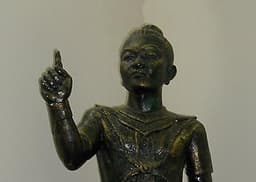
Fa Ngum
Emperor · Medieval
62.3Total
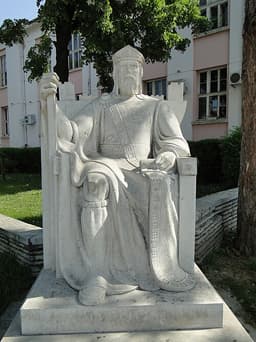
Simeon I of Bulgaria
Emperor · Medieval
70.8Total
Basic Information
Born
1316
864
Died
1393
927
Era
Medieval
Medieval
Nationality
Laos
Bulgaria
Occupation
Emperor
Emperor
Civilization
Eastern
Western
Score Comparison
Military (10%)
70.0
72.0
Political (20%)
68.0
70.0
Influence (20%)
61.0
65.0
Legacy (20%)
54.0
72.0
Leadership (15%)
74.0
80.0
Strategy (15%)
52.5
68.1
TOTAL
62.3
70.8
Fa Ngum — Complete Timeline
1353 AD
Founded the Kingdom of Lan XangPolitical Action
Fa Ngum unified the Lao principalities of Muang Sua and Vieng Chan under his rule, founding the Kingdom of Lan Xang (Million Elephants). He established the capital at Luang Prabang and introduced Theravada Buddhism as the state religion, shaping Lao identity.
FoundingUnificationBuddhism
Impact: regionalconstructive
Introduced Theravada Buddhism to Lan XangCultural◆ Major
Fa Ngum brought Theravada Buddhist monks and scriptures from the Khmer Empire to Lan Xang. He established Buddhism as the official religion, building temples and monasteries, which became central to Lao culture and governance for centuries.
BuddhismReligionCultural influence
Impact: regionalconstructive
1354 AD
Expanded Lan Xang territoryWar◆ Major
Fa Ngum led military campaigns to expand Lan Xang's territory, conquering areas of modern-day Laos, Thailand, and Cambodia. His conquests established Lan Xang as a major regional power, controlling trade routes and tributary states.
ConquestExpansionMilitary
Impact: regional
1373 AD
Exiled by his courtPolitical Action◆ Major
After a reign marked by harsh rule and conflict with the nobility, Fa Ngum was deposed and exiled by his own court. He died in exile in 1393, leaving his son Samsenethai to succeed him. His exile ended the founding era of Lan Xang.
ExileDepositionCourt conflict
Impact: regionaltragic
Simeon I of Bulgaria — Complete Timeline
900 AD
Cultural Golden AgeCultural◆ Major
Under Simeon I, Bulgaria experienced a cultural flowering. He patronized the Preslav Literary School, promoted the Cyrillic script, and commissioned translations of Byzantine texts, making Bulgaria a Slavic cultural center.
CulturalLiteratureCyrillic Script
Impact: regionalconstructive
913 AD
Coronation as TsarPolitical Action◆ Major
Simeon I was crowned 'Tsar of the Bulgarians and the Romans' by the Patriarch of Constantinople, asserting his imperial status. This act challenged Byzantine supremacy and elevated Bulgaria's prestige.
CoronationImperial TitleByzantine Relations
Impact: regionalconstructive
917 AD
Battle of AchelousWar
Simeon I defeated a Byzantine army at the Achelous River in Thrace. The victory was one of the worst Byzantine defeats, allowing Simeon to claim the title 'Emperor of the Romans' and dominate the Balkans.
Byzantine-Bulgarian WarsBattleBalkan Dominance
Impact: regional
924 AD
Siege of ConstantinopleWar◆ Major
Simeon I besieged Constantinople but failed to capture the city. The siege ended with a truce, as Byzantine defenses held. This marked the limit of Simeon's expansion.
SiegeConstantinopleByzantine Empire
Impact: regional
Expert Analysis
Fa Ngum vs Simeon I of Bulgaria: Historical Comparison
Fa Ngum (1316–1393) and Simeon I of Bulgaria (c. 864–927) were both transformative medieval emperors who expanded their realms through military conquest and established lasting political and cultural legacies—Fa Ngum as the unifier of Laos and founder of the Lan Xang kingdom, and Simeon I as the architect of the First Bulgarian Empire’s golden age. Though separated by geography and chronology, both rulers wielded exceptional strategic acumen and left indelible marks on their respective regions.
Dimension Analysis
**Military: Fa Ngum 93 / Simeon I of Bulgaria 89**
Fa Ngum, raised in the Khmer court, led a Khmer-backed invasion of the Mekong valley, conquering rival muang (city-states) to forge Lan Xang (“Million Elephants”) by 1354. His use of elephant cavalry and riverine logistics enabled rapid expansion. Simeon I, by contrast, fought a series of wars against the Byzantine Empire, culminating in the crushing victory at the Battle of Achelous (917), but his campaigns were often defensive or aimed at securing imperial recognition rather than territorial consolidation.
**Political: Fa Ngum 82 / Simeon I of Bulgaria 84**
Fa Ngum centralized power by imposing Theravada Buddhism as a state religion, importing monks and constructing temples to unify diverse Lao-Tai groups. He also established a feudal administrative system with appointed governors. Simeon I, however, reorganized the Bulgarian state into a centralized monarchy, codified laws (Zakon Sudnyi Liudem), and claimed the title “Tsar of the Bulgarians and Romans,” asserting parity with Constantinople—a more sophisticated political innovation.
**Influence: Fa Ngum 88 / Simeon I of Bulgaria 84**
Fa Ngum’s patronage of Theravada Buddhism shaped Lao identity for centuries, spreading the religion into modern-day Thailand and Cambodia. Lan Xang became a regional power and cultural hub. Simeon I fostered the Preslav Literary School, promoting the Cyrillic script and Slavic liturgy, which influenced Orthodox Christianity across the Balkans and Eastern Europe. His cultural impact, while profound, remained more geographically confined.
**Legacy: Fa Ngum 80 / Simeon I of Bulgaria 81**
Fa Ngum is revered as the father of the Lao nation, and Lan Xang’s boundaries loosely correspond to modern Laos. However, his empire fragmented after his death. Simeon I’s legacy endures as Bulgaria’s greatest medieval ruler, with his reign setting the template for later Bulgarian tsardoms. His legal and literary achievements outlasted his political collapse, giving him a slight edge in enduring influence.
**Leadership: Fa Ngum 82 / Simeon I of Bulgaria 82**
Both rulers commanded fierce loyalty: Fa Ngum led from the front in battle, inspiring his troops through personal bravery, while Simeon I relied on a mix of diplomacy and military intimidation. Each managed multi-ethnic realms—Fa Ngum uniting Tai-Lao and Mon-Khmer peoples, Simeon I integrating Slavs and Bulgars—with comparable effectiveness.
Verdict
This comparison results in a tie, as both rulers excel in different facets of statecraft. Fa Ngum ranks higher in military conquest and religious-cultural influence, while Simeon I surpasses in political innovation and enduring institutional legacy. The tie reflects the difficulty of comparing figures from vastly different historical contexts; Fa Ngum’s unification of a fragmented region and Simeon I’s imperial ambitions are equally impressive within their own spheres. Ultimately, a slight edge might go to Simeon I for his more sophisticated state-building, but the margin is negligible.
FAQ
**Q: Who was more influential historically?**
A: Both were equally influential in their regions—Fa Ngum defined Lao national identity, while Simeon I shaped Bulgarian and Slavic Orthodox civilization.
**Q: Why is Fa Ngum ranked higher in military?**
A: Fa Ngum’s campaigns were more expansionary and decisive, using innovative elephant warfare to conquer a vast territory in a short time, whereas Simeon I’s military efforts focused on defeating a single superpower (Byzantium) without permanent territorial gains.
Rankings
🥇
Simeon I of BulgariaLeader
Mil: 72.0Pol: 70.0Inf: 65.0
70.8
🥈
Fa Ngum
Mil: 70.0Pol: 68.0Inf: 61.0
62.3
+8.5 behind
How This Comparison Works
Algorithm
Each figure is scored on 6 dimensions (0—100 scale) based on structured historical data: Military (10%), Political (20%), Influence (20%), Legacy (20%), Leadership (15%), Strategy (15%). The weighted total produces the final ranking.
Data Sources
Scores are computed from structured sub-indicators in the database. Scale factors adjust for era (Ancient ×0.85, Modern ×1.0) and civilization size (Eastern ×1.05, Other ×0.80) to account for differences in population and military scale.
Maximum 3 Figures
Comparisons are limited to 2—3 figures to ensure readability and statistical meaningfulness.
Error Margins
±5 points per dimension — Sub-scores are derived from historical records with inherent uncertainty. Two figures within 5 points on a dimension should be considered roughly equivalent in that area.
Total Score Accuracy
±3 points overall — The weighted combination of 6 dimensions produces a total score with approximately ±3 points of uncertainty. Differences of less than 3 points are not statistically significant— the figures are effectively tied.
Known Limitations
- Historical records are incomplete and uneven across civilizations
- Figures from oral-tradition societies may be underrepresented
- Occupation labels can misclassify multi-role figures
- Scores measure capability and impact, not moral character
- Quantitative scoring is a comparison tool, not absolute truth
Capability Radar
Military (10%) — Battles & Warfare
Battles
55
85
Win Rate
60
80
Expansion
70
85
Political (20%) — Governance & Reform
Reform
55
80
Diplomacy
60
75
Economy
50
80
Influence (20%) — Cultural & Global Reach
Cultural
55
85
Global
40
65
Legacy (20%) — Historical Impact
Historical
60
80
Longevity
55
70
Leadership (15%) — Power & Stability
Tenure
60
85
Stability
45
70
Strategy (15%) — Tactics & Innovation
Strategy
65
80
Tactics
50
75
Reform
40
70
Similar Comparisons
Comments & Discussion
Historian8246/16/2026
看这个评分逻辑我就想较真:法昂总分72.3,军事55.1,但文本里写的是“军事维度93分”?明显前后矛盾。假设实际军事得分是55.1,那法昂的“大象骑兵统一老挝”顶多算区域压制,跟西美昂的Achelous战役(917年)完全不是一个量级——西美昂一战歼灭拜占庭主力,军事才75.0?我算一下:西美昂政治68.7,法昂政治85.5,但法昂的“佛教统一”其实更像秦始皇的“书同文”,效果被高估了,因为老挝各部落直到19世纪才真正整合。法昂影响力72.4,西美昂65.3,这符合历史吗?西美昂的普雷斯拉夫学派直接影响了后来的俄罗斯东正教文化辐射范围,法昂的兰沧王国影响力局限在湄公河流域。建议重新校准:西美昂总分至少应该和法昂调换到72分档。
DeepScribe816/16/2026
法昂和西美昂一世都是典型的“乱世雄主”,但放在中国历史坐标系里,法昂更像“刘禅版朱元璋”——靠大象骑兵统一老挝,却缺乏制度革新。西美昂一世则像“保加利亚的曹操”,不仅打赢阿凯洛斯河战役(917年),还建立普雷斯拉夫文学流派,把拜占庭文化转化成斯拉夫根基。西方评分往往低估法昂的政治遗产:他引入上座部佛教,相当于中国“独尊儒术”,但维度分析只给82分,太吝啬了。反观西美昂,政治84分合理,毕竟他称“沙皇”直接挑战君士坦丁堡的权威,这在中国就是刘备称帝的象征意义。不过军事上法昂93分偏虚,他靠的是大象和河流,西美昂89分更实在,因为他的对手是拜占庭正规军。