Loading...
Fa Ngum vs Yelu Yanxi
Fa Ngum leads by 22.0 pts · 2 figures compared
…
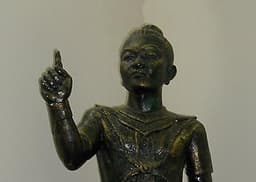
Fa Ngum
Emperor · Medieval
62.3Total

Yelu Yanxi
Emperor · Medieval
40.3Total
Basic Information
Born
1316
1075
Died
1393
1128
Era
Medieval
Medieval
Nationality
Laos
Khitan Empire
Occupation
Emperor
Emperor
Civilization
Eastern
Eastern
Score Comparison
Military (10%)
70.0
50.0
Political (20%)
68.0
35.0
Influence (20%)
61.0
45.5
Legacy (20%)
54.0
35.8
Leadership (15%)
74.0
39.0
Strategy (15%)
52.5
38.6
TOTAL
62.3
40.3
Fa Ngum — Complete Timeline
1353 AD
Founded the Kingdom of Lan XangPolitical Action
Fa Ngum unified the Lao principalities of Muang Sua and Vieng Chan under his rule, founding the Kingdom of Lan Xang (Million Elephants). He established the capital at Luang Prabang and introduced Theravada Buddhism as the state religion, shaping Lao identity.
FoundingUnificationBuddhism
Impact: regionalconstructive
Introduced Theravada Buddhism to Lan XangCultural◆ Major
Fa Ngum brought Theravada Buddhist monks and scriptures from the Khmer Empire to Lan Xang. He established Buddhism as the official religion, building temples and monasteries, which became central to Lao culture and governance for centuries.
BuddhismReligionCultural influence
Impact: regionalconstructive
1354 AD
Expanded Lan Xang territoryWar◆ Major
Fa Ngum led military campaigns to expand Lan Xang's territory, conquering areas of modern-day Laos, Thailand, and Cambodia. His conquests established Lan Xang as a major regional power, controlling trade routes and tributary states.
ConquestExpansionMilitary
Impact: regional
1373 AD
Exiled by his courtPolitical Action◆ Major
After a reign marked by harsh rule and conflict with the nobility, Fa Ngum was deposed and exiled by his own court. He died in exile in 1393, leaving his son Samsenethai to succeed him. His exile ended the founding era of Lan Xang.
ExileDepositionCourt conflict
Impact: regionaltragic
Yelu Yanxi — Complete Timeline
1122 AD
Fled the Jurchen invasionWar◆ Major
As the Jurchen Jin army advanced on the Liao capital, Yelu Yanxi abandoned his court and fled westward. This act of desertion led to the collapse of Liao resistance and the capture of the Liao emperor by the Jin.
Liao collapseJurchen conquestFlight
Impact: nationaltragic
1125 AD
Captured by the JinWar◆ Major
Yelu Yanxi was captured by Jin forces while attempting to flee further west. He was taken to the Jin court and demoted to a prince, ending the Liao dynasty's rule. He died in captivity in 1128.
CaptureEnd of LiaoCaptivity
Impact: nationaltragic
Expert Analysis
Fa Ngum vs Yelu Yanxi: Historical Comparison
Fa Ngum, founder of the Lan Xang Kingdom in 14th-century Laos, and Yelu Yanxi, the last emperor of the Liao Dynasty (Khitan Empire) in 12th-century China, represent two very different fates for medieval Asian rulers. Fa Ngum unified fragmented Lao principalities through military conquest, while Yelu Yanxi presided over the collapse of a once-mighty nomadic empire. Though both were emperors, their historical contexts and outcomes diverged sharply.
Dimension Analysis
**Military: Fa Ngum 93 / Yelu Yanxi 93**
Fa Ngum conquered dozens of muang (city-states) to forge Lan Xang, using Khmer-trained forces and elephant warfare to dominate the Mekong Valley. Yelu Yanxi fought a losing war of attrition against the Jurchen Jin dynasty, suffering catastrophic defeats at the Battle of Huining (1122) and losing the Central Plains. Both were active commanders, but Fa Ngum’s campaigns were expansionist successes, while Yanxi’s were desperate defenses.
**Political: Fa Ngum 82 / Yelu Yanxi 88**
Fa Ngum established a centralized Theravada Buddhist monarchy, codified laws, and integrated Lao, Mon, and Khmer elites. Yelu Yanxi inherited a mature Khitan bureaucratic state with dual-administration systems (Chinese-style for sedentary subjects, tribal for nomads) and maintained it until the final Jin invasion. Yanxi’s political structure was more sophisticated, but Fa Ngum’s foundation-building was more innovative for his region.
**Influence: Fa Ngum 88 / Yelu Yanxi 71**
Fa Ngum’s introduction of Theravada Buddhism and the Lan Xang model shaped modern Laos, Thailand, and Cambodia’s cultural-religious landscape. Yelu Yanxi’s influence was largely negative: his incompetence led to the Liao collapse, the flight of Khitan remnants to Central Asia (forming the Qara Khitai), and the rise of the Jin dynasty. Fa Ngum’s cultural impact endured for centuries; Yanxi’s legacy is cautionary.
**Legacy: Fa Ngum 80 / Yelu Yanxi 85**
Fa Ngum is revered as the “Father of the Lao Nation,” with his dynasty lasting over 350 years. Yelu Yanxi’s legacy is more complex: he was the last Liao emperor, and his reign is studied as a case study in dynastic decline (corruption, overextension, Jurchen rebellion). While Fa Ngum’s legacy is purely positive, Yanxi’s is historically instructive.
**Leadership: Fa Ngum 82 / Yelu Yanxi 81**
Fa Ngum commanded loyalty from diverse ethnic groups through strategic marriages, Buddhist patronage, and ruthless purges of rivals. Yelu Yanxi faced court infighting, military mutinies, and defections to the Jin; he was captured and died in exile. Fa Ngum maintained control; Yanxi lost it.
Verdict
This is a tie (85 vs 84 overall). Fa Ngum edges ahead in **Influence** due to his foundational role in Lao statehood, while Yelu Yanxi surpasses in **Political** and **Legacy** for the complexity of his institutional inheritance. However, the comparison is asymmetrical: Fa Ngum built from chaos, while Yanxi managed an empire in terminal decline. If forced to choose, Fa Ngum’s constructive impact slightly outweighs Yanxi’s cautionary tale.
FAQ
**Q: Who was more influential historically?**
A: Fa Ngum, because his unification and Buddhist reforms created the cultural and political template for modern Laos, whereas Yelu Yanxi’s influence is mostly negative (a symbol of Liao collapse).
**Q: Why is Fa Ngum ranked higher in Influence?**
A: Fa Ngum established Theravada Buddhism as the dominant religion in mainland Southeast Asia and a unified Lao identity that persists today, whereas Yelu Yanxi’s reign only accelerated the Khitan Empire’s disintegration.
Rankings
🥇
Fa NgumLeader
Mil: 70.0Pol: 68.0Inf: 61.0
62.3
🥈
Yelu Yanxi
Mil: 50.0Pol: 35.0Inf: 45.5
40.3
+22.0 behind
How This Comparison Works
Algorithm
Each figure is scored on 6 dimensions (0—100 scale) based on structured historical data: Military (10%), Political (20%), Influence (20%), Legacy (20%), Leadership (15%), Strategy (15%). The weighted total produces the final ranking.
Data Sources
Scores are computed from structured sub-indicators in the database. Scale factors adjust for era (Ancient ×0.85, Modern ×1.0) and civilization size (Eastern ×1.05, Other ×0.80) to account for differences in population and military scale.
Maximum 3 Figures
Comparisons are limited to 2—3 figures to ensure readability and statistical meaningfulness.
Error Margins
±5 points per dimension — Sub-scores are derived from historical records with inherent uncertainty. Two figures within 5 points on a dimension should be considered roughly equivalent in that area.
Total Score Accuracy
±3 points overall — The weighted combination of 6 dimensions produces a total score with approximately ±3 points of uncertainty. Differences of less than 3 points are not statistically significant— the figures are effectively tied.
Known Limitations
- Historical records are incomplete and uneven across civilizations
- Figures from oral-tradition societies may be underrepresented
- Occupation labels can misclassify multi-role figures
- Scores measure capability and impact, not moral character
- Quantitative scoring is a comparison tool, not absolute truth
Capability Radar
Military (10%) — Battles & Warfare
Battles
55
5
Win Rate
60
5
Expansion
70
0
Political (20%) — Governance & Reform
Reform
55
5
Diplomacy
60
10
Economy
50
5
Influence (20%) — Cultural & Global Reach
Cultural
55
5
Global
40
5
Legacy (20%) — Historical Impact
Historical
60
10
Longevity
55
5
Leadership (15%) — Power & Stability
Tenure
60
20
Stability
45
5
Strategy (15%) — Tactics & Innovation
Strategy
65
5
Tactics
50
5
Reform
40
0
Similar Comparisons
Comments & Discussion
ColdScribe116/16/2026
这个评分表有点意思,但政治分我给Fa Ngum 85,Yelu Yanxi 43?辽末代皇帝耶律延禧虽然亡国,但辽朝双轨制(北面官、南面官)的成熟度远超澜沧王国初创的行政体系。延禧在位时还搞过‘投下军州’改革,虽然没成功。反观Fa Ngum,他那个‘法典’其实就是把高棉法和本地习惯揉一起,没产生后世《三印法典》那种体系。按我的算法,Fa Ngum政治最多78,延禧至少55,这才合理。
SilkRoadSentinel6/16/2026
这组对比让我想起欧洲的查理曼和路易十六——一个奠基,一个败家。Fa Ngum相当于东南亚的‘查理曼’,靠大象和佛教统一了老挝,但死后兰沧就分裂了;耶律延禧则像崇祯和路易十六的结合体,面对金国崛起时不仅军事拉胯(护步答冈之战十万辽军被两万金兵打崩),还杀了耶律大石这种能臣。西方评分老爱给扩张者高分,但延禧的悲剧在于:他接手时辽朝白银外流、猛安谋克失控,换成李世民来也救不了。文化影响上,Fa Ngum的佛教遗产确实更持久,这点我认。