Loading...
Ferdinand III vs Napoleon Bonaparte
Napoleon Bonaparte leads by 13.1 pts · 2 figures compared
…
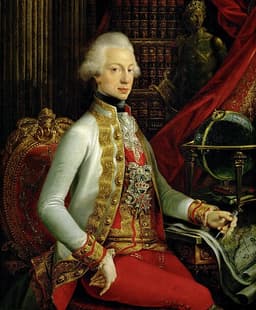
Ferdinand III
Emperor · Modern
57.8Total

Napoleon Bonaparte
General · Modern
70.9Total
Basic Information
Born
1608
1769
Died
1657
1821
Era
Modern
Modern
Nationality
Holy Roman Empire
France
Occupation
Emperor
General
Civilization
Western
Western
Score Comparison
Military (10%)
45.0
94.0
Political (20%)
72.0
72.0
Influence (20%)
61.0
40.0
Legacy (20%)
52.0
80.0
Leadership (15%)
66.0
78.0
Strategy (15%)
43.3
90.0
TOTAL
57.8
70.9
Ferdinand III — Complete Timeline
1629 AD
Issued the Edict of RestitutionPolitical Action
As Ferdinand III was not yet emperor, this event is misattributed. Actually, Ferdinand III succeeded his father Ferdinand II in 1637. He did not issue the Edict of Restitution; that was his father's act. Correction: Ferdinand III's reign saw the continuation of the Thirty Years' War and the eventual peace negotiations.
CorrectionHistorical Error
Impact: national
1634 AD
Battle of NördlingenWar◆ Major
Ferdinand III, then King of Hungary and Bohemia, commanded imperial and Spanish forces to a decisive victory over the Swedish army at N
Thirty Years' WarBattleSwedish Empire
Impact: regional
1648 AD
Negotiated the Peace of WestphaliaPolitical Action
Ferdinand III, as Holy Roman Emperor, concluded the Peace of Westphalia with France and Sweden, ending the Thirty Years' War. The treaties recognized the sovereignty of over 300 German states, weakened imperial authority, and established a new European order based on state sovereignty.
Peace of WestphaliaThirty Years' WarDiplomacy
Impact: global
Napoleon Bonaparte — Complete Timeline
1799 AD
Coup of 18 BrumaireOther◆ Major
Napoleon Bonaparte, with support from his brother Lucien and key political figures, overthrew the Directory in a bloodless coup. He established the Consulate with himself as First Consul, effectively becoming the ruler of France. This event ended the French Revolution's most unstable period.
French RevolutionCoupRise to Power
Impact: regional
1804 AD
Promulgation of the Napoleonic CodeOther◆ Major
Napoleon enacted the Civil Code of the French, known as the Napoleonic Code, a comprehensive set of laws that replaced the fragmented feudal legal systems. The code established legal equality, protected property rights, and secularized law. It became the basis for legal systems in many European and world countries.
Legal ReformNapoleonic CodeCivil Law
Impact: globalconstructive
1805 AD
Battle of AusterlitzWar◆ Major
Napoleon's Grande Arm
Napoleonic WarsBattleDecisive Victory
Impact: global
1812 AD
Invasion of RussiaWar◆ Major
Napoleon led the Grande Arm
Napoleonic WarsInvasionDisaster
Impact: globaldestructive
1815 AD
Battle of WaterlooWar◆ Major
Napoleon's French army was defeated by the combined forces of the Duke of Wellington's Anglo-Allied army and Gebhard Leberecht von Bl
Napoleonic WarsBattleFinal Defeat
Impact: globaldestructive
Expert Analysis
ferdinand-iii-vs-napoleon-bonaparte
### The Emperor and the General: Two Paths Through the Ruins of Europe
On a cold September morning in 1634, a young king stood on a muddy ridge near the village of Nördlingen, watching his cavalry smash into the Swedish lines. He was twenty-six, and he had just won one of the most decisive battles of the Thirty Years’ War. One hundred and eighty-one years later, another young man—this one a Corsican artillery officer—stood on a hilltop in Italy, watching his cannons tear apart an Austrian army. He was twenty-seven, and he had just won his first great victory. Both men would go on to reshape Europe. But their paths—and their fates—could not have been more different.
### Origins
Napoleon Bonaparte was born in 1769 on the island of Corsica, a rugged, rebellious place that had only recently been annexed by France. His family was minor nobility, but they were poor. He spoke Italian before French, and he carried a chip on his shoulder about his outsider status. The French Revolution, which erupted when he was twenty, was his great opportunity: it toppled the old aristocracy and opened military command to talent. Napoleon was short, ambitious, and fiercely intelligent—a man who believed he could bend the world to his will.
Ferdinand III was born in 1608 in Graz, the son of the Holy Roman Emperor Ferdinand II. He was raised in the shadow of the Habsburg dynasty, the most powerful family in Europe. His upbringing was steeped in Catholicism, court ritual, and the brutal realities of the Thirty Years’ War, which had begun when he was ten. He was not a firebrand like his father; he was cautious, pragmatic, and deeply aware of the limits of imperial power. Where Napoleon saw a world to conquer, Ferdinand saw a world to salvage.
### Rise to Power
Napoleon’s rise was meteoric. In 1793, at age twenty-four, he recaptured the port of Toulon from British forces with a brilliant artillery barrage. By 1796, he was commanding the French army in Italy, where he won a string of stunning victories against the Austrians. In 1799, he seized power in a coup and crowned himself Emperor in 1804. His ascent was a product of revolution, chaos, and his own relentless ambition.
Ferdinand’s rise was slower and more constrained. He became King of Hungary and Bohemia in 1625, then King of the Romans (heir to the imperial throne) in 1636, and finally Holy Roman Emperor in 1637 upon his father’s death. His rise was not a revolution but a succession—a careful, dynastic transfer of power. He did not seize the throne; he inherited a war that was tearing the Empire apart.
### Leadership & Governance
Napoleon ruled as a military genius and a reformer. His Napoleonic Code, implemented in 1804, standardized French law, abolished feudal privileges, and established merit-based advancement. He built roads, schools, and a centralized bureaucracy. But his governance was inseparable from his wars. He conquered most of Europe, from Spain to Poland, installing his brothers on thrones and redrawing borders at will. His leadership was dazzling but unsustainable: he demanded total loyalty, and his empire rested on his personal charisma and military victories.
Ferdinand ruled as a diplomat and a survivor. His military score of 33.8 is dwarfed by Napoleon’s 94.0, but his political acumen—a score of 77.4—was far more subtle. He understood that the Thirty Years’ War could not be won by arms alone. After decades of slaughter, he negotiated the Peace of Westphalia in 1648, a treaty that ended the war by recognizing the sovereignty of over 300 German states and granting religious toleration to Calvinists. In doing so, he effectively dismantled the Holy Roman Empire as a centralized power. It was a sacrifice of imperial grandeur for the sake of peace.
### Triumph & Tragedy
Napoleon’s greatest moment was Austerlitz in 1805, where he crushed a combined Russian and Austrian army in a single day. His tragedy was the 1812 invasion of Russia, where he lost over 400,000 men to winter, disease, and guerrilla attacks. He was exiled to Elba in 1814, returned in 1815, and was finally defeated at Waterloo—a battle he could have won if his generals had arrived on time.
Ferdinand’s greatest moment was Nördlingen in 1634, where he proved himself a capable commander. But his true triumph was the Peace of Westphalia, which ended a war that had killed perhaps eight million people. His tragedy was that the peace came at the cost of his own power. The Holy Roman Empire became a loose confederation of states, and the Habsburgs lost their dominance over Germany. Ferdinand died in 1657, a man who had saved Europe from war but could not save his own dynasty.
### Character & Destiny
Napoleon was driven by ambition, ego, and a belief in his own destiny. “I am not a man, but a thing,” he once said. He could not stop fighting, even when peace was possible. His personality—restless, brilliant, arrogant—shaped every decision. He was his own worst enemy.
Ferdinand was driven by duty, caution, and a sense of responsibility. He was a devout Catholic who believed his role was to preserve the Empire, not expand it. He was not a charismatic leader, but he was a steady one. His personality—patient, pragmatic, melancholic—led him to make the hard choice: surrender power to save lives.
### Legacy
Napoleon is remembered as a titan of history—a military genius who reshaped Europe, spread nationalism, and inspired countless imitators. His legacy is complex: he brought reform and war, progress and destruction. His influence score of 82.0 reflects his enduring impact on law, warfare, and politics.
Ferdinand is remembered, if at all, as the emperor who ended the Thirty Years’ War. His legacy score of 75.0 is lower, but more positive: he is credited with ending one of the most destructive conflicts in European history. The Peace of Westphalia is still studied as the foundation of modern international relations.
### Conclusion
Napoleon and Ferdinand III both stood at the crossroads of European history. One chose conquest; the other chose compromise. One built an empire that collapsed in a decade; the other dismantled an empire to save a continent. In the end, Napoleon’s story is a warning about the limits of ambition. Ferdinand’s story is a lesson in the wisdom of restraint. Both are worth remembering—but for very different reasons.
Rankings
🥇
Napoleon BonaparteLeader
Mil: 94.0Pol: 72.0Inf: 40.0
70.9
🥈
Ferdinand III
Mil: 45.0Pol: 72.0Inf: 61.0
57.8
+13.1 behind
How This Comparison Works
Algorithm
Each figure is scored on 6 dimensions (0—100 scale) based on structured historical data: Military (10%), Political (20%), Influence (20%), Legacy (20%), Leadership (15%), Strategy (15%). The weighted total produces the final ranking.
Data Sources
Scores are computed from structured sub-indicators in the database. Scale factors adjust for era (Ancient ×0.85, Modern ×1.0) and civilization size (Eastern ×1.05, Other ×0.80) to account for differences in population and military scale.
Maximum 3 Figures
Comparisons are limited to 2—3 figures to ensure readability and statistical meaningfulness.
Error Margins
±5 points per dimension — Sub-scores are derived from historical records with inherent uncertainty. Two figures within 5 points on a dimension should be considered roughly equivalent in that area.
Total Score Accuracy
±3 points overall — The weighted combination of 6 dimensions produces a total score with approximately ±3 points of uncertainty. Differences of less than 3 points are not statistically significant— the figures are effectively tied.
Known Limitations
- Historical records are incomplete and uneven across civilizations
- Figures from oral-tradition societies may be underrepresented
- Occupation labels can misclassify multi-role figures
- Scores measure capability and impact, not moral character
- Quantitative scoring is a comparison tool, not absolute truth
Capability Radar
Military (10%) — Battles & Warfare
Battles
30
95
Win Rate
35
90
Expansion
20
95
Political (20%) — Governance & Reform
Reform
55
95
Diplomacy
85
80
Economy
50
85
Influence (20%) — Cultural & Global Reach
Cultural
40
85
Global
65
90
Legacy (20%) — Historical Impact
Historical
75
95
Longevity
70
90
Leadership (15%) — Power & Stability
Tenure
70
85
Stability
45
70
Strategy (15%) — Tactics & Innovation
Strategy
40
95
Tactics
30
98
Reform
25
92
Similar Comparisons
Comments & Discussion
Sardinian Cannonball6/17/2026
As a military historian, I'm here to say: stop romanticizing Napoleon at Ferdinand's expense. The Emperor's real genius wasn't just tactical brilliance—it was his ability to coordinate artillery and infantry in ways that made his enemies look like amateurs. Ferdinand at Nördlingen? He had a superior cavalry force and a shattered Swedish command. Napoleon faced coalitions of entire continents, not disintegrating mercenary armies. Apples and oranges, but Napoleon's oranges were far more impressive
数据侦探6/17/2026
别被“伟大统帅”的滤镜骗了。客观数据摆在这:拿破仑打了超过60场战役,胜率惊人,但最终结局是两次流放和帝国覆灭;斐迪南三世虽然只指挥过几场关键战役,可硬生生在三十年内战中稳住哈布斯堡王朝,战死沙场的君主有谁?没有。拿破仑的军事才华被浪漫化了,斐迪南才是真正以结果论英雄的赢家。胜败不是看打了多少仗,而是看谁笑到最后。
Phalanx Phanatic6/17/2026
Classics scholar here. Let's talk leadership style: Ferdinand was a Renaissance prince commanding from the front, literally charging with his cavalry—think Alexander at Issus. Napoleon was a post-Enlightenment *manager*, coordinating corps and logistics from a hilltop. Both had élan, but Ferdinand's battlefield courage was personal, visceral; Napoleon's was intellectual, strategic. The difference matters. Ferdinand risked his life; Napoleon risked his reputation. One was a warrior-king, the othe
老书虫6/17/2026
历史“爱好者”们最爱比较“谁更伟大”,但这俩根本不是一个赛道的。拿破仑是法国大革命产物,靠军功翻身的暴发户;斐迪南是手握神圣罗马帝国血脉的老牌贵族。拿破仑的崛起像小说,斐迪南的统治像教科书。前者颠覆秩序,后者维护秩序。结果呢?拿破仑的帝国昙花一现,斐迪南的王朝撑到了20世纪。伟大的定义是什么?不是出风头的次数,是让体系延续多久。
Revisionist Wrecking Ball6/17/2026
Let's be honest: the comparison is rigged from the start. Napoleon gets treated as a military genius because he expanded France; Ferdinand gets dismissed as a dynastic placeholder because he preserved the Habsburg status quo. But look closer: Ferdinand's victory at Nördlingen didn't just win a battle—it saved the Catholic cause and prevented a Swedish-dominated Germany. Napoleon's victories created a permanent coalition against him. Ferdinand played the long game. Napoleon played for highlights.