Loading...
This comparison has not been analyzed yet.
One-time AI generation (~1 minute). Scores and timeline are already available below.
Francisco Franco vs Pavel Batov
Francisco Franco leads by 9.7 pts · 2 figures compared
…
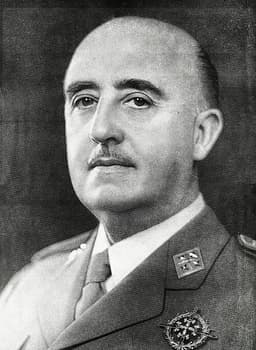
Francisco Franco
General · Modern
61.9Total

Pavel Batov
General · Modern
52.2Total
Basic Information
Born
1892
1897
Died
1975
1985
Era
Modern
Modern
Nationality
Spain
USSR
Occupation
General
General
Civilization
Western
Western
Score Comparison
Military (10%)
52.5
70.0
Political (20%)
68.0
37.9
Influence (20%)
56.7
51.8
Legacy (20%)
58.0
45.0
Leadership (15%)
78.0
57.6
Strategy (15%)
60.7
66.3
TOTAL
61.9
52.2
Francisco Franco — Complete Timeline
1936 AD
Appointed Generalissimo and Head of StatePolitical Action◆ Major
On October 1, 1936, the Nationalist faction appointed Francisco Franco as Generalissimo and Head of State of the Spanish State. This consolidated his leadership over the Nationalist forces during the Spanish Civil War, giving him supreme military and political authority.
Spanish Civil WarNationalist FactionLeadership
Impact: national
1939 AD
Declared Victory in the Spanish Civil WarOther◆ Major
On April 1, 1939, Franco announced the end of the Spanish Civil War after the Nationalist forces captured Madrid and the last Republican strongholds. This victory established Franco as the undisputed dictator of Spain, leading to a regime that lasted until his death.
Spanish Civil WarDictatorshipVictory
Impact: nationaldestructive
1947 AD
Signed the Law of SuccessionReform◆ Major
Franco enacted the Law of Succession in 1947, which declared Spain a monarchy but left Franco as regent for life with the power to choose his successor. This law institutionalized his personal rule and ensured the continuity of his regime after his death.
SuccessionMonarchyRegime Consolidation
Impact: national
1959 AD
Opened Spain to Foreign InvestmentOther◆ Major
In 1959, Franco approved the Stabilization Plan, which liberalized the Spanish economy, ended autarky, and opened Spain to foreign investment and tourism. This led to the 'Spanish Miracle' of rapid economic growth in the 1960s, transforming Spain from a poor agrarian country to a modern industrial economy.
Economic ReformStabilization PlanGrowth
Impact: nationalconstructive
1969 AD
Appointed Juan Carlos as SuccessorPolitical Action◆ Major
In 1969, Franco formally designated Prince Juan Carlos de Borb
SuccessionMonarchyTransition
Impact: national
Pavel Batov — Complete Timeline
1942 AD
Battle of StalingradWar◆ Major
Batov commanded the 65th Army during the Battle of Stalingrad. His forces fought in the city and later participated in Operation Uranus, the encirclement of the German 6th Army.
World War IIStalingradOperation Uranus
Impact: global
1943 AD
Battle of KurskWar◆ Major
Batov's 65th Army fought in the Battle of Kursk, defending the northern face of the salient. His forces repelled German attacks and later participated in the counteroffensive that liberated Orel.
World War IIKurskDefense
Impact: regional
1944 AD
Crossing of the DanubeWar
Batov's 65th Army crossed the Danube River during the Belgrade Offensive. The crossing was conducted under fire and enabled the Soviet advance into Hungary and the encirclement of Budapest.
World War IIDanubeHungary
Impact: regional
1955 AD
Appointment as Commander of the Carpathian Military DistrictPolitical Action
Batov was appointed Commander of the Carpathian Military District. He held this position until 1958, overseeing Soviet forces in western Ukraine and the border with NATO countries.
Cold WarMilitary DistrictUkraine
Impact: regional
This comparison has not been analyzed yet.
One-time AI generation (~1 minute). Scores and timeline are already available below.
Rankings
🥇
Francisco FrancoLeader
Mil: 52.5Pol: 68.0Inf: 56.7
61.9
🥈
Pavel Batov
Mil: 70.0Pol: 37.9Inf: 51.8
52.2
+9.7 behind
How This Comparison Works
Algorithm
Each figure is scored on 6 dimensions (0—100 scale) based on structured historical data: Military (10%), Political (20%), Influence (20%), Legacy (20%), Leadership (15%), Strategy (15%). The weighted total produces the final ranking.
Data Sources
Scores are computed from structured sub-indicators in the database. Scale factors adjust for era (Ancient ×0.85, Modern ×1.0) and civilization size (Eastern ×1.05, Other ×0.80) to account for differences in population and military scale.
Maximum 3 Figures
Comparisons are limited to 2—3 figures to ensure readability and statistical meaningfulness.
Error Margins
±5 points per dimension — Sub-scores are derived from historical records with inherent uncertainty. Two figures within 5 points on a dimension should be considered roughly equivalent in that area.
Total Score Accuracy
±3 points overall — The weighted combination of 6 dimensions produces a total score with approximately ±3 points of uncertainty. Differences of less than 3 points are not statistically significant— the figures are effectively tied.
Known Limitations
- Historical records are incomplete and uneven across civilizations
- Figures from oral-tradition societies may be underrepresented
- Occupation labels can misclassify multi-role figures
- Scores measure capability and impact, not moral character
- Quantitative scoring is a comparison tool, not absolute truth
Capability Radar
Military (10%) — Battles & Warfare
Battles
65
65
Win Rate
70
70
Expansion
20
30
Political (20%) — Governance & Reform
Reform
40
20
Diplomacy
50
30
Economy
45
20
Influence (20%) — Cultural & Global Reach
Cultural
40
20
Global
55
20
Legacy (20%) — Historical Impact
Historical
60
40
Longevity
55
30
Leadership (15%) — Power & Stability
Tenure
90
30
Stability
55
30
Strategy (15%) — Tactics & Innovation
Strategy
65
70
Tactics
60
65
Reform
55
40
Similar Comparisons
Comments & Discussion
No comments yet. Be the first to share your thoughts!