Loading...
Francisco Solano Lopez vs Napoleon Bonaparte
Napoleon Bonaparte leads by 18.8 pts · 2 figures compared
…
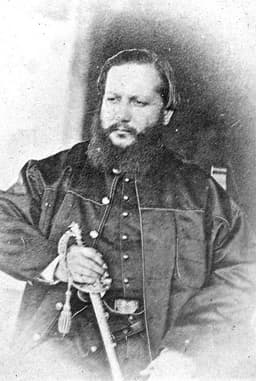
Francisco Solano Lopez
Emperor · Modern
52.1Total

Napoleon Bonaparte
General · Modern
70.9Total
Basic Information
Born
1827
1769
Died
1870
1821
Era
Modern
Modern
Nationality
Paraguay
France
Occupation
Emperor
General
Civilization
Western
Western
Score Comparison
Military (10%)
46.7
94.0
Political (20%)
46.6
72.0
Influence (20%)
53.3
40.0
Legacy (20%)
44.2
80.0
Leadership (15%)
67.0
78.0
Strategy (15%)
60.0
90.0
TOTAL
52.1
70.9
Francisco Solano Lopez — Complete Timeline
1862 AD
Became President of ParaguayPolitical Action◆ Major
Upon his father's death, Francisco Solano L
SuccessionPresidencyAggression
Impact: national
1864 AD
Invaded Brazil and ArgentinaWar◆ Major
López ordered the invasion of Brazilian territory in Mato Grosso in December 1864, followed by an invasion of Argentina's Corrientes province in April 1865. These actions triggered the War of the Triple Alliance against Paraguay.
War of the Triple AllianceInvasionAggression
Impact: regionaldestructive
1866 AD
Battle of TuyutíWar◆ Major
On May 24, 1866, L
War of the Triple AllianceBattleDefeat
Impact: regionaltragic
1870 AD
Killed at the Battle of Cerro CoráWar◆ Major
On March 1, 1870, L
War of the Triple AllianceDeathTotal Defeat
Impact: regionaltragic
Napoleon Bonaparte — Complete Timeline
1799 AD
Coup of 18 BrumaireOther◆ Major
Napoleon Bonaparte, with support from his brother Lucien and key political figures, overthrew the Directory in a bloodless coup. He established the Consulate with himself as First Consul, effectively becoming the ruler of France. This event ended the French Revolution's most unstable period.
French RevolutionCoupRise to Power
Impact: regional
1804 AD
Promulgation of the Napoleonic CodeOther◆ Major
Napoleon enacted the Civil Code of the French, known as the Napoleonic Code, a comprehensive set of laws that replaced the fragmented feudal legal systems. The code established legal equality, protected property rights, and secularized law. It became the basis for legal systems in many European and world countries.
Legal ReformNapoleonic CodeCivil Law
Impact: globalconstructive
1805 AD
Battle of AusterlitzWar◆ Major
Napoleon's Grande Arm
Napoleonic WarsBattleDecisive Victory
Impact: global
1812 AD
Invasion of RussiaWar◆ Major
Napoleon led the Grande Arm
Napoleonic WarsInvasionDisaster
Impact: globaldestructive
1815 AD
Battle of WaterlooWar◆ Major
Napoleon's French army was defeated by the combined forces of the Duke of Wellington's Anglo-Allied army and Gebhard Leberecht von Bl
Napoleonic WarsBattleFinal Defeat
Impact: globaldestructive
Expert Analysis
francisco-solano-lopez-vs-napoleon-bonaparte
**The Emperor and the Dictator: Two Visions of Power in the Age of Modern War**
The year is 1815, and a man in a gray overcoat stands on a muddy field near Waterloo, watching his empire dissolve into smoke and retreat. Half a century later and an ocean away, another man in a gold-braided uniform waits in a jungle clearing at Cerro Corá, knowing his own end is minutes away. Both are rulers who led their nations into catastrophic wars. Both are remembered as tyrants. But the gulf between Napoleon Bonaparte and Francisco Solano López is not merely one of success and failure—it is a chasm of historical circumstance, personal genius, and the strange alchemy that turns ambition into either legend or ruin.
**Origins**
Napoleon was born in 1769 on the island of Corsica, a place only recently annexed by France. His family was minor nobility, poor enough to know hunger but well-connected enough to send him to military school. The French Revolution erupted when he was twenty, shattering the old order and creating opportunities unknown under the monarchy. A young artillery officer with a talent for mathematics and a hunger for glory, Napoleon emerged from the chaos of the 1790s as a man who believed that will could reshape the world.
Francisco Solano López was born in 1827 in Asunción, the son of Paraguay’s dictator, Carlos Antonio López. He was not a self-made man but a prince of a peculiar kingdom—a landlocked, isolated nation that his father had dragged into the modern age with railroads, telegraphs, and a professional army. Young López was sent to Europe in 1853, where he admired Napoleon III’s Paris and bought weapons. He returned to Paraguay convinced that his country could become a South American France, and that he was its destined emperor.
**Rise to Power**
Napoleon’s ascent was a masterpiece of timing and audacity. In 1796, at twenty-six, he took command of the starving, ragged Army of Italy and turned it into a conquering force. His victories forced Austria to sue for peace, and his political instincts led him to seize power in the 1799 coup of 18 Brumaire. He crowned himself emperor in 1804, not by inheritance but by the will of the people and the bayonets of his soldiers.
López’s rise was simpler. When his father died in 1862, he simply became president. He had inherited a military that was, by South American standards, modern—equipped with British rifles and trained by European instructors. But he had inherited nothing of his father’s caution. Carlos Antonio López had built Paraguay into a fortress through diplomacy and isolation. His son wanted to conquer.
**Leadership & Governance**
Napoleon governed through a blend of iron discipline and enlightened reform. His Napoleonic Code standardized French law, abolished feudal privileges, and established meritocratic principles that spread across Europe. He built roads, founded banks, and centralized education. Yet his political score of 75 reflects a man who, for all his administrative genius, could not resist the lure of absolute power. He made his brothers kings, suppressed dissent, and surrounded himself with flatterers.
López governed Paraguay with a paranoid intensity that bordered on the pathological. He spied on his own officers, purged anyone suspected of disloyalty, and turned the country into a garrison state. His political score of 53 hints at the truth: he was less a statesman than a warlord who mistook brutality for strength. His military score of 31.9 is devastating. He was not a stupid man—he could speak French, study military tactics, and plan campaigns—but he lacked the intuitive genius that Napoleon possessed in abundance. At the Battle of Tuyutí in May 1866, López hurled his best troops against the Allied camp in a frontal assault that killed 6,000 Paraguayans in a single day. Napoleon would have recognized the courage. He would have condemned the waste.
**Triumph & Tragedy**
Napoleon’s greatest moment was Austerlitz in 1805, where he crushed the combined armies of Austria and Russia in a battle that remains a textbook example of tactical brilliance. His worst was the invasion of Russia in 1812, a catastrophic miscalculation that cost half a million men and destroyed his invincible reputation. Yet even in defeat, he was allowed to return from exile on Elba, raise another army, and fight one last campaign. His final exile on Saint Helena was a prison, but it was a prison with servants and memoirs.
López’s tragedy was absolute. The War of the Triple Alliance (1864-1870) pitted Paraguay against Brazil, Argentina, and Uruguay. It was a war López started by invading Brazilian territory in December 1864, then Argentina in 1865. He believed his army could defeat his neighbors one by one. Instead, the Allies ground Paraguay down through sheer numbers. By 1870, the country had lost perhaps 70% of its adult male population. López fled into the northern jungles with a dwindling band of followers, many of them children and old men. On March 1, 1870, Brazilian cavalry cornered him at Cerro Corá. He refused to surrender, shouted “I die with my country!” and was shot down.
**Character & Destiny**
Napoleon was driven by a vision of himself as a world-historical figure. “Impossible is a word to be found only in the dictionary of fools,” he once said. He was ruthless, but he was also pragmatic. He knew when to negotiate, when to retreat, and when to gamble.
López was driven by something darker: a conviction that he was chosen by destiny, that Paraguay was his personal possession, and that death was preferable to humiliation. His leadership score of 78.9 is surprisingly high, but it reflects the loyalty he inspired in his soldiers, not the wisdom of his decisions. He led his nation into a war it could not win, refused every offer of peace, and dragged millions into the abyss because he could not imagine surrender.
**Legacy**
Napoleon’s legacy is written across Europe. His legal code, his administrative systems, his military reforms, and his very idea of the modern state survive in countless nations. He is remembered as both a liberator and a tyrant, a genius and a monster. His influence score of 82 and legacy score of 78 reflect a figure who cannot be ignored.
López’s legacy is more ambiguous. In Paraguay, he is a national hero, a martyr who fought against overwhelming odds. Statues of him stand in Asunción, and schoolchildren are taught that he died for the fatherland. Outside Paraguay, he is seen as a deluded megalomaniac who destroyed his own country. His influence score of 73.7 is inflated by this nationalist myth, but his legacy score of 60.6 tells a harsher truth: he left behind a nation in ruins, a generation of orphans, and a lesson about the cost of unchecked ambition.
**Conclusion**
Standing at Waterloo, Napoleon could have said that he had conquered Europe and changed the world. Standing at Cerro Corá, López could only say that he had fought to the end. One man built an empire that shaped a continent; the other destroyed a nation that barely survived him. The difference between them is not merely talent or luck. It is the difference between a man who understood that power must be tempered by reason, and a man who believed that will alone was enough. Napoleon’s tragedy was that he forgot this lesson. López’s tragedy was that he never learned it.
Rankings
🥇
Napoleon BonaparteLeader
Mil: 94.0Pol: 72.0Inf: 40.0
70.9
🥈
Francisco Solano Lopez
Mil: 46.7Pol: 46.6Inf: 53.3
52.1
+18.8 behind
How This Comparison Works
Algorithm
Each figure is scored on 6 dimensions (0—100 scale) based on structured historical data: Military (10%), Political (20%), Influence (20%), Legacy (20%), Leadership (15%), Strategy (15%). The weighted total produces the final ranking.
Data Sources
Scores are computed from structured sub-indicators in the database. Scale factors adjust for era (Ancient ×0.85, Modern ×1.0) and civilization size (Eastern ×1.05, Other ×0.80) to account for differences in population and military scale.
Maximum 3 Figures
Comparisons are limited to 2—3 figures to ensure readability and statistical meaningfulness.
Error Margins
±5 points per dimension — Sub-scores are derived from historical records with inherent uncertainty. Two figures within 5 points on a dimension should be considered roughly equivalent in that area.
Total Score Accuracy
±3 points overall — The weighted combination of 6 dimensions produces a total score with approximately ±3 points of uncertainty. Differences of less than 3 points are not statistically significant— the figures are effectively tied.
Known Limitations
- Historical records are incomplete and uneven across civilizations
- Figures from oral-tradition societies may be underrepresented
- Occupation labels can misclassify multi-role figures
- Scores measure capability and impact, not moral character
- Quantitative scoring is a comparison tool, not absolute truth
Capability Radar
Military (10%) — Battles & Warfare
Battles
45
95
Win Rate
20
90
Expansion
30
95
Political (20%) — Governance & Reform
Reform
50
95
Diplomacy
10
80
Economy
40
85
Influence (20%) — Cultural & Global Reach
Cultural
30
85
Global
30
90
Legacy (20%) — Historical Impact
Historical
45
95
Longevity
30
90
Leadership (15%) — Power & Stability
Tenure
55
85
Stability
15
70
Strategy (15%) — Tactics & Innovation
Strategy
35
95
Tactics
40
98
Reform
60
92
Similar Comparisons
Comments & Discussion
TheLittleCorsican6/17/2026
Sure, Napoleon was a military genius, but López defended his homeland against three empires while outnumbered 10-to-1. Bonaparte's campaigns were about personal glory; at Cerro Corá, López fought to the last man with a 15-year-old boy by his side. That's not tyranny—that's tragic patriotism. Waterloo was a defeat; Paraguay's 1864-70 war was an annihilation that killed 70% of its population. Self-made genius? More like self-serving conqueror.
数据拆解师6/17/2026
比战绩?拿破仑横扫欧洲靠的是法国大革命留下的现代化军队,洛佩斯拿什么比——巴拉圭1864年人口才40万,连法国零头都不到。战略上拿破仓懂得撤退保存实力,洛佩斯17869年在塞罗科拉死磕到全军覆没,这叫军事才能?不过是独裁者拉着国家陪葬的典型案例。
BibliophileBarbarian6/17/2026
Napoleon studied Caesar, wrote military manuals, and reformed French law. López? He devoured his father's love letters to power but never read a page of Clausewitz. One man built an empire on strategy and bureaucracy; the other burned his nation to ash because he confused personal honor with statecraft. Waterloo ended a career; Cerro Corá ended a country. Genius versus pride, plain and simple.
河畔史官6/17/2026
拿两人放一起比,就像把雷雨比作细雨。拿破仑1821年死在圣赫勒拿岛时至少有人写传记,洛佩斯死在南美丛林里,尸体被敌人拖走扔进河里——连个像样墓碑都没有。历史不是比谁更聪明,拿破仑玩的是欧洲棋局,洛佩斯连棋盘都踩碎了。最该记住的是:一个让人写书,一个让人忘记。
RemingtonRogue6/17/2026
Glory-hogging aside, let's check logistics. Napoleon kept 600,000 men fed and marching to Russia; López couldn't supply 30,000 soldiers across a river. By 1868, Paraguay's army was using corncobs for bullets—that's not strategy, that's incompetence dressed up in gold braid. Bonaparte lost at Waterloo because of muddy roads; López lost because he refused to negotiate when Brazil offered peace in 1867. Compare them? One was a victim of weather, the other of his own ego.