Loading...
Frederick IX of Denmark vs Napoleon Bonaparte
Napoleon Bonaparte leads by 19.2 pts · 2 figures compared
…
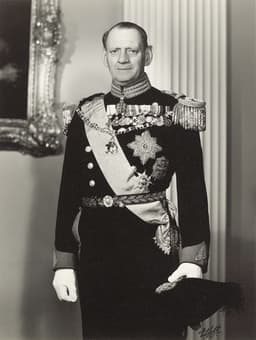
Frederick IX of Denmark
Emperor · Modern
51.7Total

Napoleon Bonaparte
General · Modern
70.9Total
Basic Information
Born
1899
1769
Died
1972
1821
Era
Modern
Modern
Nationality
Denmark
France
Occupation
Emperor
General
Civilization
Western
Western
Score Comparison
Military (10%)
11.4
94.0
Political (20%)
60.0
72.0
Influence (20%)
51.8
40.0
Legacy (20%)
42.5
80.0
Leadership (15%)
79.8
78.0
Strategy (15%)
60.0
90.0
TOTAL
51.7
70.9
Frederick IX of Denmark — Complete Timeline
1947 AD
Accession to the ThronePolitical Action◆ Major
Frederick IX became King of Denmark upon the death of his father, King Christian X. His reign began during post-World War II reconstruction. He was known for his informal style and love of sailing, which helped modernize the Danish monarchy's public image.
AccessionMonarchyDenmark
Impact: nationalconstructive
1950 AD
Danish Economic ModernizationReform
During Frederick IX's reign, Denmark underwent significant economic modernization, transitioning from agriculture to an industrial and welfare state. The king supported social reforms and infrastructure projects, though his role was largely ceremonial. This period saw rising living standards and urbanization.
Economic ReformModernizationWelfare State
Impact: nationalconstructive
1953 AD
Signing of the Danish Constitution of 1953Reform◆ Major
Frederick IX signed the new Danish constitution, which abolished the Landsting (upper house) and established a unicameral parliament (Folketing). The constitution also allowed for female succession to the throne, paving the way for his daughter Margrethe II to become queen.
ConstitutionReformSuccession
Impact: nationalprogressive
Napoleon Bonaparte — Complete Timeline
1799 AD
Coup of 18 BrumaireOther◆ Major
Napoleon Bonaparte, with support from his brother Lucien and key political figures, overthrew the Directory in a bloodless coup. He established the Consulate with himself as First Consul, effectively becoming the ruler of France. This event ended the French Revolution's most unstable period.
French RevolutionCoupRise to Power
Impact: regional
1804 AD
Promulgation of the Napoleonic CodeOther◆ Major
Napoleon enacted the Civil Code of the French, known as the Napoleonic Code, a comprehensive set of laws that replaced the fragmented feudal legal systems. The code established legal equality, protected property rights, and secularized law. It became the basis for legal systems in many European and world countries.
Legal ReformNapoleonic CodeCivil Law
Impact: globalconstructive
1805 AD
Battle of AusterlitzWar◆ Major
Napoleon's Grande Arm
Napoleonic WarsBattleDecisive Victory
Impact: global
1812 AD
Invasion of RussiaWar◆ Major
Napoleon led the Grande Arm
Napoleonic WarsInvasionDisaster
Impact: globaldestructive
1815 AD
Battle of WaterlooWar◆ Major
Napoleon's French army was defeated by the combined forces of the Duke of Wellington's Anglo-Allied army and Gebhard Leberecht von Bl
Napoleonic WarsBattleFinal Defeat
Impact: globaldestructive
Expert Analysis
frederick-ix-of-denmark-vs-napoleon-bonaparte
# The Emperor and the Sailor King
On a June morning in 1815, Napoleon Bonaparte stood on a muddy field near Waterloo, watching his elite Imperial Guard march into the muzzles of British cannon. Twenty-two years later, across the narrow sea in Copenhagen, a different kind of king was born—one who would wear tattoos on his arms and pilot his own yacht through the Danish straits. The contrast between these two figures captures something essential about the chasm between the 19th and 20th centuries, between conquest and compromise, between the man who tried to rule Europe and the man who accepted that his role was to be a symbol.
Origins
Napoleon Bonaparte was born in 1769 on the island of Corsica, a territory that had only recently become French. His family was minor nobility, poor enough that young Napoleon had to win a scholarship to attend military school in mainland France. There, the other cadets mocked his Corsican accent and provincial manners. That early humiliation forged something in him—a hunger for recognition, a will to prove that he was not merely the equal of the old aristocracy but their superior.
Frederick IX of Denmark, born in 1899, faced no such struggle. He was the grandson of King Christian IX, the "father-in-law of Europe," and from birth his path was clear. What set him apart was not ambition but temperament. As a young prince, he developed a passion for the sea and for music—he played the piano with genuine skill—and he carried a sailor's casual ease through a life that required constant formality. His tattoos, acquired during naval service, became his most famous signature, a visible defiance of the stiff collars and gold braid that defined his station.
Rise to Power
Napoleon's ascent was a rocket's arc. At 24, he drove the British out of Toulon and became a brigadier general. At 26, he crushed a royalist uprising in Paris with a "whiff of grapeshot." By 30, he had conquered Italy and Egypt. The French Revolution had shattered the old order, and in that chaos, a man of genius could rise faster than any nobleman could block him. Napoleon seized the moment, and the moment made him.
Frederick IX's accession was the opposite of dramatic. He became king in 1947, at age 47, upon the death of his father, Christian X. Denmark had already been a constitutional monarchy for decades, and Frederick's role was largely ceremonial. His great test came not on a battlefield but in a parliament chamber. In 1953, he signed the new Danish constitution, which abolished the upper house and established a unicameral system. It was a quiet revolution—the king voluntarily surrendered what remained of his political power.
Leadership & Governance
Napoleon governed with the same energy he brought to war. He reformed French law with the Napoleonic Code, which standardized legal systems across Europe and influenced civil codes from Louisiana to Japan. He reorganized education, established the Bank of France, and built roads and canals. But his genius was also his flaw: he could not stop. The same drive that created the Code also drove him to invade Russia, to refuse any peace that did not confirm his dominance, to fight on until the coalition against him was overwhelming.
Frederick IX governed by restraint. His Denmark underwent economic modernization during his reign—transitioning from agriculture to an industrial and service economy—but the king's role was to sign laws, not to make them. His military score of 45.0 reflects not incompetence but irrelevance; Denmark's king was no longer a warrior. His strategy score of 58.9 similarly reflects a different kind of statecraft: the strategy of survival for a small nation between great powers, a strategy that required not conquest but careful navigation.
Triumph & Tragedy
Napoleon's greatest triumph was his greatest tragedy. At Austerlitz in 1805, he destroyed the armies of Austria and Russia, cementing his mastery of Europe. But the seeds of his fall were already planted. The Continental System, his attempt to blockade Britain, failed and alienated his allies. The Peninsular War bled his army in Spain. The invasion of Russia in 1812 cost him half a million men. He was exiled to Elba, returned, and was defeated again at Waterloo in 1815. His final exile on Saint Helena, where he died in 1821 at age 51, was a slow, bitter end.
Frederick IX faced no such dramatic reversal. His reign was marked by steady, quiet success. The modernization of Denmark proceeded without crisis. The constitutional reforms of 1953 were accepted by all parties. His personal tragedy was perhaps that he was a sailor who spent most of his life on land, a king whose tattoos spoke of freedom but whose duties required confinement.
Character & Destiny
Napoleon's character was his destiny. His ambition was boundless, his energy inexhaustible, his confidence unshakeable. He once said, "Impossible is a word to be found only in the dictionary of fools." That belief made him great—and destroyed him. He could not stop because he could not imagine stopping. The same will that conquered Italy could not accept a compromise peace.
Frederick IX's character was equally decisive but in a different direction. He accepted his role as a constitutional monarch with grace. He understood that the king's power in modern Denmark was symbolic, and he made that symbolism warm and human. His tattoos, his love of jazz, his informal manner—these were not weaknesses but strengths in a world where monarchy had to be loved or die.
Legacy
Napoleon's legacy is written in law codes, in the borders of Europe, in the very concept of modern warfare. His total score of 82.4 reflects a figure who reshaped his world. But his legacy is also a warning: genius without restraint becomes tyranny, ambition without wisdom becomes disaster.
Frederick IX's legacy is quieter. His score of 63.3 reflects a different kind of success. He is remembered as the king who modernized Danish monarchy, who made it relevant in a democratic age. His tattoos, once shocking, now seem charming. He proved that a king could be both a symbol and a human being.
Conclusion
Standing at the extremes of modern European history, Napoleon and Frederick IX represent two answers to the question of power. Napoleon believed that power was something to seize and wield. Frederick believed that power was something to hold carefully and then let go. One conquered Europe and lost everything. One accepted his limits and kept his throne. The Corsican who would be emperor and the sailor who would be king—both shaped their nations, but only one understood that sometimes the greatest strength is knowing when to stand down.
Rankings
🥇
Napoleon BonaparteLeader
Mil: 94.0Pol: 72.0Inf: 40.0
70.9
🥈
Frederick IX of Denmark
Mil: 11.4Pol: 60.0Inf: 51.8
51.7
+19.2 behind
How This Comparison Works
Algorithm
Each figure is scored on 6 dimensions (0—100 scale) based on structured historical data: Military (10%), Political (20%), Influence (20%), Legacy (20%), Leadership (15%), Strategy (15%). The weighted total produces the final ranking.
Data Sources
Scores are computed from structured sub-indicators in the database. Scale factors adjust for era (Ancient ×0.85, Modern ×1.0) and civilization size (Eastern ×1.05, Other ×0.80) to account for differences in population and military scale.
Maximum 3 Figures
Comparisons are limited to 2—3 figures to ensure readability and statistical meaningfulness.
Error Margins
±5 points per dimension — Sub-scores are derived from historical records with inherent uncertainty. Two figures within 5 points on a dimension should be considered roughly equivalent in that area.
Total Score Accuracy
±3 points overall — The weighted combination of 6 dimensions produces a total score with approximately ±3 points of uncertainty. Differences of less than 3 points are not statistically significant— the figures are effectively tied.
Known Limitations
- Historical records are incomplete and uneven across civilizations
- Figures from oral-tradition societies may be underrepresented
- Occupation labels can misclassify multi-role figures
- Scores measure capability and impact, not moral character
- Quantitative scoring is a comparison tool, not absolute truth
Capability Radar
Military (10%) — Battles & Warfare
Battles
39
95
Win Rate
40
90
Expansion
42
95
Political (20%) — Governance & Reform
Reform
65
95
Diplomacy
55
80
Economy
60
85
Influence (20%) — Cultural & Global Reach
Cultural
30
85
Global
20
90
Legacy (20%) — Historical Impact
Historical
35
95
Longevity
30
90
Leadership (15%) — Power & Stability
Tenure
60
85
Stability
70
70
Strategy (15%) — Tactics & Innovation
Strategy
47
95
Tactics
49
98
Reform
54
92
Similar Comparisons
Comments & Discussion
炮击专家6/17/2026
拿破仑在1815年6月滑铁卢的泥泞中失去了他的帝国卫队,而弗雷德里克九世在同一年才刚出生——不,差了几十年。这种对比根本是胡扯。拿一个试图改写欧洲地图的军事天才,跟一个只会在丹麦海峡开游艇的纹身国王相提并论,简直是对历史的侮辱。想要学军事史的人,别浪费时间看这种软绵绵的标题党。
QuantHistorian6/17/2026
Calling this a "comparison" is like comparing a hydrogen bomb to a firecracker. Napoleon reshaped the legal and political foundations of a continent; Frederick IX was a pleasant figurehead who once piloted a yacht and played piano. A military historian can't find two more unequal subjects. This analysis tries to dress up trivia as depth, but the only real lesson is that you can be a beloved monarch without ever firing a shot in anger.