Loading...
Frederick Ulrich of Brunswick vs Napoleon Bonaparte
Napoleon Bonaparte leads by 36.1 pts · 2 figures compared
…
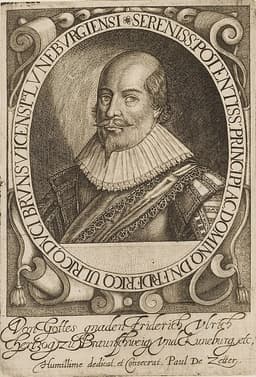
Frederick Ulrich of Brunswick
Emperor · Modern
34.8Total

Napoleon Bonaparte
General · Modern
70.9Total
Basic Information
Born
1591
1769
Died
1634
1821
Era
Modern
Modern
Nationality
Brunswick
France
Occupation
Emperor
General
Civilization
Western
Western
Score Comparison
Military (10%)
20.0
94.0
Political (20%)
26.4
72.0
Influence (20%)
45.5
40.0
Legacy (20%)
33.3
80.0
Leadership (15%)
31.2
78.0
Strategy (15%)
45.0
90.0
TOTAL
34.8
70.9
Frederick Ulrich of Brunswick — Complete Timeline
1626 AD
Lost control of the duchy during the Thirty Years' WarWar◆ Major
During the Thirty Years' War, Frederick Ulrich's weak leadership led to the occupation of Brunswick-Wolfenb
Thirty Years' WarOccupationLoss of Power
Impact: regionaldestructive
1629 AD
Signed the Treaty of LübeckPolitical Action
Frederick Ulrich signed the Treaty of L
TreatyThirty Years' WarDiplomacy
Impact: regionaldestructive
1634 AD
Died without legitimate issuePolitical Action◆ Major
Frederick Ulrich died without a legitimate heir, leading to a succession crisis in Brunswick-Wolfenb
SuccessionDynastyDeath
Impact: regional
Napoleon Bonaparte — Complete Timeline
1799 AD
Coup of 18 BrumaireOther◆ Major
Napoleon Bonaparte, with support from his brother Lucien and key political figures, overthrew the Directory in a bloodless coup. He established the Consulate with himself as First Consul, effectively becoming the ruler of France. This event ended the French Revolution's most unstable period.
French RevolutionCoupRise to Power
Impact: regional
1804 AD
Promulgation of the Napoleonic CodeOther◆ Major
Napoleon enacted the Civil Code of the French, known as the Napoleonic Code, a comprehensive set of laws that replaced the fragmented feudal legal systems. The code established legal equality, protected property rights, and secularized law. It became the basis for legal systems in many European and world countries.
Legal ReformNapoleonic CodeCivil Law
Impact: globalconstructive
1805 AD
Battle of AusterlitzWar◆ Major
Napoleon's Grande Arm
Napoleonic WarsBattleDecisive Victory
Impact: global
1812 AD
Invasion of RussiaWar◆ Major
Napoleon led the Grande Arm
Napoleonic WarsInvasionDisaster
Impact: globaldestructive
1815 AD
Battle of WaterlooWar◆ Major
Napoleon's French army was defeated by the combined forces of the Duke of Wellington's Anglo-Allied army and Gebhard Leberecht von Bl
Napoleonic WarsBattleFinal Defeat
Impact: globaldestructive
Expert Analysis
frederick-ulrich-of-brunswick-vs-napoleon-bonaparte
# The Emperor and the Duke: Two Faces of Power in Modern Europe
On a June morning in 1815, Napoleon Bonaparte watched the rain-soaked fields of Waterloo and prepared for a battle that would seal his fate. He had conquered Italy, Egypt, and most of Europe, codified laws that still shape Western jurisprudence, and crowned himself Emperor of the French. Less than two centuries earlier, another German prince, Frederick Ulrich of Brunswick, had stood in his own duchy watching his lands slip through his fingers—not in a blaze of glory, but in a slow, humiliating collapse. Both men inherited power; both faced the crucible of war. One reshaped the world; the other vanished into obscurity. What made the difference?
Origins
Napoleon was born in 1769 on the Mediterranean island of Corsica, a rocky territory only recently annexed by France. His family belonged to the minor nobility, but they were not wealthy. From childhood, Napoleon absorbed the volatile politics of a frontier society where honor and ambition were survival tools. He entered the military academy at Brienne at age nine, a short, intense boy with a thick Corsican accent, mocked by his French classmates. That early experience of being an outsider—both Corsican and French, both aristocrat and pauper—forged a relentless drive to prove himself.
Frederick Ulrich, born in 1591, came from the ancient House of Welf, rulers of Brunswick-Wolfenbüttel in the Holy Roman Empire. His inheritance was secure, his lineage impeccable, his resources modest but stable. The Thirty Years’ War, which erupted in 1618, would shatter that stability. Frederick Ulrich grew up in a world of fragile princely states, where power was less about personal genius than about dynastic alliances and imperial patronage. He was never trained to seize the moment; he was trained to preserve what he had.
The difference in their eras is critical. Napoleon emerged from the chaos of the French Revolution, a time when old hierarchies crumbled and a young artillery officer could rise to command armies. Frederick Ulrich lived in a world where legitimacy was inherited, not earned—a world that punished innovation and rewarded caution.
Rise to Power
Napoleon’s ascent was meteoric. In 1793, at age twenty-four, he drove the British fleet from Toulon. By 1796, he commanded the Army of Italy and won a series of stunning victories against the Austrians. His 1798 Egyptian campaign, though ultimately a strategic failure, showcased his genius for propaganda and self-promotion. In 1799, he returned to France and seized power in the coup of 18 Brumaire, becoming First Consul. Five years later, he crowned himself Emperor. Every step was calculated, every risk measured.
Frederick Ulrich’s path was far different—and far less dramatic. He inherited the duchy in 1613, a minor prince in a sprawling empire. His key moment came in 1626, when the armies of the Catholic League, led by the imperial general Tilly, invaded Brunswick-Wolfenbüttel. Frederick Ulrich had neither the military skill nor the political allies to resist. He lost control of his duchy, his lands occupied, his authority reduced to a title. In 1629, he signed the Treaty of Lübeck, which ended Danish involvement in the war but did nothing to restore his power. He became a footnote in a conflict that consumed Germany.
Why did one man rise and the other fall? Napoleon had the revolution to break the rules; Frederick Ulrich had only the rules to break him.
Leadership & Governance
Napoleon’s leadership was a paradox of brilliance and tyranny. As a military commander, he was nearly peerless: his 1805 victory at Austerlitz shattered the Third Coalition, and his Grande Armée swept across Europe with unprecedented speed. But his genius extended beyond the battlefield. The Napoleonic Code, introduced in 1804, standardized French law, abolished feudal privileges, and enshrined principles of meritocracy and property rights. He reformed education, centralized the administration, and built infrastructure that connected his empire. Yet his governance was also autocratic; he suppressed dissent, censored the press, and placed his brothers on European thrones.
Frederick Ulrich’s leadership, by contrast, was defined by weakness. His military score of 46.1 and political score of 41.3 reflect a ruler who could not command loyalty or inspire action. The Thirty Years’ War was a conflict of shifting alliances and mercenary armies, where survival required either overwhelming force or diplomatic cunning. Frederick Ulrich had neither. His duchy became a pawn in the struggles of greater powers—the Habsburgs, the Danes, the Swedes. He could not reform, could not fight, could not even negotiate effectively.
Triumph & Tragedy
Napoleon’s greatest triumph was Austerlitz, where he outmaneuvered the combined armies of Russia and Austria with a brilliance that still shapes military doctrine. His greatest tragedy was the 1812 invasion of Russia, a catastrophic campaign that cost hundreds of thousands of lives and destroyed his Grande Armée. He was exiled to Elba in 1814, returned for a hundred days, and fell finally at Waterloo in 1815, dying in British captivity on Saint Helena in 1821.
Frederick Ulrich’s greatest moment was perhaps the Treaty of Lübeck, which at least ended his direct involvement in the war. His tragedy was not a single battle but a lifetime of irrelevance. He died in 1634 without a legitimate heir, triggering a succession crisis that further destabilized his family. His total score of 44.3 reflects a life that left no mark on history.
Character & Destiny
Napoleon was restless, ambitious, and supremely confident. “Impossible is a word to be found only in the dictionary of fools,” he once said. That confidence drove him to conquer, but also to overreach. He could not stop; he could not consolidate. His personality—combining strategic genius with a hunger for glory—made his rise inevitable and his fall equally so.
Frederick Ulrich was cautious, passive, and perhaps overwhelmed. He lacked the ruthlessness to fight for his inheritance and the charisma to attract allies. In an era where princes were expected to lead armies, he could not. His destiny was shaped not by his choices but by his failures to choose.
Legacy
Napoleon’s legacy is vast and contested. The Napoleonic Code influenced legal systems across Europe, Latin America, and beyond. His military campaigns are studied in every war college. He reshaped the map of Europe, ended the Holy Roman Empire, and inspired nationalist movements. Yet he also left a trail of destruction, a legacy of war that killed millions. His influence score of 82.0 and legacy score of 78.0 place him among the most consequential figures in history.
Frederick Ulrich’s legacy is almost invisible. He is remembered, if at all, as a cautionary tale of weak leadership during the Thirty Years’ War. His scores—military 46.1, political 41.3, influence 62.6, legacy 45.3—tell the story of a ruler who faded from memory because he never truly ruled.
Conclusion
What separates Napoleon from Frederick Ulrich is not merely talent or opportunity. It is the willingness to act, to risk everything, to believe that history can be bent by individual will. Napoleon bent history until it broke him. Frederick Ulrich let history sweep him aside. In the end, both were mortal, both failed, both died. But one left a world transformed; the other left a world that hardly noticed he was gone. The difference is not in their bloodlines or their eras, but in the fire they carried—or failed to carry—within themselves.
Rankings
🥇
Napoleon BonaparteLeader
Mil: 94.0Pol: 72.0Inf: 40.0
70.9
🥈
Frederick Ulrich of Brunswick
Mil: 20.0Pol: 26.4Inf: 45.5
34.8
+36.1 behind
How This Comparison Works
Algorithm
Each figure is scored on 6 dimensions (0—100 scale) based on structured historical data: Military (10%), Political (20%), Influence (20%), Legacy (20%), Leadership (15%), Strategy (15%). The weighted total produces the final ranking.
Data Sources
Scores are computed from structured sub-indicators in the database. Scale factors adjust for era (Ancient ×0.85, Modern ×1.0) and civilization size (Eastern ×1.05, Other ×0.80) to account for differences in population and military scale.
Maximum 3 Figures
Comparisons are limited to 2—3 figures to ensure readability and statistical meaningfulness.
Error Margins
±5 points per dimension — Sub-scores are derived from historical records with inherent uncertainty. Two figures within 5 points on a dimension should be considered roughly equivalent in that area.
Total Score Accuracy
±3 points overall — The weighted combination of 6 dimensions produces a total score with approximately ±3 points of uncertainty. Differences of less than 3 points are not statistically significant— the figures are effectively tied.
Known Limitations
- Historical records are incomplete and uneven across civilizations
- Figures from oral-tradition societies may be underrepresented
- Occupation labels can misclassify multi-role figures
- Scores measure capability and impact, not moral character
- Quantitative scoring is a comparison tool, not absolute truth
Capability Radar
Military (10%) — Battles & Warfare
Battles
5
95
Win Rate
5
90
Expansion
5
95
Political (20%) — Governance & Reform
Reform
5
95
Diplomacy
10
80
Economy
5
85
Influence (20%) — Cultural & Global Reach
Cultural
5
85
Global
5
90
Legacy (20%) — Historical Impact
Historical
5
95
Longevity
5
90
Leadership (15%) — Power & Stability
Tenure
10
85
Stability
5
70
Strategy (15%) — Tactics & Innovation
Strategy
5
95
Tactics
5
98
Reform
5
92
Similar Comparisons
Comments & Discussion
BrunoTheBodyCount6/17/2026
You're comparing Waterloo's master to a footnote? Napoleon fought 60+ battles across a continent; Frederick Ulrich couldn't even hold his own duchy. The Duke lost Braunschweig in a single failed siege in 1615. Napoleon lost twice and still came back from Elba. One rebuilt empires from scratch, the other couldn't protect his backyard. The gap isn't just talent—it's scale. Frederick Ulrich played checkers while Napoleon played chess with God.|
废墟的叹息6/17/2026
拿破仑手滑了滑铁卢,弗雷德里希却连滑铁卢的资格都没混上?他沦落到卖掉家族珠宝付战争债,最后孤零零死在路边小旅馆。一个皇帝在圣赫勒拿岛口述回忆录,影响后世;一个公爵连传记都难以查全,像个错误缓存。关键是心态:拿破仑输得起政治翻盘,弗雷德里希压根没赢过命运。|
HabsburgGhost6/17/2026
Military history isn't a meritocracy of willpower; it's about resources and timing. Frederick Ulrich ruled a fragmented Duchy of 150,000 souls in the Thirty Years' War's shadow—a minor prince crushed between Catholic League and Protestant Union. Napoleon commanded 400,000 men after remaking France's bureaucracy and economy. Give Frederick Ulrich the Grande Armée, national conscription, and a bankrupt republic to exploit, and maybe he doesn't fade into dust. Circumstance made the "genius," not th
帝国残阳6/17/2026
拿皇像流星划过大陆,弗雷德里希只是旧制度的尸体。他死于1634年,帝国崩溃前夕,死时连块像样的墓碑都没有。但别把拿破仑神化了——他沾满人民鲜血的皇袍下藏着独裁的野心,法典是锁链,帝国是囚笼。弗雷德里希至少算一个封建领主,不伪善。历史歌颂拿破仑的露骨,却忘了它踩碎的都是一样的骨头。|
CorsicanGlory6/17/2026
Pure talent wins. Frederick Ulrich inherited power and failed to defend it. Napoleon built his empire from artillery school and sheer intensity. One man's name is a synonym for ambition; the other's a trivia question. Let's not romanticize "context"—Napoleon faced entire coalitions, internal revolts, and still imposed his legacy. Frederick Ulrich couldn't even stop his own uncle from seizing his lands. That's not bad luck; that's incompetence.