Loading...
This comparison has not been analyzed yet.
One-time AI generation (~1 minute). Scores and timeline are already available below.
Frederik IX of Denmark vs Nadir Muhammad
Frederik IX of Denmark leads by 12.0 pts · 2 figures compared
…
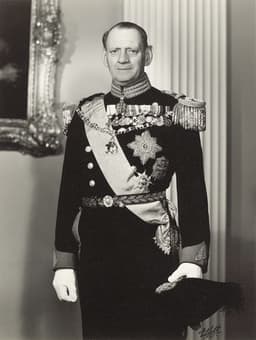
Frederik IX of Denmark
Emperor · Modern
51.7Total

Nadir Muhammad
Emperor · Modern
39.7Total
Basic Information
Born
1899
1590
Died
1972
1651
Era
Modern
Modern
Nationality
Denmark
Khanate of Bukhara
Occupation
Emperor
Emperor
Civilization
Western
Eastern
Score Comparison
Military (10%)
25.6
22.6
Political (20%)
62.7
32.2
Influence (20%)
51.8
46.3
Legacy (20%)
40.0
35.0
Leadership (15%)
72.0
55.3
Strategy (15%)
60.0
39.6
TOTAL
51.7
39.7
Frederik IX of Denmark — Complete Timeline
1947 AD
Accession to the thronePolitical Action◆ Major
Frederik IX became King of Denmark on April 20, 1947, following the death of his father, Christian X. His reign oversaw the post-war reconstruction and modernization of Denmark.
AccessionSuccession
Impact: national
1949 AD
Support for NATO membershipPolitical Action◆ Major
Frederik IX supported Denmark's accession to NATO in 1949, aligning the country with Western powers during the Cold War. This marked a shift from Denmark's traditional neutrality.
NATOCold WarForeign Policy
Impact: regionalconstructive
1953 AD
Signing of the 1953 constitutionReform◆ Major
Frederik IX signed a new constitution in 1953 that abolished the upper house (Landsting), introduced a unicameral parliament (Folketing), and allowed female succession to the throne. This modernized the Danish political system.
Constitutional ReformUnicameralismFemale Succession
Impact: nationalprogressive
1960 AD
Modernization of the Danish welfare stateReform◆ Major
During Frederik IX's reign, Denmark expanded its welfare state, including the introduction of universal healthcare, old-age pensions, and social security. These reforms were part of the post-war social democratic consensus.
Welfare StateSocial ReformHealthcare
Impact: nationalconstructive
1972 AD
Death and succession of Margrethe IIPolitical Action◆ Major
Frederik IX died on January 14, 1972, and was succeeded by his daughter, Margrethe II, who became Denmark's first reigning queen in centuries. His death marked the end of an era of post-war reconstruction.
DeathSuccessionMargrethe II
Impact: national
Nadir Muhammad — Complete Timeline
1641 AD
Accession to the throne of BukharaPolitical Action◆ Major
Nadir Muhammad became the Jani-Begid ruler of the Khanate of Bukhara after the abdication of his brother Imam Quli Khan. His reign was marked by internal strife and external threats.
Jani-BegidsAccessionBukhara
Impact: regional
1646 AD
Loss of Balkh to the MughalsWar◆ Major
Nadir Muhammad lost the city of Balkh and its surrounding territory to the Mughal Empire under Shah Jahan. The Mughals launched a campaign into Central Asia, capturing Balkh and forcing Nadir Muhammad to cede the region.
Jani-BegidsWarMughals
Impact: regionaldestructive
1651 AD
Deposition and deathPolitical Action◆ Major
Nadir Muhammad was deposed by his son Abd al-Aziz Khan after a period of internal conflict. He died shortly after, ending his troubled reign and allowing his son to restore stability to the khanate.
Jani-BegidsDepositionDeath
Impact: regionaltragic
This comparison has not been analyzed yet.
One-time AI generation (~1 minute). Scores and timeline are already available below.
Rankings
🥇
Frederik IX of DenmarkLeader
Mil: 25.6Pol: 62.7Inf: 51.8
51.7
🥈
Nadir Muhammad
Mil: 22.6Pol: 32.2Inf: 46.3
39.7
+12.0 behind
How This Comparison Works
Algorithm
Each figure is scored on 6 dimensions (0—100 scale) based on structured historical data: Military (10%), Political (20%), Influence (20%), Legacy (20%), Leadership (15%), Strategy (15%). The weighted total produces the final ranking.
Data Sources
Scores are computed from structured sub-indicators in the database. Scale factors adjust for era (Ancient ×0.85, Modern ×1.0) and civilization size (Eastern ×1.05, Other ×0.80) to account for differences in population and military scale.
Maximum 3 Figures
Comparisons are limited to 2—3 figures to ensure readability and statistical meaningfulness.
Error Margins
±5 points per dimension — Sub-scores are derived from historical records with inherent uncertainty. Two figures within 5 points on a dimension should be considered roughly equivalent in that area.
Total Score Accuracy
±3 points overall — The weighted combination of 6 dimensions produces a total score with approximately ±3 points of uncertainty. Differences of less than 3 points are not statistically significant— the figures are effectively tied.
Known Limitations
- Historical records are incomplete and uneven across civilizations
- Figures from oral-tradition societies may be underrepresented
- Occupation labels can misclassify multi-role figures
- Scores measure capability and impact, not moral character
- Quantitative scoring is a comparison tool, not absolute truth
Capability Radar
Military (10%) — Battles & Warfare
Battles
35
15
Win Rate
38
10
Expansion
42
10
Political (20%) — Governance & Reform
Reform
55
15
Diplomacy
50
20
Economy
50
15
Influence (20%) — Cultural & Global Reach
Cultural
30
10
Global
20
5
Legacy (20%) — Historical Impact
Historical
30
10
Longevity
20
10
Leadership (15%) — Power & Stability
Tenure
60
30
Stability
65
20
Strategy (15%) — Tactics & Innovation
Strategy
42
15
Tactics
49
15
Reform
51
10
Similar Comparisons
Comments & Discussion
No comments yet. Be the first to share your thoughts!