Loading...
Fukushima Masanori vs Napoleon Bonaparte
Napoleon Bonaparte leads by 13.5 pts · 2 figures compared
…
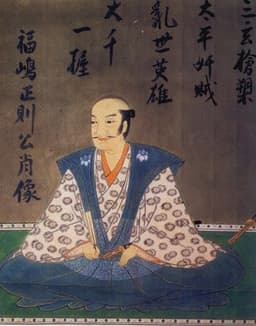
Fukushima Masanori
General · Modern
57.4Total

Napoleon Bonaparte
General · Modern
70.9Total
Basic Information
Born
1561
1769
Died
1624
1821
Era
Modern
Modern
Nationality
Japan
France
Occupation
General
General
Civilization
Eastern
Western
Score Comparison
Military (10%)
60.0
94.0
Political (20%)
68.0
72.0
Influence (20%)
53.3
40.0
Legacy (20%)
45.0
80.0
Leadership (15%)
71.0
78.0
Strategy (15%)
60.0
90.0
TOTAL
57.4
70.9
Fukushima Masanori — Complete Timeline
1590 AD
Siege of OdawaraWar◆ Major
Fukushima Masanori participated in Toyotomi Hideyoshi's siege of Odawara Castle against the Hojo clan. The siege ended with Hojo surrender, consolidating Hideyoshi's control over Japan.
OdawaraSiegeHideyoshi
Impact: national
1600 AD
Battle of SekigaharaWar
Fukushima Masanori commanded a division on the Eastern Army side under Tokugawa Ieyasu at Sekigahara. His forces played a key role in the victory, leading to his appointment as daimyo of Hiroshima Domain.
SekigaharaBattleTokugawa
Impact: nationalconstructive
1619 AD
Loss of Hiroshima DomainPolitical Action◆ Major
Fukushima Masanori was stripped of his Hiroshima Domain by the Tokugawa shogunate for alleged misrule and unauthorized castle repairs. He was exiled to a smaller domain, ending his political influence.
ExileTokugawaDomain Loss
Impact: nationaltragic
Napoleon Bonaparte — Complete Timeline
1799 AD
Coup of 18 BrumaireOther◆ Major
Napoleon Bonaparte, with support from his brother Lucien and key political figures, overthrew the Directory in a bloodless coup. He established the Consulate with himself as First Consul, effectively becoming the ruler of France. This event ended the French Revolution's most unstable period.
French RevolutionCoupRise to Power
Impact: regional
1804 AD
Promulgation of the Napoleonic CodeOther◆ Major
Napoleon enacted the Civil Code of the French, known as the Napoleonic Code, a comprehensive set of laws that replaced the fragmented feudal legal systems. The code established legal equality, protected property rights, and secularized law. It became the basis for legal systems in many European and world countries.
Legal ReformNapoleonic CodeCivil Law
Impact: globalconstructive
1805 AD
Battle of AusterlitzWar◆ Major
Napoleon's Grande Arm
Napoleonic WarsBattleDecisive Victory
Impact: global
1812 AD
Invasion of RussiaWar◆ Major
Napoleon led the Grande Arm
Napoleonic WarsInvasionDisaster
Impact: globaldestructive
1815 AD
Battle of WaterlooWar◆ Major
Napoleon's French army was defeated by the combined forces of the Duke of Wellington's Anglo-Allied army and Gebhard Leberecht von Bl
Napoleonic WarsBattleFinal Defeat
Impact: globaldestructive
Expert Analysis
fukushima-masanori-vs-napoleon-bonaparte
# The Conqueror and the Loyalist: Napoleon and Fukushima Masanori
On a June morning in 1815, Napoleon Bonaparte stood on a muddy field near Waterloo, watching his Imperial Guard march into cannon fire for the last time. Two centuries earlier and half a world away, Fukushima Masanori knelt in the dust of Hiroshima Castle, his domain stripped away by the very shogun he had helped place in power. Both men were warriors who rose from modest beginnings to touch the heights of their worlds. Yet one reshaped an entire continent while the other faded into a footnote. Why did their paths diverge so dramatically? The answer lies not merely in talent, but in the invisible architecture of opportunity and constraint that each man inherited.
Origins
Napoleon was born in 1769 on the island of Corsica, a territory only recently annexed by France. His family was minor nobility, poor enough that his father’s death forced the young artillery officer to accelerate his career. The French Revolution had shattered the old order, creating a world where a brilliant commoner could climb faster than any noble. Corsica’s rough independence and France’s revolutionary chaos forged in Napoleon a hunger for order through conquest.
Fukushima Masanori, born in 1561, emerged from a Japan still bleeding from a century of civil war. He was the son of a samurai who served the powerful Oda clan, and his world was one of rigid hierarchy. A man’s worth was measured by loyalty to his lord, not by personal ambition. The chaos of the Sengoku period offered opportunity, but only within the strict framework of feudal obligation. Masanori’s path was not to remake Japan, but to serve those who would.
Rise to Power
Napoleon’s ascent was a rocket. At age 24, he drove the British from Toulon and was promoted to brigadier general. By 30, he had conquered Italy and Egypt, each victory a stepping stone. His 1799 coup made him First Consul, and by 1804 he crowned himself Emperor. The key turning point was 1796, when he took command of the Army of Italy—a starving, mutinous force he transformed into a conquering legion through sheer will and tactical brilliance. “I see only the masses,” he wrote, “and I am drawn by them.”
Fukushima Masanori’s rise was slower, more traditional. He fought under Toyotomi Hideyoshi at the Siege of Odawara in 1590, proving his worth in the slow grind of siege warfare. His great moment came at the Battle of Sekigahara in 1600, where he commanded a division on Tokugawa Ieyasu’s side. His forces helped turn the tide, and for this loyalty, Ieyasu awarded him the vast Hiroshima Domain. Where Napoleon seized power, Masanori earned it through service.
Leadership & Governance
Napoleon ruled as a whirlwind of reform and war. He centralized the French state, established the Napoleonic Code, and reorganized education. His military genius—scored at 94—was unmatched: he could coordinate corps across hundreds of miles and strike with devastating speed. But his political score of 75 reflects his fatal flaw: he could conquer but not consolidate. His Continental System to blockade Britain backfired, and his invasion of Russia in 1812 bled his empire dry.
Fukushima Masanori governed as a daimyo, a feudal lord. His leadership score of 87 suggests a commander respected by his men, but his military score of 64 and strategy of 58 indicate he was no Napoleon. His governance was traditional: collect taxes, maintain order, and above all, stay loyal to the shogun. Yet in 1619, he was stripped of Hiroshima Domain for alleged misrule and unauthorized castle repairs. The shogunate’s suspicion of powerful lords, hardened after Sekigahara, made any misstep fatal. Masanori’s tragedy was that he was a competent lord in an era that demanded absolute submission.
Triumph & Tragedy
Napoleon’s triumph was Austerlitz in 1805, where he crushed the combined armies of Russia and Austria. It was the masterpiece of his career. His tragedy was Waterloo, where a combination of rain, Prussian reinforcements, and his own exhaustion ended his empire. Exiled to St. Helena, he died at 51, a prisoner of the British.
Fukushima Masanori’s triumph was Sekigahara, where he helped secure the Tokugawa peace that would last 250 years. His tragedy was the loss of his domain—not in battle, but through the quiet machinations of a shogunate that no longer needed him. He died in 1624, a lord without land, a samurai without purpose.
Character & Destiny
Napoleon was driven by insatiable ambition. “Impossible is a word to be found only in the dictionary of fools,” he said. He believed in destiny, in the power of will to reshape reality. This made him a genius and a tyrant, a liberator and a conqueror. His character was his destiny: he could not stop, and so he fell.
Fukushima Masanori was driven by loyalty. He fought for Hideyoshi, then for Ieyasu, never for himself. His character was shaped by a culture that prized duty over ambition. In Japan, the greatest tragedy was not failure in battle but failure in loyalty. His destiny was to be a faithful sword that, once its purpose was served, was set aside.
Legacy
Napoleon’s legacy is colossal. The Napoleonic Code still shapes European law. His military tactics are studied in every war college. He redrew the map of Europe and inspired nationalism across the continent. His score of 82 for influence and 78 for legacy reflect a man who, even in defeat, changed the world.
Fukushima Masanori’s legacy is modest. He is remembered by historians as a loyal general at Sekigahara, a footnote in the Tokugawa story. His legacy score of 63 and influence of 75 reflect a man who served a system that eventually consumed him. In Japan, he is not forgotten, but he is not celebrated.
Conclusion
Standing at Waterloo, Napoleon could look back on a life that had remade Europe. Kneeling at Hiroshima, Fukushima Masanori could look back on a life of service that ended in silence. The difference between them is not talent—both were skilled commanders. It is not courage—both faced death. The difference is the world each inhabited. Napoleon’s Europe was a continent in revolution, where one man could shatter thrones. Masanori’s Japan was a nation in consolidation, where one man could only serve the shogun. In the end, the conqueror and the loyalist both fell. But one fell from a height that still casts a shadow, while the other fell into the long, quiet dusk of a history that moves on without him.
Rankings
🥇
Napoleon BonaparteLeader
Mil: 94.0Pol: 72.0Inf: 40.0
70.9
🥈
Fukushima Masanori
Mil: 60.0Pol: 68.0Inf: 53.3
57.4
+13.5 behind
How This Comparison Works
Algorithm
Each figure is scored on 6 dimensions (0—100 scale) based on structured historical data: Military (10%), Political (20%), Influence (20%), Legacy (20%), Leadership (15%), Strategy (15%). The weighted total produces the final ranking.
Data Sources
Scores are computed from structured sub-indicators in the database. Scale factors adjust for era (Ancient ×0.85, Modern ×1.0) and civilization size (Eastern ×1.05, Other ×0.80) to account for differences in population and military scale.
Maximum 3 Figures
Comparisons are limited to 2—3 figures to ensure readability and statistical meaningfulness.
Error Margins
±5 points per dimension — Sub-scores are derived from historical records with inherent uncertainty. Two figures within 5 points on a dimension should be considered roughly equivalent in that area.
Total Score Accuracy
±3 points overall — The weighted combination of 6 dimensions produces a total score with approximately ±3 points of uncertainty. Differences of less than 3 points are not statistically significant— the figures are effectively tied.
Known Limitations
- Historical records are incomplete and uneven across civilizations
- Figures from oral-tradition societies may be underrepresented
- Occupation labels can misclassify multi-role figures
- Scores measure capability and impact, not moral character
- Quantitative scoring is a comparison tool, not absolute truth
Capability Radar
Military (10%) — Battles & Warfare
Battles
55
95
Win Rate
60
90
Expansion
45
95
Political (20%) — Governance & Reform
Reform
30
95
Diplomacy
50
80
Economy
40
85
Influence (20%) — Cultural & Global Reach
Cultural
30
85
Global
20
90
Legacy (20%) — Historical Impact
Historical
35
95
Longevity
25
90
Leadership (15%) — Power & Stability
Tenure
45
85
Stability
45
70
Strategy (15%) — Tactics & Innovation
Strategy
55
95
Tactics
50
98
Reform
30
92
Similar Comparisons
Comments & Discussion
WaterlooWanderer6/17/2026
Comparing a European conqueror to a Japanese loyalist is like comparing a wildfire to a hearth fire. Napoleon changed Europe by leveraging revolutionary chaos—any peasant with a cannon could rise. Fukushima was bound by samurai codes that demanded fealty, not ambition. That's why one built an empire and the other lost his castle at Hiroshima.
历史之锚6/17/2026
拿破仑的火药桶炸开了整个欧洲,福岛正则却困在忠诚的牢笼里。一个是从贫穷贵族爬到皇帝宝座,另一个是助家康登顶后反被夺城。权力不看你有多强,看你生在什么地方——法国的革命裂缝让野心者钻洞,日本的铁板秩序压死一切出头鸟。
DataDrill6/17/2026
The analysis misses a simple truth: numbers don't lie. Napoleon commanded armies of 600,000; Fukushima led maybe 10,000 at best. You can't rewrite history when the resource gap is that wide. Waterloo had 72,000 French against coalition forces; Fukushima's entire domain was worth 200,000 koku. Size matters more than loyalty or ambition.
镰仓之眼6/17/2026
别被西方英雄叙事骗了。福岛正则要是生在欧洲,可能就是另一个拿破仑。差别在于:法国的混乱是条裂缝,让科西嘉小子爬上去;日本的战国末期是座金字塔,你只能站在家康给你画好的格子里。忠诚不是美德,是生存策略——福岛输就输在信错了这套规则。
RevisionistRaven6/17/2026
Let's be real: Fukushima didn't "fade into a footnote" because he lacked talent. He lost because he backed the wrong horse at Sekigahara—his loyalty was to the wrong branch. Napoleon'd be just as forgotten if he'd backed the Bourbons instead of the Revolution. History's winners write the narratives, and both were pawns in bigger games.