Loading...
This comparison has not been analyzed yet.
One-time AI generation (~1 minute). Scores and timeline are already available below.
Gediminas of Lithuania vs Qutuz
Qutuz leads by 2.0 pts · 2 figures compared
…

Gediminas of Lithuania
Emperor · Medieval
60.4Total
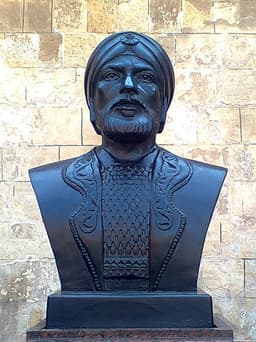
Qutuz
Emperor · Medieval
62.4Total
Basic Information
Born
1275
1220
Died
1341
1260
Era
Medieval
Medieval
Nationality
Lithuania
Egypt
Occupation
Emperor
Emperor
Civilization
Western
Middle Eastern
Score Comparison
Military (10%)
67.3
82.0
Political (20%)
62.7
68.0
Influence (20%)
56.7
55.0
Legacy (20%)
55.0
55.0
Leadership (15%)
72.0
64.0
Strategy (15%)
55.0
68.5
TOTAL
60.4
62.4
Gediminas of Lithuania — Complete Timeline
1316 AD
Founded the Gediminid DynastyPolitical Action
Gediminas established the Gediminid dynasty, which ruled Lithuania and later Poland for centuries. He consolidated power after the death of previous rulers, creating a stable succession line.
DynastyLithuania
Impact: regionalconstructive
1320 AD
Conquest of Ruthenian PrincipalitiesWar◆ Major
Gediminas conquered the principalities of Kiev, Volhynia, and Podolia, expanding Lithuanian control over much of modern Belarus and Ukraine. This made Lithuania the dominant power in Eastern Europe.
ExpansionRuthenia
Impact: regional
1323 AD
Correspondence with Western EuropeCultural
Gediminas wrote letters to Western European cities and the Pope, inviting merchants, artisans, and knights to settle in Lithuania. This opened Lithuania to Western influence and trade.
DiplomacyWesternization
Impact: regionalconstructive
1331 AD
Battle of the VistulaWar◆ Major
Gediminas led a campaign against the Teutonic Knights, defeating them at the Battle of the Vistula. This victory halted the Knights' advance into Lithuania and secured Lithuanian independence.
Teutonic KnightsBattle
Impact: regionalconstructive
Qutuz — Complete Timeline
1257 AD
Regency for Al-Mansur Ali (1257-1259)Political Action◆ Major
After Aybak's murder, Qutuz became regent for Aybak's young son Al-Mansur Ali. He effectively ruled Egypt as the power behind the throne. This period saw the consolidation of Mamluk power and preparation for the Mongol threat.
RegencyMamluk SultanatePower Consolidation
Impact: regional
1259 AD
Accession as Sultan (1259)Political Action◆ Major
Qutuz deposed Al-Mansur Ali and proclaimed himself Sultan of Egypt. He justified this by the need for strong leadership against the impending Mongol invasion. His accession was accepted by the Mamluk commanders, uniting Egypt under his rule.
SuccessionMamluk SultanateMongol Threat
Impact: regional
1260 AD
Battle of Ain Jalut (1260)War
Qutuz led the Mamluk army to victory against the Mongols at Ain Jalut in Palestine. This was the first major defeat of the Mongol Empire. The battle halted Mongol expansion into the Middle East and secured Mamluk control over Syria.
Mongol InvasionBattleMamluk Victory
Impact: globalconstructive
Assassination of Qutuz (1260)Other◆ Major
Shortly after the victory at Ain Jalut, Qutuz was assassinated by Baybars and other Mamluk commanders during a hunting expedition. Baybars then seized the sultanate. Qutuz's death ended his brief but decisive reign and elevated Baybars to power.
AssassinationSuccessionMamluk Sultanate
Impact: regionaltragic
This comparison has not been analyzed yet.
One-time AI generation (~1 minute). Scores and timeline are already available below.
Rankings
🥇
QutuzLeader
Mil: 82.0Pol: 68.0Inf: 55.0
62.4
🥈
Gediminas of Lithuania
Mil: 67.3Pol: 62.7Inf: 56.7
60.4
+2.0 behind
How This Comparison Works
Algorithm
Each figure is scored on 6 dimensions (0—100 scale) based on structured historical data: Military (10%), Political (20%), Influence (20%), Legacy (20%), Leadership (15%), Strategy (15%). The weighted total produces the final ranking.
Data Sources
Scores are computed from structured sub-indicators in the database. Scale factors adjust for era (Ancient ×0.85, Modern ×1.0) and civilization size (Eastern ×1.05, Other ×0.80) to account for differences in population and military scale.
Maximum 3 Figures
Comparisons are limited to 2—3 figures to ensure readability and statistical meaningfulness.
Error Margins
±5 points per dimension — Sub-scores are derived from historical records with inherent uncertainty. Two figures within 5 points on a dimension should be considered roughly equivalent in that area.
Total Score Accuracy
±3 points overall — The weighted combination of 6 dimensions produces a total score with approximately ±3 points of uncertainty. Differences of less than 3 points are not statistically significant— the figures are effectively tied.
Known Limitations
- Historical records are incomplete and uneven across civilizations
- Figures from oral-tradition societies may be underrepresented
- Occupation labels can misclassify multi-role figures
- Scores measure capability and impact, not moral character
- Quantitative scoring is a comparison tool, not absolute truth
Capability Radar
Military (10%) — Battles & Warfare
Battles
65
75
Win Rate
70
80
Expansion
80
70
Political (20%) — Governance & Reform
Reform
60
50
Diplomacy
70
70
Economy
55
55
Influence (20%) — Cultural & Global Reach
Cultural
55
60
Global
50
70
Legacy (20%) — Historical Impact
Historical
70
75
Longevity
65
65
Leadership (15%) — Power & Stability
Tenure
75
45
Stability
65
50
Strategy (15%) — Tactics & Innovation
Strategy
75
82
Tactics
60
85
Reform
55
60
Similar Comparisons
Comments & Discussion
No comments yet. Be the first to share your thoughts!