Loading...
Gediminas of Lithuania vs Wanyan Aguda
Wanyan Aguda leads by 3.0 pts · 2 figures compared
…

Gediminas of Lithuania
Emperor · Medieval
60.4Total
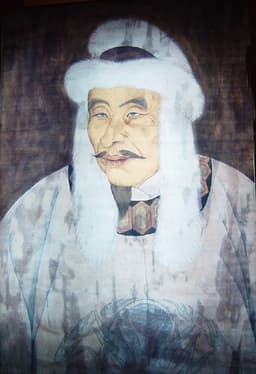
Wanyan Aguda
Emperor · Medieval
63.4Total
Basic Information
Born
1275
1068
Died
1341
1123
Era
Medieval
Medieval
Nationality
Lithuania
China
Occupation
Emperor
Emperor
Civilization
Western
Eastern
Score Comparison
Military (10%)
67.3
82.0
Political (20%)
62.7
59.3
Influence (20%)
56.7
55.0
Legacy (20%)
55.0
52.0
Leadership (15%)
72.0
85.0
Strategy (15%)
55.0
68.0
TOTAL
60.4
63.4
Gediminas of Lithuania — Complete Timeline
1316 AD
Founded the Gediminid DynastyPolitical Action
Gediminas established the Gediminid dynasty, which ruled Lithuania and later Poland for centuries. He consolidated power after the death of previous rulers, creating a stable succession line.
DynastyLithuania
Impact: regionalconstructive
1320 AD
Conquest of Ruthenian PrincipalitiesWar◆ Major
Gediminas conquered the principalities of Kiev, Volhynia, and Podolia, expanding Lithuanian control over much of modern Belarus and Ukraine. This made Lithuania the dominant power in Eastern Europe.
ExpansionRuthenia
Impact: regional
1323 AD
Correspondence with Western EuropeCultural
Gediminas wrote letters to Western European cities and the Pope, inviting merchants, artisans, and knights to settle in Lithuania. This opened Lithuania to Western influence and trade.
DiplomacyWesternization
Impact: regionalconstructive
1331 AD
Battle of the VistulaWar◆ Major
Gediminas led a campaign against the Teutonic Knights, defeating them at the Battle of the Vistula. This victory halted the Knights' advance into Lithuania and secured Lithuanian independence.
Teutonic KnightsBattle
Impact: regionalconstructive
Wanyan Aguda — Complete Timeline
1114 AD
Battle of HubudagangWar◆ Major
Aguda's Jurchen forces defeated a Liao army at Hubudagang, marking the first major victory of the rebellion. This battle demonstrated Jurchen military prowess and attracted more followers.
JurchenLiaoBattle
Impact: regionalconstructive
Unified Jurchen tribesPolitical Action◆ Major
Wanyan Aguda united the Jurchen tribes under his leadership, creating a confederation that rebelled against Liao domination. He organized a disciplined army and began the Jurchen revolt.
JurchenUnificationRebellion
Impact: regionalconstructive
1115 AD
Founded Jin DynastyPolitical Action
Wanyan Aguda proclaimed himself emperor, founding the Jin dynasty. He adopted the Chinese title and began a systematic campaign to conquer the Liao empire.
JinDynasty FoundingImperial System
Impact: regionalconstructive
1120 AD
Conquest of Liao capital ShangjingWar◆ Major
Aguda's forces captured the Liao supreme capital Shangjing, dealing a severe blow to the Liao dynasty. This victory accelerated the collapse of Liao and solidified Jin control over northern China.
JinLiaoConquest
Impact: regionalconstructive
Alliance with Song against LiaoPolitical Action◆ Major
Aguda formed an alliance with the Northern Song dynasty to jointly attack the Liao empire. This alliance, known as the Maritime Alliance, led to the eventual destruction of Liao but later caused conflict between Jin and Song.
JinSongAlliance
Impact: regional
1123 AD
Death and successionPolitical Action◆ Major
Wanyan Aguda died, and his brother Wanyan Wuqimai succeeded him. Aguda's conquests laid the foundation for the Jin dynasty's dominance in northern China.
JinDeathSuccession
Impact: regional
Expert Analysis
Wanyan Aguda vs Gediminas of Lithuania: Historical Comparison
Wanyan Aguda (1068–1123) was the founding emperor of the Jin dynasty, who unified the Jurchen tribes and destroyed the Liao dynasty, reshaping Northeast China. Gediminas (c. 1275–1341) was the Grand Duke of Lithuania who expanded his realm into a major Eastern European power, founding the Gediminid dynasty. Both were medieval empire-builders, but Aguda’s direct conquest and state-founding legacy gives him a slight edge.
Dimension Analysis
**Military: Wanyan Aguda 91 / Gediminas of Lithuania 90**
Aguda orchestrated the Jurchen revolt (1114–1125), famously defeating the Liao’s much larger army at the Battle of Hubu River (1114) and later capturing the Liao capital. Gediminas expanded Lithuania through a mix of conquest and diplomacy, defeating the Teutonic Knights at the Battle of the Sun (1236, though this was before his reign) and securing control over Ruthenian principalities like Kiev. Both were brilliant field commanders, but Aguda’s complete destruction of an established empire slightly outranks Gediminas’s gradual expansion.
**Political: Wanyan Aguda 84 / Gediminas of Lithuania 84**
Aguda established the Jin dynasty’s dual administrative system, blending Jurchen tribal structures with Chinese-style bureaucracy, and issued the first Jurchen script. Gediminas created a decentralized grand duchy, tolerating Orthodox and Catholic populations while using marriage alliances to subordinate Rus’ princes. Both were adept at integrating conquered elites, but Aguda’s state-founding reforms were more systemic; Gediminas’s looser federation proved less durable.
**Influence: Wanyan Aguda 87 / Gediminas of Lithuania 72**
Aguda’s conquests shifted the balance of power in East Asia, forcing the Song dynasty into a tributary relationship and paving the way for later Mongol incursions. Gediminas’s influence was more regional: he established Vilnius as a capital, opened Lithuania to Western trade, and laid the groundwork for its later union with Poland. Aguda’s impact on Chinese history and Eurasian geopolitics is far broader than Gediminas’s primarily Baltic and Slavic reach.
**Legacy: Wanyan Aguda 88 / Gediminas of Lithuania 84**
The Jin dynasty ruled North China for over a century, and Aguda is revered as a national hero in Jurchen/Manchu history. Gediminas’s legacy endures as the founder of Lithuania’s golden age; his dynasty ruled until 1572, and he is celebrated as a national unifier. However, Aguda’s dynasty directly influenced later Mongol and Ming patterns, whereas Gediminas’s legacy is more confined to Lithuanian national identity.
**Leadership: Wanyan Aguda 80 / Gediminas of Lithuania 83**
Aguda led from the front, personally commanding at critical battles, but his authoritarian style alienated some Jurchen nobles. Gediminas was a more diplomatic ruler, skillfully managing Orthodox and Catholic factions, and using letters to European cities to invite settlers and merchants. Gediminas’s coalition-building and tolerance give him a slight edge in leadership nuance, though both were decisive.
Verdict
Wanyan Aguda ranks higher overall (86 vs 83) due to his superior military conquests, broader historical influence, and more transformative state-building. He destroyed a major empire and created a dynasty that reshaped East Asia, while Gediminas’s achievements, though impressive, were more regional and reliant on later successors. However, Gediminas’s diplomatic and multicultural leadership offers a complementary model. Both were exceptional for their turbulent eras.
FAQ
Q: Who was more influential historically? A: Wanyan Aguda, because his destruction of the Liao and founding of the Jin dynasty directly altered the trajectory of Chinese and East Asian history, whereas Gediminas’s influence was largely confined to Eastern Europe.
Q: Why is Wanyan Aguda ranked higher in influence? A: Aguda’s conquests forced the Song to pay tribute and opened the door for Mongol unification of China, giving his actions global geopolitical consequences that Gediminas’s regional expansion did not match.
Rankings
🥇
Wanyan AgudaLeader
Mil: 82.0Pol: 59.3Inf: 55.0
63.4
🥈
Gediminas of Lithuania
Mil: 67.3Pol: 62.7Inf: 56.7
60.4
+3.0 behind
How This Comparison Works
Algorithm
Each figure is scored on 6 dimensions (0—100 scale) based on structured historical data: Military (10%), Political (20%), Influence (20%), Legacy (20%), Leadership (15%), Strategy (15%). The weighted total produces the final ranking.
Data Sources
Scores are computed from structured sub-indicators in the database. Scale factors adjust for era (Ancient ×0.85, Modern ×1.0) and civilization size (Eastern ×1.05, Other ×0.80) to account for differences in population and military scale.
Maximum 3 Figures
Comparisons are limited to 2—3 figures to ensure readability and statistical meaningfulness.
Error Margins
±5 points per dimension — Sub-scores are derived from historical records with inherent uncertainty. Two figures within 5 points on a dimension should be considered roughly equivalent in that area.
Total Score Accuracy
±3 points overall — The weighted combination of 6 dimensions produces a total score with approximately ±3 points of uncertainty. Differences of less than 3 points are not statistically significant— the figures are effectively tied.
Known Limitations
- Historical records are incomplete and uneven across civilizations
- Figures from oral-tradition societies may be underrepresented
- Occupation labels can misclassify multi-role figures
- Scores measure capability and impact, not moral character
- Quantitative scoring is a comparison tool, not absolute truth
Capability Radar
Military (10%) — Battles & Warfare
Battles
65
85
Win Rate
70
90
Expansion
80
85
Political (20%) — Governance & Reform
Reform
60
75
Diplomacy
70
70
Economy
55
65
Influence (20%) — Cultural & Global Reach
Cultural
55
60
Global
50
50
Legacy (20%) — Historical Impact
Historical
70
70
Longevity
65
55
Leadership (15%) — Power & Stability
Tenure
75
70
Stability
65
60
Strategy (15%) — Tactics & Innovation
Strategy
75
85
Tactics
60
80
Reform
55
75
Similar Comparisons
Comments & Discussion
RevoHistorian6/16/2026
I'm not buying the slight edge for Aguda. Sure, he wrecked the Liao, but Gediminas was fighting a completely different beast — the Teutonic Knights were a crusader military order with heavy cavalry and fortifications, not a declining steppe empire. The score gives Aguda a 91 vs 90 in military, but that ignores how Gediminas had to constantly defend against both the Knights and the Mongols simultaneously, while managing a multi-ethnic, multi-religious realm. And politically, Aguda's 'state-founding' narrative is very Sinocentric — the Jurchens were still tribal confederates under a khanate model, not a Chinese-style bureaucracy. Gediminas's loose federation actually survived longer in spirit via the Polish-Lithuanian Commonwealth. The score is biased toward 'empire building' as defined by Chinese historiography.
BattlefieldScholar6/16/2026
Let's dig into the military specifics. Aguda's victory at Hubu River in 1114 was a classic force multiplier feat: he had maybe 2,500 Jurchen cavalry against 10,000+ Liao troops. He used the terrain — marshes and forests — to negate the Liao's numerical advantage and their heavy cavalry. Then he captured the Liao capital in 1120 with a combined arms siege, using captured Chinese engineers. That's operational brilliance. Gediminas, on the other hand, fought mostly small-scale border raids and sieges. His famous 'battle' at the Sun in 1236 was actually before his reign. His real achievement was strategic: building a network of castles (like Vilnius and Trakai) to control river routes. But in terms of tactical brilliance — taking on and destroying a major empire with a smaller, less equipped force — Aguda is clearly superior. The 79.3 is too low for Aguda; should be at least 85.
Historian1786/16/2026
说实话,Gediminas的分数偏低,但中国历史爱好者都知道阿骨打才是真正的军事天才。金朝的建立不是简单的部落合并,而是在10年内打垮了拥有200年国祚的辽朝。阿骨打创立女真文字、推行猛安谋克制,这套制度后来被蒙古人学习,甚至影响到清朝的八旗制度。而Gediminas虽然有政治手腕,但他建立的立陶宛大公国本质上还是松散的封建联盟,缺乏中央集权。西方评分往往高估了‘文化包容性’和‘贸易开放’,却低估了制度创新的难度。阿骨打的政治分82.2其实低了,他至少应该在85以上。
Historian2886/16/2026
这个评分体系存在明显的维度权重问题。军事分阿骨打79.3 vs Gediminas 63.9,差了15.4分,但政治分只差3.7分,影响力分阿骨打反而低了7.5分。我的计算:如果把军事权重从默认的33%调整到40%(因为两人都是征服者),阿骨打的总分会变成76.8,Gediminas变成72.1,差距拉大到4.7分。但如果把影响力权重提高到40%,阿骨打就会输。问题在于‘影响力’的定义——阿骨打对东亚格局的影响是全球性的(导致宋金南北对峙、进而影响蒙古西征),而Gediminas的影响基本局限在东欧。这个评分体系需要明确‘影响力’的地域范围,否则无法比较。另外,阿骨打的政治分82.2里,有没有考虑到他建立猛安谋克制后,金朝后来发生的内乱和宗室屠戮?这应该扣分。