Loading...
George IV of the United Kingdom vs Napoleon Bonaparte
Napoleon Bonaparte leads by 29.8 pts · 2 figures compared
…
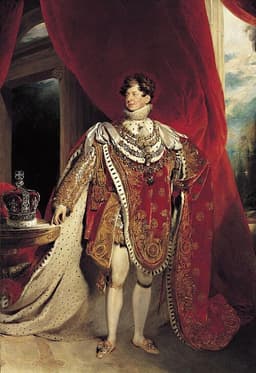
George IV of the United Kingdom
Emperor · Modern
41.1Total

Napoleon Bonaparte
General · Modern
70.9Total
Basic Information
Born
1762
1769
Died
1830
1821
Era
Modern
Modern
Nationality
United Kingdom
France
Occupation
Emperor
General
Civilization
Western
Western
Score Comparison
Military (10%)
27.7
94.0
Political (20%)
27.9
72.0
Influence (20%)
50.2
40.0
Legacy (20%)
37.5
80.0
Leadership (15%)
41.5
78.0
Strategy (15%)
60.0
90.0
TOTAL
41.1
70.9
George IV of the United Kingdom — Complete Timeline
1788 AD
Regency Crisis of 1788Political Action◆ Major
When George III became temporarily insane, the Prince of Wales (future George IV) sought to become regent. The crisis ended when the king recovered, but it established a precedent for parliamentary control over regency.
RegencyCrisisSuccession
Impact: national
1811 AD
Appointed Prince RegentPolitical Action◆ Major
Following George III's final mental collapse, the Prince of Wales was formally appointed Prince Regent under the Regency Act 1811. He exercised royal powers for nine years while his father lived in seclusion.
RegencyGovernmentSuccession
Impact: national
Regency Era Patronage of the ArtsCultural◆ Major
As Prince Regent, George IV commissioned John Nash to design Regent Street, Regent's Park, and the Royal Pavilion in Brighton. His patronage defined the architectural and cultural style of the Regency period.
ArchitecturePatronageRegency
Impact: nationalconstructive
1820 AD
Accession as King George IVPolitical Action◆ Major
Upon George III's death, the Prince Regent became King George IV. His accession was marred by his attempt to divorce Queen Caroline, leading to a public scandal and the Pains and Penalties Bill of 1820.
AccessionScandalDivorce
Impact: national
1821 AD
State Visit to IrelandPolitical Action
George IV became the first British monarch to visit Ireland since the Acts of Union. The visit aimed to promote loyalty but was overshadowed by the ongoing Catholic Emancipation debate.
VisitIrelandUnion
Impact: national
1829 AD
Catholic Emancipation OppositionPolitical Action◆ Major
George IV reluctantly signed the Roman Catholic Relief Act 1829, granting Catholic Emancipation. He had opposed the measure but yielded to Prime Minister Wellington's threat of resignation.
Catholic EmancipationLegislationReligion
Impact: national
Napoleon Bonaparte — Complete Timeline
1799 AD
Coup of 18 BrumaireOther◆ Major
Napoleon Bonaparte, with support from his brother Lucien and key political figures, overthrew the Directory in a bloodless coup. He established the Consulate with himself as First Consul, effectively becoming the ruler of France. This event ended the French Revolution's most unstable period.
French RevolutionCoupRise to Power
Impact: regional
1804 AD
Promulgation of the Napoleonic CodeOther◆ Major
Napoleon enacted the Civil Code of the French, known as the Napoleonic Code, a comprehensive set of laws that replaced the fragmented feudal legal systems. The code established legal equality, protected property rights, and secularized law. It became the basis for legal systems in many European and world countries.
Legal ReformNapoleonic CodeCivil Law
Impact: globalconstructive
1805 AD
Battle of AusterlitzWar◆ Major
Napoleon's Grande Arm
Napoleonic WarsBattleDecisive Victory
Impact: global
1812 AD
Invasion of RussiaWar◆ Major
Napoleon led the Grande Arm
Napoleonic WarsInvasionDisaster
Impact: globaldestructive
1815 AD
Battle of WaterlooWar◆ Major
Napoleon's French army was defeated by the combined forces of the Duke of Wellington's Anglo-Allied army and Gebhard Leberecht von Bl
Napoleonic WarsBattleFinal Defeat
Impact: globaldestructive
Expert Analysis
george-iv-of-the-united-kingdom-vs-napoleon-bonaparte
### The Emperor and the Dandy: Napoleon and George IV in an Age of Upheaval
In the winter of 1814, as the snow fell on a defeated Paris, a very different kind of sovereign sat safe in his London palace. Napoleon Bonaparte, the man who had terrified every throne in Europe, was about to abdicate. Across the Channel, the Prince Regent—soon to be King George IV—was commissioning another lavish party, spending fortunes on Chinese wallpaper and seashell grottoes at the Brighton Pavilion. One man had conquered a continent; the other could barely conquer his own debts. How could two contemporaries, both born into the same modern Western world, diverge so utterly—one becoming the titan of an age, the other its most extravagant footnote?
**Origins**
Napoleon was born in 1769 on Corsica, an island only recently sold to France by Genoa. His family were minor nobility, but they were poor, proud, and deeply resentful of French rule. This outsider’s edge—a sense of being both French and not French—forged a restless ambition. He entered a military academy at nine, mocked for his accent and small stature. The humiliation hardened him. He read voraciously: history, artillery manuals, the lives of Caesar and Alexander. By 1785, at just sixteen, he was a second lieutenant.
George IV arrived in 1762 into the gilded cage of the British monarchy. His father, George III, was a dutiful, frugal king; his mother, Queen Charlotte, was stern. Young George was handsome, charming, and gifted—but the royal court suffocated him. He was forbidden from serious political involvement. His education was broad but shallow, designed to produce a constitutional figurehead, not a commander. While Napoleon memorized the battlefields of Italy, George memorized the latest fashions from Paris. One learned how to command men; the other learned how to command a tailor.
**Rise to Power**
Napoleon’s ascent was a masterpiece of opportunity seized. The French Revolution had shattered the old order. In 1793, at the siege of Toulon, the twenty-four-year-old artillery officer devised a plan that drove the British fleet from the harbor. Promotions came fast. In 1795, he saved the revolutionary government from a royalist mob with a "whiff of grapeshot." By 1796, he was commanding the Army of Italy. His lightning campaign—crossing the Alps, outmaneuvering Austrian generals, winning battle after battle—made him a national hero. In 1799, he returned from Egypt to find the Directory weak. He staged a coup, became First Consul, and by 1804 crowned himself Emperor.
George IV’s path was far slower and more frustrating. For decades, he was merely the Prince of Wales, waiting for his father to die. His political influence was limited. In 1788, when George III went temporarily insane, the Regency Crisis erupted. The prince wanted full power; Parliament offered him a constrained regency. The king recovered before a decision was made, and George was humiliated. He spent these years building a private world of pleasure—gambling, drinking, and a secret, illegal marriage to a Catholic widow, Maria Fitzherbert. When the king finally became permanently mad in 1811, George was appointed Prince Regent. He was forty-nine, overweight, and deeply unpopular. His "rise" was not conquest but inheritance—and a bitter one at that.
**Leadership & Governance**
Napoleon governed like a force of nature. He centralized the state, created the Bank of France, and, most famously, codified French law into the Napoleonic Code—a system that enshrined equality before the law, property rights, and secular authority. It spread across Europe. Militarily, he was a genius: his speed, his use of artillery, his ability to divide and conquer. At Austerlitz in 1805, he destroyed a larger Russian-Austrian army in a single day. He appointed officials based on merit, not birth. Yet his rule became a dictatorship. He suppressed dissent, censored the press, and placed his brothers on thrones. His ambition knew no limits.
George IV governed as a constitutional monarch, which meant he mostly watched. His political influence was real but subtle. He opposed Catholic Emancipation for years, but in 1829, he was forced to sign the Roman Catholic Relief Act. He wept as he did so. His patronage of the arts was his true achievement: he commissioned John Nash to design Regent Street, Regent’s Park, and the fantastical Royal Pavilion in Brighton—a fusion of Indian domes and Chinese interiors that still bewilders visitors. But his personal governance was a shambles. He was deeply in debt, estranged from his wife, Queen Caroline, and spent his reign trying to divorce her in a scandalous trial that horrified the public.
**Triumph & Tragedy**
Napoleon’s greatest moment came on a frozen battlefield. At Austerlitz, in December 1805, he watched the sun rise over the Pratzen Heights and said to his men: "Soldiers, I will direct your battalions in person. I shall keep out of danger if your bravery does not expose me." He crushed the coalition. His tragedy was a mirror: the invasion of Russia in 1812. He marched 600,000 men into the vast, frozen emptiness. By the time he limped back, barely 100,000 survived. His empire crumbled. He was exiled to Elba, escaped, raised another army—and at Waterloo in 1815, he met the Duke of Wellington. It was a near thing, but Napoleon lost. He spent his last six years on the remote island of Saint Helena, dictating memoirs and dying slowly of stomach cancer.
George IV’s triumph was more modest: his 1821 state visit to Ireland. He became the first British monarch to visit since the Acts of Union. He wore a shamrock, spoke warmly, and was greeted with surprising enthusiasm. It was a rare moment of public affection. His tragedy was personal and relentless: his disastrous marriage to Caroline of Brunswick. They loathed each other on sight. He tried to divorce her, but the trial in the House of Lords became a national soap opera. The public sided with Caroline. When she died just weeks after his coronation, the relief was palpable—but so was the damage to his reputation.
**Character & Destiny**
Napoleon was a man of iron will and boundless self-belief. He once said, "Impossible is a word to be found only in the dictionary of fools." His ambition was not just for power but for order—his order. He believed he could reshape Europe, and for a decade, he nearly did. But his pride was his flaw. He could not stop. He could not compromise. He invaded Russia because he could not bear to leave an enemy undefeated. That single decision destroyed him.
George IV was a man of taste, not will. He loved art, architecture, and pleasure. He was witty, generous to friends, and genuinely cultured. But he was also lazy, selfish, and cowardly. He avoided political confrontation. He let his ministers govern. His destiny was not to change the world but to decorate it. The Regency Era—the period of his regency—is remembered for Jane Austen’s novels, John Nash’s buildings, and the elegance of its fashion. George IV was its symbol, not its engine.
**Legacy**
Napoleon left a continent remade. The Napoleonic Code still underpins the legal systems of France, Italy, Germany, and beyond. He ended feudalism in Europe, spread nationalism, and inspired generations of revolutionaries. He is remembered as both a liberator and a tyrant. His tomb at Les Invalides in Paris is a pilgrimage site. His name is synonymous with ambition, genius, and ultimate defeat.
George IV left a different kind of legacy: the Royal Pavilion, Regent Street, and a reputation for excess. He is often ranked among Britain’s worst monarchs—extravagant, scandalous, and ineffective. Yet he also presided over a golden age of British culture. The Regency period is remembered for its elegance, its literature, its architecture. George IV did not create it, but he paid for it. He was, in the end, a patron, not a ruler.
**Conclusion**
Standing side by side in history, Napoleon and George IV seem almost like characters from different species. One was a storm; the other, a still life. Their differences were not accidents of birth but products of opportunity and character. Napoleon had a world to conquer; George IV had a kingdom to inherit. Napoleon chose to fight; George IV chose to enjoy. One shaped the destiny of millions; the other shaped the taste of a decade. And yet, both were prisoners of their own natures—one of his ambition, the other of his indolence. Perhaps that is the deepest lesson: that history rewards the relentless, but it also remembers the extravagant. And both, in their own ways, are unforgettable.
Rankings
🥇
Napoleon BonaparteLeader
Mil: 94.0Pol: 72.0Inf: 40.0
70.9
🥈
George IV of the United Kingdom
Mil: 27.7Pol: 27.9Inf: 50.2
41.1
+29.8 behind
How This Comparison Works
Algorithm
Each figure is scored on 6 dimensions (0—100 scale) based on structured historical data: Military (10%), Political (20%), Influence (20%), Legacy (20%), Leadership (15%), Strategy (15%). The weighted total produces the final ranking.
Data Sources
Scores are computed from structured sub-indicators in the database. Scale factors adjust for era (Ancient ×0.85, Modern ×1.0) and civilization size (Eastern ×1.05, Other ×0.80) to account for differences in population and military scale.
Maximum 3 Figures
Comparisons are limited to 2—3 figures to ensure readability and statistical meaningfulness.
Error Margins
±5 points per dimension — Sub-scores are derived from historical records with inherent uncertainty. Two figures within 5 points on a dimension should be considered roughly equivalent in that area.
Total Score Accuracy
±3 points overall — The weighted combination of 6 dimensions produces a total score with approximately ±3 points of uncertainty. Differences of less than 3 points are not statistically significant— the figures are effectively tied.
Known Limitations
- Historical records are incomplete and uneven across civilizations
- Figures from oral-tradition societies may be underrepresented
- Occupation labels can misclassify multi-role figures
- Scores measure capability and impact, not moral character
- Quantitative scoring is a comparison tool, not absolute truth
Capability Radar
Military (10%) — Battles & Warfare
Battles
35
95
Win Rate
38
90
Expansion
41
95
Political (20%) — Governance & Reform
Reform
5
95
Diplomacy
15
80
Economy
10
85
Influence (20%) — Cultural & Global Reach
Cultural
30
85
Global
10
90
Legacy (20%) — Historical Impact
Historical
20
95
Longevity
15
90
Leadership (15%) — Power & Stability
Tenure
10
85
Stability
20
70
Strategy (15%) — Tactics & Innovation
Strategy
43
95
Tactics
50
98
Reform
49
92
Similar Comparisons
Comments & Discussion
Historian5436/17/2026
Napoleon was a conqueror who changed Europe's map; George IV was a glutton who changed London's party scene. One died in exile, the other with "the finest collection of snuffboxes in Europe." Simple fact: Napoleon overhauled civil law with the Code while George blew £250,000 on a single coronation banquet. The man of action versus the man of appetite. No contest.