Loading...
Habib Bourguiba vs James A. Garfield
Habib Bourguiba leads by 23.6 pts · 2 figures compared
…
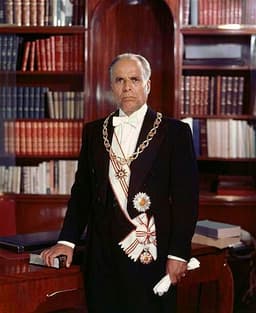
Habib Bourguiba
Politician · Modern
64.4Total

James A. Garfield
Politician · Modern
40.8Total
Basic Information
Born
1903
1831
Died
2000
1881
Era
Modern
Modern
Nationality
Tunisia
United States
Occupation
Politician
Politician
Civilization
Middle Eastern
Western
Score Comparison
Military (10%)
39.9
39.9
Political (20%)
82.0
32.2
Influence (20%)
68.0
47.9
Legacy (20%)
55.0
38.3
Leadership (15%)
80.0
33.6
Strategy (15%)
53.8
53.8
TOTAL
64.4
40.8
Habib Bourguiba — Complete Timeline
1956 AD
Code of Personal StatusReform◆ Major
Bourguiba enacted the Code of Personal Status, a progressive family law that abolished polygamy, established legal minimum age for marriage, and granted women rights to divorce and custody. This reform was unprecedented in the Arab world and modernized Tunisian society.
Women's RightsLegal ReformSocial Change
Impact: nationalprogressive
Tunisian IndependencePolitical Action
Habib Bourguiba led Tunisia to independence from France through a combination of political negotiation and nationalist pressure. He became the first Prime Minister of independent Tunisia, ending 75 years of French protectorate rule.
IndependenceDecolonizationNationalism
Impact: nationalconstructive
1957 AD
Proclamation of the RepublicPolitical Action◆ Major
Bourguiba abolished the Tunisian monarchy and proclaimed the Republic of Tunisia, with himself as President. This move consolidated his power and established a presidential system that would dominate Tunisian politics for decades.
RepublicConstitutional ChangePresidency
Impact: national
1961 AD
Bizerte CrisisWar◆ Major
Bourguiba demanded the evacuation of the French naval base at Bizerte. When negotiations failed, Tunisian forces blockaded the base, leading to a violent confrontation with French troops. The crisis resulted in hundreds of Tunisian casualties and strained Franco-Tunisian relations.
ConflictDecolonizationBizerte
Impact: regionaltragic
1987 AD
Removal from PowerPolitical Action◆ Major
Prime Minister Zine El Abidine Ben Ali removed Bourguiba from office in a bloodless coup, citing his failing health and inability to govern. Bourguiba was placed under house arrest, ending his 30-year presidency and his role as Tunisia's founding father.
CoupSuccessionBen Ali
Impact: nationaltragic
James A. Garfield — Complete Timeline
1880 AD
Election as President of the United StatesPolitical Action◆ Major
Garfield won the 1880 presidential election as a Republican, defeating Democrat Winfield Scott Hancock. The election was closely contested, with Garfield winning the popular vote by a narrow margin but securing a comfortable Electoral College victory.
Presidential ElectionRepublican Party
Impact: national
Advocacy for Civil Rights and EducationPolitical Action
During his brief presidency, Garfield advocated for African American civil rights and federal support for education. He appointed several African Americans to federal positions and supported the Blair Education Bill, which aimed to provide federal aid to public schools.
Civil RightsEducation Policy
Impact: nationalprogressive
1881 AD
Assassination by Charles GuiteauPolitical Action
Garfield was shot by Charles Guiteau, a disgruntled office-seeker, at the Baltimore and Potomac Railroad Station in Washington, D.C. He died from complications of his wounds on September 19, 1881, after serving only 200 days in office.
AssassinationPresidential Death
Impact: nationaltragic
Expert Analysis
Origins
Habib Bourguiba was born on August 3, 1903, in Monastir, Tunisia, into a modest family. His father, a former army officer, died when Bourguiba was young. He studied at the Sadiki College in Tunis and later at the University of Paris, where he earned a law degree. His exposure to French political thought and nationalist movements shaped his early activism. Bourguiba joined the Destour party but soon broke away to form the Neo Destour party in 1934, advocating for a more pragmatic approach to independence.
James Abram Garfield was born on November 19, 1831, in a log cabin in Orange, Ohio, the youngest of five children. His father died when he was 18 months old. Garfield worked as a canal boat driver to fund his education, attending the Western Reserve Eclectic Institute (now Hiram College) and later Williams College, graduating in 1856. He became a teacher, then a lawyer, and entered politics as a Republican. His humble beginnings and self-made education defined his character.
Rise to Power
Bourguiba's rise was marked by relentless activism and strategic negotiation. He was imprisoned multiple times by French authorities for his nationalist activities. In 1938, he was arrested and exiled to France, then to Egypt. After World War II, he returned to Tunisia and intensified demands for autonomy. The turning point came in 1954 when French Prime Minister Pierre Mendès France initiated negotiations, leading to internal autonomy in 1955 and full independence on March 20, 1956. Bourguiba became Prime Minister and later proclaimed the republic on July 25, 1957, becoming its first President. His political score of 82.0 reflects his masterful navigation of colonial politics.
Garfield's rise was more conventional. He served as a major general in the Union Army during the Civil War, earning a reputation at the Battle of Chickamauga. He was elected to the U.S. House of Representatives in 1862, serving nine terms. In 1880, the Republican Party was deadlocked over the presidential nomination; on the 36th ballot, Garfield emerged as a compromise candidate. He won the general election against Democrat Winfield Scott Hancock by a slim popular vote margin (48.3% to 48.2%). His political score of 32.2 indicates a less dominant political career.
Leadership & Governance
Bourguiba's leadership was authoritarian but progressive. He centralized power, ruling as president for life from 1975. His signature reform was the Code of Personal Status (1956), which abolished polygamy, established a minimum marriage age (18 for women, 20 for men), and granted women the right to divorce. This was revolutionary for the Arab world. He also promoted secular education and state-led modernization. However, his governance suppressed political dissent, with a single-party state and limited freedoms. His leadership score of 80.0 reflects his decisive but controversial rule.
Garfield's presidency lasted only 200 days, from March to September 1881. His governance was cut short, but he advocated for civil rights and education. He appointed several African Americans to federal positions, including Frederick Douglass as Recorder of Deeds. He also pushed for federal aid to education. Garfield's leadership score of 33.6 reflects his unfulfilled potential. He died before implementing major policies, so his governance is judged on intentions rather than achievements.
Triumph & Tragedy
Bourguiba's greatest triumph was achieving Tunisian independence without a protracted war, unlike Algeria. The Code of Personal Status remains a lasting legacy for women's rights. However, his tragedy was his declining health and eventual removal by Prime Minister Zine El Abidine Ben Ali in 1987. His later years saw economic stagnation and political repression, tarnishing his earlier achievements. The Bizerte Crisis in 1961, where Tunisian forces blockaded a French base, resulted in over 600 Tunisian deaths and damaged relations with France.
Garfield's triumph was his election itself, overcoming party divisions. He also exposed the corrupt patronage system that would later lead to the Pendleton Civil Service Reform Act. His tragedy was his assassination by Charles Guiteau, a deranged office-seeker, on July 2, 1881. Garfield died on September 19 from infections caused by poor medical care. His death highlighted the need for civil service reform but cut short any substantive policy impact.
Character & Destiny
Bourguiba was charismatic, pragmatic, and stubborn. He was known as 'the Supreme Warrior' for his relentless drive. His character combined French rationalism with Tunisian nationalism, allowing him to negotiate with colonial powers while maintaining popular support. However, his authoritarian tendencies and refusal to groom a successor led to his downfall. Historical assessments note his vision but criticize his later despotism.
Garfield was intelligent, principled, and a gifted orator. He was one of the few self-made men to reach the presidency. His character was marked by integrity and a commitment to education. His destiny was tragically cut short by an assassin's bullet. Historians often ponder what he might have achieved, but his brief tenure limits his impact.
Legacy
Bourguiba's legacy is profound in Tunisia and the Arab world. The Code of Personal Status remains a model for women's rights. He established a secular state that avoided the religious extremism seen elsewhere. However, his authoritarianism set a precedent for Ben Ali's dictatorship. His influence score of 68.0 and legacy score of 55.0 reflect his mixed but significant impact.
Garfield's legacy is mostly symbolic. The Pendleton Act, passed in 1883, was a direct response to his assassination, reforming the civil service. His advocacy for civil rights and education influenced later policies. His influence score of 47.9 and legacy score of 38.3 indicate a limited but notable impact, primarily through his death rather than his life.
Conclusion
Habib Bourguiba had a greater impact than James Garfield. Bourguiba scored 64.4 overall compared to Garfield's 40.8. Bourguiba founded a nation, enacted transformative social reforms, and shaped Tunisia's identity for decades. Garfield's assassination spurred reform, but his actual governance was minimal. In terms of political achievement and lasting change, Bourguiba's influence far outweighs Garfield's. The score gap of 23.6 points reflects this disparity.
Rankings
🥇
Habib BourguibaLeader
Mil: 39.9Pol: 82.0Inf: 68.0
64.4
🥈
James A. Garfield
Mil: 39.9Pol: 32.2Inf: 47.9
40.8
+23.6 behind
How This Comparison Works
Algorithm
Each figure is scored on 6 dimensions (0—100 scale) based on structured historical data: Military (10%), Political (20%), Influence (20%), Legacy (20%), Leadership (15%), Strategy (15%). The weighted total produces the final ranking.
Data Sources
Scores are computed from structured sub-indicators in the database. Scale factors adjust for era (Ancient ×0.85, Modern ×1.0) and civilization size (Eastern ×1.05, Other ×0.80) to account for differences in population and military scale.
Maximum 3 Figures
Comparisons are limited to 2—3 figures to ensure readability and statistical meaningfulness.
Error Margins
±5 points per dimension — Sub-scores are derived from historical records with inherent uncertainty. Two figures within 5 points on a dimension should be considered roughly equivalent in that area.
Total Score Accuracy
±3 points overall — The weighted combination of 6 dimensions produces a total score with approximately ±3 points of uncertainty. Differences of less than 3 points are not statistically significant— the figures are effectively tied.
Known Limitations
- Historical records are incomplete and uneven across civilizations
- Figures from oral-tradition societies may be underrepresented
- Occupation labels can misclassify multi-role figures
- Scores measure capability and impact, not moral character
- Quantitative scoring is a comparison tool, not absolute truth
Capability Radar
Military (10%) — Battles & Warfare
Battles
5
10
Win Rate
5
10
Expansion
5
5
Political (20%) — Governance & Reform
Reform
90
20
Diplomacy
85
30
Economy
75
15
Influence (20%) — Cultural & Global Reach
Cultural
70
15
Global
65
10
Legacy (20%) — Historical Impact
Historical
75
20
Longevity
65
10
Leadership (15%) — Power & Stability
Tenure
85
5
Stability
70
5
Strategy (15%) — Tactics & Innovation
Strategy
5
15
Tactics
5
15
Reform
10
5
Similar Comparisons
Comments & Discussion
No comments yet. Be the first to share your thoughts!