Loading...
Harry S. Truman vs Jacob Zuma
Harry S. Truman leads by 17.9 pts · 2 figures compared
…
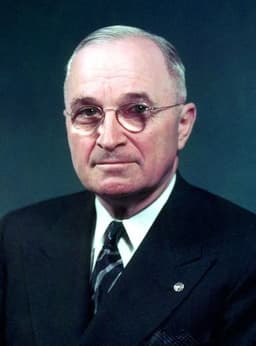
Harry S. Truman
Politician · Modern
63.7Total

Jacob Zuma
Politician · Modern
45.8Total
Basic Information
Born
1884
1942
Died
1972
—
Era
Modern
Modern
Nationality
United States
South Africa
Occupation
Politician
Politician
Civilization
Western
Other
Score Comparison
Military (10%)
30.0
46.6
Political (20%)
55.0
33.6
Influence (20%)
68.0
54.9
Legacy (20%)
72.0
39.2
Leadership (15%)
79.8
55.3
Strategy (15%)
55.0
42.9
TOTAL
63.7
45.8
Harry S. Truman — Complete Timeline
1945 AD
Ordered atomic bombings of Hiroshima and NagasakiWar
Truman authorized the use of atomic bombs against Japan. Hiroshima was bombed on August 6, Nagasaki on August 9. Japan surrendered on August 15, ending World War II. The bombings caused massive civilian casualties and initiated the nuclear age.
World War IINuclear WeaponsJapan
Impact: globaldestructive
1947 AD
Announced the Truman DoctrinePolitical Action◆ Major
Truman declared that the United States would provide political, military, and economic assistance to all democratic nations under threat from authoritarian forces. This policy was first applied to Greece and Turkey, marking the start of the Cold War containment strategy.
Cold WarContainmentForeign Policy
Impact: globalconstructive
1948 AD
Desegregated the U.S. armed forcesReform◆ Major
Truman issued Executive Order 9981, mandating equality of treatment and opportunity for all persons in the armed services regardless of race. This order began the process of racial integration in the U.S. military, a major step in the civil rights movement.
Civil RightsMilitaryDesegregation
Impact: nationalprogressive
Signed the Marshall Plan into lawPolitical Action◆ Major
Truman signed the Economic Cooperation Act, implementing the Marshall Plan. This program provided over $12 billion in economic aid to rebuild Western European economies after World War II, stabilizing the region and countering Soviet influence.
Cold WarEconomic AidEurope
Impact: globalconstructive
1950 AD
Ordered U.S. intervention in the Korean WarWar◆ Major
After North Korea invaded South Korea, Truman committed U.S. forces under a United Nations mandate. The war lasted until 1953, ended in an armistice, and solidified the division of Korea. It also led to the militarization of the Cold War.
Korean WarCold WarMilitary Intervention
Impact: global
Jacob Zuma — Complete Timeline
2005 AD
Charged with corruption in the Arms DealPolitical Action◆ Major
Jacob Zuma was charged with corruption, fraud, and racketeering related to the multi-billion rand arms deal. His financial advisor Schabir Shaik was convicted, leading to Zuma's dismissal as Deputy President by Thabo Mbeki.
CorruptionArms DealLegal Scandal
Impact: nationaldestructive
Dismissed as Deputy PresidentPolitical Action◆ Major
President Thabo Mbeki dismissed Zuma as Deputy President following the conviction of his financial advisor Schabir Shaik for corruption. This event deepened the rift within the ANC and fueled Zuma's populist support.
DismissalANC SplitCorruption
Impact: nationaldestructive
2009 AD
Elected President of South AfricaPolitical Action◆ Major
Zuma was elected President by the National Assembly after the ANC won the general election. His presidency began amid high expectations but was soon overshadowed by corruption allegations and policy failures.
ElectionPresidencyANC
Impact: national
2017 AD
Survived no-confidence motionPolitical Action
Zuma survived a motion of no confidence in the National Assembly, with 198 votes against and 177 in favor. The vote was held by secret ballot, and several ANC MPs voted against him, reflecting growing discontent.
No-confidenceParliamentPolitical Crisis
Impact: national
2018 AD
Resigned as PresidentPolitical Action◆ Major
Facing mounting pressure from the ANC and public protests, Zuma resigned as President of South Africa. His resignation followed a deadline set by the ANC and ended his nine-year tenure marked by corruption scandals.
ResignationEnd of PresidencyANC
Impact: nationaldestructive
2021 AD
Arrested and sentenced for contempt of courtPolitical Action◆ Major
Zuma was arrested for failing to appear before the State Capture Inquiry, leading to a 15-month prison sentence for contempt of court. His arrest sparked widespread protests and looting in KwaZulu-Natal and Gauteng.
ArrestContempt of CourtState Capture
Impact: nationaldestructive
Expert Analysis
Origins
Harry S. Truman was born on May 8, 1884, in Lamar, Missouri, into a farming family. He did not attend college, instead working various jobs before entering politics. His early career included service as a judge in Jackson County and later as a U.S. Senator from Missouri.
Jacob Zuma was born on April 12, 1942, in Nkandla, South Africa. He grew up in poverty and received little formal education. He became involved in the anti-apartheid movement early, joining the African National Congress (ANC) in 1959 and its armed wing, Umkhonto we Sizwe, in 1962.
Rise to Power
Truman rose to national prominence when he was selected as Franklin D. Roosevelt's running mate in 1944. He became President on April 12, 1945, upon Roosevelt's death, inheriting a world war and the decision to use atomic weapons.
Zuma rose through the ranks of the ANC, becoming head of intelligence during the exile period. After the end of apartheid, he held various government positions, including Deputy President from 1999 to 2005. He was elected President of South Africa in 2009, succeeding Thabo Mbeki.
Leadership & Governance
Truman's leadership style was decisive and direct. He made the controversial decision to drop atomic bombs on Hiroshima and Nagasaki in August 1945, ending World War II. He then implemented the Truman Doctrine (1947) to contain communism, the Marshall Plan (1948) to rebuild Europe, and ordered U.S. intervention in the Korean War (1950). Domestically, he desegregated the armed forces via Executive Order 9981 (1948).
Zuma's leadership was marked by a lack of accountability and rampant corruption. His term saw the Gupta family influence state decisions, leading to what was termed "state capture." The economy stagnated, and unemployment rose. His governance score of 33.6 reflects the ineffective and corrupt administration.
Triumph & Tragedy
Truman's triumphs include ending WWII with minimal American casualties, establishing the post-war international order, and advancing civil rights. His tragedies include the human cost of the atomic bombings (estimated 200,000 deaths by end of 1945) and the Korean War stalemate, which cost over 36,000 American lives.
Zuma's triumphs are limited: he oversaw the 2010 FIFA World Cup in South Africa, which boosted national pride. His tragedies are numerous: corruption charges, the Arms Deal scandal, a failed economy, and his arrest in 2021 for contempt of court, leading to a 15-month prison sentence.
Character & Destiny
Truman was known for his plain-speaking, integrity, and willingness to take responsibility. He famously kept a "The Buck Stops Here" sign on his desk. His character led him to make tough decisions that shaped the Cold War.
Zuma was charismatic but secretive and resistant to accountability. His personal life was controversial with multiple wives and children. His character led to a presidency defined by scandal, ending in resignation and imprisonment.
Legacy
Truman's legacy is substantial: he laid the foundations for American Cold War policy, desegregated the military, and supported Israel's creation. His total score of 63.7 reflects his enduring impact on global politics.
Zuma's legacy is overwhelmingly negative: he damaged South Africa's institutions, eroded the rule of law, and left the economy in decline. His total score of 45.8 is among the lowest for modern leaders.
Conclusion
Harry Truman had a significantly greater impact on world history than Jacob Zuma. Truman's decisions shaped the post-war world, while Zuma's tenure weakened a nation. The 17.9-point score gap underscores Truman's superior leadership and legacy. Truman ranks as a transformative figure; Zuma ranks as a cautionary tale.
Rankings
🥇
Harry S. TrumanLeader
Mil: 30.0Pol: 55.0Inf: 68.0
63.7
🥈
Jacob Zuma
Mil: 46.6Pol: 33.6Inf: 54.9
45.8
+17.9 behind
How This Comparison Works
Algorithm
Each figure is scored on 6 dimensions (0—100 scale) based on structured historical data: Military (10%), Political (20%), Influence (20%), Legacy (20%), Leadership (15%), Strategy (15%). The weighted total produces the final ranking.
Data Sources
Scores are computed from structured sub-indicators in the database. Scale factors adjust for era (Ancient ×0.85, Modern ×1.0) and civilization size (Eastern ×1.05, Other ×0.80) to account for differences in population and military scale.
Maximum 3 Figures
Comparisons are limited to 2—3 figures to ensure readability and statistical meaningfulness.
Error Margins
±5 points per dimension — Sub-scores are derived from historical records with inherent uncertainty. Two figures within 5 points on a dimension should be considered roughly equivalent in that area.
Total Score Accuracy
±3 points overall — The weighted combination of 6 dimensions produces a total score with approximately ±3 points of uncertainty. Differences of less than 3 points are not statistically significant— the figures are effectively tied.
Known Limitations
- Historical records are incomplete and uneven across civilizations
- Figures from oral-tradition societies may be underrepresented
- Occupation labels can misclassify multi-role figures
- Scores measure capability and impact, not moral character
- Quantitative scoring is a comparison tool, not absolute truth
Capability Radar
Military (10%) — Battles & Warfare
Battles
0
20
Win Rate
0
26
Expansion
0
28
Political (20%) — Governance & Reform
Reform
65
15
Diplomacy
75
30
Economy
60
10
Influence (20%) — Cultural & Global Reach
Cultural
55
20
Global
80
20
Legacy (20%) — Historical Impact
Historical
80
15
Longevity
70
10
Leadership (15%) — Power & Stability
Tenure
70
45
Stability
60
5
Strategy (15%) — Tactics & Innovation
Strategy
70
30
Tactics
0
34
Reform
60
37
Similar Comparisons
Comments & Discussion
No comments yet. Be the first to share your thoughts!