Loading...
Hugo Chavez vs Robert Peel
Robert Peel leads by 15.1 pts · 2 figures compared
…
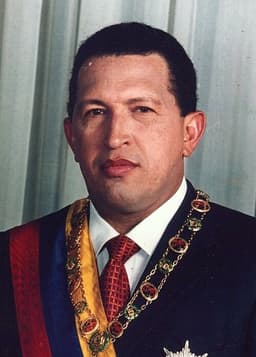
Hugo Chavez
Politician · Modern
50.9Total

Robert Peel
Politician · Modern
66.0Total
Basic Information
Born
1954
1788
Died
—
1850
Era
Modern
Modern
Nationality
Venezuela
United Kingdom
Occupation
Politician
Politician
Civilization
Western
Western
Score Comparison
Military (10%)
10.0
50.0
Political (20%)
62.7
85.0
Influence (20%)
56.7
72.0
Legacy (20%)
49.2
55.0
Leadership (15%)
68.0
82.0
Strategy (15%)
38.3
42.4
TOTAL
50.9
66.0
Hugo Chavez — Complete Timeline
1992 AD
Failed 1992 coup attemptPolitical Action◆ Major
Chávez, then a lieutenant colonel, led a failed military coup against President Carlos Andrés Pérez. The coup was crushed, and Chávez was imprisoned. His televised speech accepting responsibility made him a national figure and martyr for the poor.
CoupImprisonmentPolitical Rise
Impact: national
1998 AD
Election as President of VenezuelaPolitical Action
Chávez won the presidential election with 56% of the vote, running on a platform of anti-corruption and social justice. His victory marked the beginning of the Bolivarian Revolution, a leftist movement aimed at transforming Venezuela's political and economic system.
ElectionBolivarian RevolutionPopulism
Impact: nationalconstructive
2001 AD
Nationalization of oil industryReform◆ Major
Chávez enacted a new Hydrocarbons Law that increased state control over the oil industry, raising royalties and taxes on foreign companies. He also reasserted control over PDVSA, the state oil company, using oil revenues to fund social programs.
NationalizationOilEconomic Policy
Impact: nationalconstructive
2002 AD
2002 coup attempt and return to powerPolitical Action◆ Major
Chávez was briefly overthrown in a coup led by business and military sectors, but was restored to power after 47 hours due to mass protests and loyalist military units. The coup attempt deepened political polarization in Venezuela.
CoupPolitical CrisisReturn
Impact: national
2004 AD
Creation of the Bolivarian Alliance for the Americas (ALBA)Political Action◆ Major
Chávez founded ALBA as an alternative to the Free Trade Area of the Americas, promoting regional integration based on solidarity, barter, and social welfare. The alliance included Cuba, Bolivia, and other leftist governments in Latin America.
Regional IntegrationSocialismAnti-imperialism
Impact: regionalconstructive
Robert Peel — Complete Timeline
1829 AD
Founded Metropolitan PoliceReform
As Home Secretary, Peel established the Metropolitan Police Act in 1829, creating the first modern professional police force in London. Officers became known as 'bobbies' or 'peelers' after him. This model was later adopted across Britain and influenced policing worldwide.
PoliceLaw EnforcementReform
Impact: globalconstructive
Catholic Emancipation ActReform◆ Major
Peel, despite earlier opposition, supported the Catholic Relief Act 1829, which removed most restrictions on Catholics in the UK. This allowed Catholics to sit in Parliament and hold public office. The act was passed to avoid civil war in Ireland.
Catholic RightsReligious FreedomIreland
Impact: nationalprogressive
1834 AD
Tamworth ManifestoPolitical Action
Peel issued the Tamworth Manifesto in December 1834, outlining the principles of the new Conservative Party. It accepted the Reform Act of 1832 and advocated for moderate reform, establishing the modern Conservative Party's platform and defining 'One Nation' conservatism.
Conservative PartyPolitical ManifestoReform
Impact: nationalconstructive
1842 AD
Mines Act 1842Reform
Peel's government passed the Mines Act 1842, which prohibited women and girls from working underground in coal mines and set a minimum age of 10 for boys. This was a significant labor reform, improving working conditions in the mining industry.
Labor ReformMiningChild Labor
Impact: nationalprogressive
1846 AD
Repeal of the Corn LawsReform
Peel, as Prime Minister, repealed the Corn Laws in June 1846, ending tariffs on imported grain. This split the Conservative Party, as many protectionists opposed free trade. Peel's government fell immediately after, but the repeal lowered food prices and shaped British economic policy.
Free TradeCorn LawsEconomic Policy
Impact: nationalconstructive
Expert Analysis
Origins
Hugo Rafael Chávez Frías was born on July 28, 1954, in Sabaneta, Barinas, Venezuela, into a poor family of schoolteachers. He attended the Venezuelan Academy of Military Sciences, graduating in 1975 as a second lieutenant. His early life was marked by exposure to poverty and inequality, which shaped his later political ideology.
Robert Peel was born on February 5, 1788, in Bury, Lancashire, England, into a wealthy industrialist family. His father, Sir Robert Peel, 1st Baronet, was a cotton manufacturer and Member of Parliament. Peel studied at Harrow and Christ Church, Oxford, graduating with a double first in classics and mathematics. He entered Parliament in 1809 at age 21.
Rise to Power
Chávez rose to prominence through a failed coup attempt on February 4, 1992, when he led a military uprising against President Carlos Andrés Pérez. The coup was crushed, and Chávez was imprisoned for two years. After his release, he founded the Fifth Republic Movement and ran for president in 1998, winning with 56% of the vote. His electoral victory marked the beginning of the Bolivarian Revolution.
Peel's rise was more conventional: he became Chief Secretary for Ireland in 1812 at age 24, then Home Secretary in 1822. He established the Metropolitan Police in 1829, earning the nickname "Father of Modern Policing." In 1834, he issued the Tamworth Manifesto, founding the modern Conservative Party. He became Prime Minister briefly in 1834-35 and again from 1841 to 1846.
Leadership & Governance
Chávez centralized power, nationalized key industries (oil, telecommunications, electricity), and expanded social programs. His score of 68.0 in leadership reflects his ability to connect with the masses, but his governance was authoritarian: he weakened democratic institutions, controlled the judiciary, and suppressed opposition media. His economic policies led to inflation and shortages.
Peel, with a leadership score of 82.0, was a pragmatic reformer. As Home Secretary, he professionalized policing. As Prime Minister, he repealed the Corn Laws in 1846, a free trade measure that split his party but benefited consumers. He also passed the Mines Act 1842, banning women and children from underground work. His governance was marked by responsiveness to social issues and economic liberalism.
Triumph & Tragedy
Chávez's greatest success was reducing poverty and illiteracy through social missions (Misiones), using oil revenues. His 2002 return to power after a coup attempt demonstrated his resilience. However, his failures include economic mismanagement (inflation, currency devaluation) and increased authoritarianism. His political score of 62.7 reflects mixed results.
Peel's triumph was the repeal of the Corn Laws, which lowered food prices and advanced free trade. He also passed Catholic Emancipation in 1829, despite earlier opposition. His tragedy was the split of the Conservative Party over the Corn Laws, ending his premiership. His political score of 85.0 indicates high effectiveness.
Character & Destiny
Chávez was charismatic, confrontational, and anti-imperialist. His personality shaped his destiny: his polarizing style alienated many, leading to the 2002 coup attempt. His strategy score of 38.3 suggests poor long-term planning. He remained in power until his death in 2013.
Peel was cautious, pragmatic, and principled. He changed his stance on Catholic Emancipation and the Corn Laws based on circumstances, earning accusations of inconsistency but also effectiveness. His strategy score of 42.4 indicates moderate strategic thinking. He died after a horse-riding accident in 1850.
Legacy
Chávez's legacy is mixed: he inspired leftist movements across Latin America, but his policies led to economic collapse in Venezuela. His influence score of 56.7 reflects his impact on regional politics. The Bolivarian Alliance for the Americas (ALBA) he founded still exists. However, his legacy score of 49.2 indicates limited enduring positive impact.
Peel's legacy is more lasting: he founded the modern Conservative Party, established the Metropolitan Police (which became a model worldwide), and advanced free trade. His influence score of 72.0 reflects these achievements. His legacy score of 55.0 is moderate but sustained.
Conclusion
Robert Peel had greater impact than Hugo Chavez, with a total score of 66.0 versus 50.9. While Chavez transformed Venezuela temporarily, his policies unraveled after his death. Peel's institutional creations—the Conservative Party and the Metropolitan Police—endured for centuries. Peel's political score of 85.0 against Chavez's 62.7 underscores his effectiveness. Thus, Peel's legacy is more substantial and positive.
Rankings
🥇
Robert PeelLeader
Mil: 50.0Pol: 85.0Inf: 72.0
66.0
🥈
Hugo Chavez
Mil: 10.0Pol: 62.7Inf: 56.7
50.9
+15.1 behind
How This Comparison Works
Algorithm
Each figure is scored on 6 dimensions (0—100 scale) based on structured historical data: Military (10%), Political (20%), Influence (20%), Legacy (20%), Leadership (15%), Strategy (15%). The weighted total produces the final ranking.
Data Sources
Scores are computed from structured sub-indicators in the database. Scale factors adjust for era (Ancient ×0.85, Modern ×1.0) and civilization size (Eastern ×1.05, Other ×0.80) to account for differences in population and military scale.
Maximum 3 Figures
Comparisons are limited to 2—3 figures to ensure readability and statistical meaningfulness.
Error Margins
±5 points per dimension — Sub-scores are derived from historical records with inherent uncertainty. Two figures within 5 points on a dimension should be considered roughly equivalent in that area.
Total Score Accuracy
±3 points overall — The weighted combination of 6 dimensions produces a total score with approximately ±3 points of uncertainty. Differences of less than 3 points are not statistically significant— the figures are effectively tied.
Known Limitations
- Historical records are incomplete and uneven across civilizations
- Figures from oral-tradition societies may be underrepresented
- Occupation labels can misclassify multi-role figures
- Scores measure capability and impact, not moral character
- Quantitative scoring is a comparison tool, not absolute truth
Capability Radar
Military (10%) — Battles & Warfare
Battles
0
26
Win Rate
0
32
Expansion
0
33
Political (20%) — Governance & Reform
Reform
70
85
Diplomacy
60
70
Economy
40
80
Influence (20%) — Cultural & Global Reach
Cultural
60
60
Global
55
65
Legacy (20%) — Historical Impact
Historical
55
75
Longevity
40
70
Leadership (15%) — Power & Stability
Tenure
75
75
Stability
30
70
Strategy (15%) — Tactics & Innovation
Strategy
0
41
Tactics
0
40
Reform
10
41
Similar Comparisons
Comments & Discussion
No comments yet. Be the first to share your thoughts!