Loading...
Hugo Chavez vs Taro Aso
Hugo Chavez leads by 12.6 pts · 2 figures compared
…
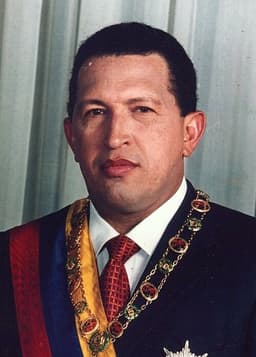
Hugo Chavez
Politician · Modern
50.9Total

Taro Aso
Politician · Modern
38.3Total
Basic Information
Born
1954
1940
Died
—
—
Era
Modern
Modern
Nationality
Venezuela
Japan
Occupation
Politician
Politician
Civilization
Western
Eastern
Score Comparison
Military (10%)
10.0
12.4
Political (20%)
62.7
32.2
Influence (20%)
56.7
48.6
Legacy (20%)
49.2
35.8
Leadership (15%)
68.0
51.9
Strategy (15%)
38.3
33.7
TOTAL
50.9
38.3
Hugo Chavez — Complete Timeline
1992 AD
Failed 1992 coup attemptPolitical Action◆ Major
Chávez, then a lieutenant colonel, led a failed military coup against President Carlos Andrés Pérez. The coup was crushed, and Chávez was imprisoned. His televised speech accepting responsibility made him a national figure and martyr for the poor.
CoupImprisonmentPolitical Rise
Impact: national
1998 AD
Election as President of VenezuelaPolitical Action
Chávez won the presidential election with 56% of the vote, running on a platform of anti-corruption and social justice. His victory marked the beginning of the Bolivarian Revolution, a leftist movement aimed at transforming Venezuela's political and economic system.
ElectionBolivarian RevolutionPopulism
Impact: nationalconstructive
2001 AD
Nationalization of oil industryReform◆ Major
Chávez enacted a new Hydrocarbons Law that increased state control over the oil industry, raising royalties and taxes on foreign companies. He also reasserted control over PDVSA, the state oil company, using oil revenues to fund social programs.
NationalizationOilEconomic Policy
Impact: nationalconstructive
2002 AD
2002 coup attempt and return to powerPolitical Action◆ Major
Chávez was briefly overthrown in a coup led by business and military sectors, but was restored to power after 47 hours due to mass protests and loyalist military units. The coup attempt deepened political polarization in Venezuela.
CoupPolitical CrisisReturn
Impact: national
2004 AD
Creation of the Bolivarian Alliance for the Americas (ALBA)Political Action◆ Major
Chávez founded ALBA as an alternative to the Free Trade Area of the Americas, promoting regional integration based on solidarity, barter, and social welfare. The alliance included Cuba, Bolivia, and other leftist governments in Latin America.
Regional IntegrationSocialismAnti-imperialism
Impact: regionalconstructive
Taro Aso — Complete Timeline
2008 AD
Prime Ministership During Global Financial CrisisPolitical Action◆ Major
Aso became Prime Minister in September 2008 amid the global financial crisis. His government implemented a series of economic stimulus packages, but the recession deepened, and his approval ratings plummeted due to perceived ineffective leadership.
Financial CrisisEconomic PolicyStimulus
Impact: national
2009 AD
Resignation as LDP PresidentPolitical Action◆ Major
Aso resigned as LDP president after the party suffered a historic defeat in the 2009 general election, losing power to the DPJ. The LDP won only 119 seats, its worst result since 1955, ending over 50 years of near-continuous rule.
Election DefeatLDP LossPolitical Change
Impact: nationaldestructive
2012 AD
Finance Minister Under AbePolitical Action◆ Major
Aso served as Deputy Prime Minister and Finance Minister in Shinzo Abe's cabinet from 2012 to 2021. He was a key architect of Abenomics, implementing aggressive monetary easing and fiscal stimulus, and overseeing the consumption tax hike.
AbenomicsEconomic PolicyFinance Minister
Impact: national
2013 AD
Controversial Historical StatementsCultural
Aso made repeated controversial statements about Japan's wartime history, including questioning the fairness of the Tokyo Trials and suggesting Japan should learn from Nazi Germany's constitutional changes. These remarks drew international condemnation.
Historical RevisionismControversyDiplomatic Tensions
Impact: regional
Expert Analysis
Origins
Hugo Chávez (born 1954) grew up in poverty in Sabaneta, Venezuela. He attended the Venezuelan Academy of Military Sciences, graduating in 1975 as a second lieutenant. His early exposure to leftist ideas and the inequality in Venezuela shaped his worldview. Taro Aso (born 1940) was born into a wealthy political family in Fukuoka, Japan. His grandfather was Prime Minister Shigeru Yoshida, and his father was a politician. Aso studied at Gakushuin University and later at Stanford University and the London School of Economics, entering the family business before politics.
Rise to Power
Chávez rose to prominence through a failed coup on February 4, 1992, against President Carlos Andrés Pérez. The coup attempt, though unsuccessful, made him a national figure. After imprisonment and pardon, he won the presidency in 1998 with 56% of the vote, campaigning on anti-corruption and social justice. Aso entered politics in 1979, winning a seat in the House of Representatives. He held various ministerial posts, including Minister of Internal Affairs and Communications, before becoming Prime Minister in September 2008, succeeding Yasuo Fukuda.
Leadership & Governance
Chávez implemented the Bolivarian Revolution, nationalizing key industries, including oil in 2001, and expanding social programs. He used oil wealth to fund health and education missions, but his policies led to inflation and economic decline. His leadership was confrontational, often clashing with the US and business elites. Aso, as Prime Minister during the 2008 global financial crisis, enacted stimulus packages worth 75 trillion yen. However, his approval ratings fell due to perceived ineffectiveness and gaffes. As Finance Minister under Abe (2012-2021), he was a key architect of Abenomics, involving monetary easing, fiscal stimulus, and structural reforms.
Triumph & Tragedy
Chávez's greatest success was reducing poverty from 49% in 1999 to 27% in 2011, and improving access to healthcare and education. His tragedy was the long-term economic collapse, with GDP falling 18% in 2014 and hyperinflation emerging after his death. Aso's triumph was his role in stabilizing Japan's economy during the financial crisis and later as part of Abe's economic team. His tragedy was his brief, unpopular premiership; the LDP lost 64 seats in the 2009 election, leading to his resignation.
Character & Destiny
Chávez was charismatic, impulsive, and authoritarian. His personality drew fierce loyalty and opposition. His decision to centralize power and ignore economic fundamentals led to Venezuela's decline. Aso was known for his bluntness and controversial statements, such as praising Nazi methods in constitutional reform. His gaffes undermined his leadership, but his loyalty to Abe allowed him to remain in power as finance minister for nearly a decade.
Legacy
Chávez's legacy is mixed: he inspired leftist movements across Latin America, but his economic policies left Venezuela in crisis. The Bolivarian Revolution continues under Maduro, but with diminished results. Aso is remembered as a key figure in Japan's economic policy, particularly Abenomics, but his premiership is seen as a failure. His influence on Japan's fiscal policy endured through his tenure as finance minister.
Conclusion
Hugo Chávez had a greater impact on global politics and his nation's trajectory than Taro Aso. Despite Aso's role in Japan's economic policy, Chávez's political score of 62.7 and influence score of 56.7 far exceed Aso's 32.2 and 48.6 respectively. Chávez's legacy, while flawed, reshaped Venezuela and inspired a movement, whereas Aso's impact was more contained within Japan's bureaucratic sphere. Chávez's total score of 50.9 to Aso's 38.3 reflects his broader significance.
Rankings
🥇
Hugo ChavezLeader
Mil: 10.0Pol: 62.7Inf: 56.7
50.9
🥈
Taro Aso
Mil: 12.4Pol: 32.2Inf: 48.6
38.3
+12.6 behind
How This Comparison Works
Algorithm
Each figure is scored on 6 dimensions (0—100 scale) based on structured historical data: Military (10%), Political (20%), Influence (20%), Legacy (20%), Leadership (15%), Strategy (15%). The weighted total produces the final ranking.
Data Sources
Scores are computed from structured sub-indicators in the database. Scale factors adjust for era (Ancient ×0.85, Modern ×1.0) and civilization size (Eastern ×1.05, Other ×0.80) to account for differences in population and military scale.
Maximum 3 Figures
Comparisons are limited to 2—3 figures to ensure readability and statistical meaningfulness.
Error Margins
±5 points per dimension — Sub-scores are derived from historical records with inherent uncertainty. Two figures within 5 points on a dimension should be considered roughly equivalent in that area.
Total Score Accuracy
±3 points overall — The weighted combination of 6 dimensions produces a total score with approximately ±3 points of uncertainty. Differences of less than 3 points are not statistically significant— the figures are effectively tied.
Known Limitations
- Historical records are incomplete and uneven across civilizations
- Figures from oral-tradition societies may be underrepresented
- Occupation labels can misclassify multi-role figures
- Scores measure capability and impact, not moral character
- Quantitative scoring is a comparison tool, not absolute truth
Capability Radar
Military (10%) — Battles & Warfare
Battles
0
17
Win Rate
0
17
Expansion
0
19
Political (20%) — Governance & Reform
Reform
70
20
Diplomacy
60
25
Economy
40
20
Influence (20%) — Cultural & Global Reach
Cultural
60
10
Global
55
10
Legacy (20%) — Historical Impact
Historical
55
10
Longevity
40
5
Leadership (15%) — Power & Stability
Tenure
75
30
Stability
30
15
Strategy (15%) — Tactics & Innovation
Strategy
0
26
Tactics
0
26
Reform
10
27
Similar Comparisons
Comments & Discussion
No comments yet. Be the first to share your thoughts!