Loading...
Ibn Saud vs Napoleon Bonaparte
Napoleon Bonaparte leads by 4.8 pts · 2 figures compared
…
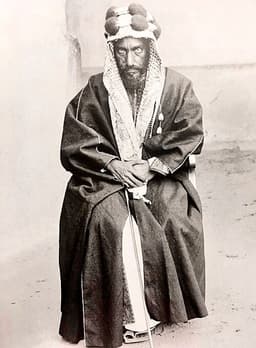
Ibn Saud
Emperor · Modern
66.1Total

Napoleon Bonaparte
General · Modern
70.9Total
Basic Information
Born
1875
1769
Died
1953
1821
Era
Modern
Modern
Nationality
Saudi Arabia
France
Occupation
Emperor
General
Civilization
Middle Eastern
Western
Score Comparison
Military (10%)
78.5
94.0
Political (20%)
85.0
72.0
Influence (20%)
68.0
40.0
Legacy (20%)
40.0
80.0
Leadership (15%)
78.0
78.0
Strategy (15%)
68.1
90.0
TOTAL
66.1
70.9
Ibn Saud — Complete Timeline
1902 AD
Capture of RiyadhWar
Ibn Saud led a small force of 40 men in a daring night raid to recapture Riyadh from the Al Rashid clan. This victory re-established the House of Saud in the Najd region and marked the beginning of his campaign to unify Arabia.
ConquestUnificationRaid
Impact: regional
1929 AD
Battle of SabillaWar◆ Major
Ibn Saud's forces defeated the Ikhwan rebels at the Battle of Sabilla, ending the Ikhwan uprising. This battle solidified his control over the Arabian Peninsula and allowed him to consolidate power under a centralized state.
Civil WarRebellionConsolidation
Impact: regionaldestructive
1932 AD
Proclamation of the Kingdom of Saudi ArabiaPolitical Action
Ibn Saud formally unified the regions of Najd, Hejaz, and other territories into the Kingdom of Saudi Arabia. He declared himself king, establishing a hereditary monarchy that has ruled the country ever since.
State FormationUnificationMonarchy
Impact: globalconstructive
1933 AD
Signing of the Saudi Aramco concessionPolitical Action
Ibn Saud granted Standard Oil of California (SOCAL) a 60-year oil concession in eastern Saudi Arabia. This agreement led to the discovery of vast oil reserves, transforming the kingdom's economy and geopolitical standing.
OilEconomic TransformationForeign Investment
Impact: globalconstructive
Napoleon Bonaparte — Complete Timeline
1799 AD
Coup of 18 BrumaireOther◆ Major
Napoleon Bonaparte, with support from his brother Lucien and key political figures, overthrew the Directory in a bloodless coup. He established the Consulate with himself as First Consul, effectively becoming the ruler of France. This event ended the French Revolution's most unstable period.
French RevolutionCoupRise to Power
Impact: regional
1804 AD
Promulgation of the Napoleonic CodeOther◆ Major
Napoleon enacted the Civil Code of the French, known as the Napoleonic Code, a comprehensive set of laws that replaced the fragmented feudal legal systems. The code established legal equality, protected property rights, and secularized law. It became the basis for legal systems in many European and world countries.
Legal ReformNapoleonic CodeCivil Law
Impact: globalconstructive
1805 AD
Battle of AusterlitzWar◆ Major
Napoleon's Grande Arm
Napoleonic WarsBattleDecisive Victory
Impact: global
1812 AD
Invasion of RussiaWar◆ Major
Napoleon led the Grande Arm
Napoleonic WarsInvasionDisaster
Impact: globaldestructive
1815 AD
Battle of WaterlooWar◆ Major
Napoleon's French army was defeated by the combined forces of the Duke of Wellington's Anglo-Allied army and Gebhard Leberecht von Bl
Napoleonic WarsBattleFinal Defeat
Impact: globaldestructive
Expert Analysis
ibn-saud-vs-napoleon-bonaparte
# The Conqueror and the Unifier: Napoleon and Ibn Saud
In the winter of 1812, Napoleon Bonaparte watched his Grand Armée freeze in the snows of Russia, a catastrophe that would unravel an empire built on battlefield brilliance. Just ninety years later, in the summer of 1902, a young Arab exile named Abdulaziz ibn Saud crept through the walls of Riyadh with forty men, retaking his ancestral home in a single night. One man conquered Europe and lost everything; the other conquered a desert and built a kingdom that survives today. Why did their paths diverge so dramatically?
Origins
Napoleon was born in 1769 on Corsica, an island recently annexed by France, into a minor noble family struggling with debt. The French Revolution erupted when he was twenty, shattering the old order and creating unprecedented opportunities for ambitious young men. He absorbed Enlightenment ideas, studied military strategy obsessively, and emerged from a world where merit could overcome birth.
Ibn Saud was born in 1875 into the House of Saud, a dynasty that had once ruled much of Arabia but had been driven into exile by the rival Al Rashid clan. He grew up in the desert, learning Bedouin warfare, tribal diplomacy, and the austere Wahhabi interpretation of Islam. His world was not one of revolutionary upheaval but of ancient clan rivalries, where honor and survival depended on loyalty to kin and faith.
The difference in their eras is crucial. Napoleon came of age when Europe was remaking itself, when a man could rise from artillery officer to emperor in a decade. Ibn Saud came of age when Arabia was fragmenting, when the Ottoman Empire was weakening and no single power could dominate the peninsula—a vacuum he would fill.
Rise to Power
Napoleon's rise was meteoric. In 1796, at twenty-six, he took command of the French army in Italy and stunned Europe with a series of lightning victories. By 1799, he seized power in a coup, and by 1804, he crowned himself Emperor. His path was paved by the Revolution's chaos and his own military genius—scores of 94.0 for military ability and 93.0 for strategy reflect a commander who redefined warfare.
Ibn Saud's rise was slower, more patient. After capturing Riyadh in 1902 with just forty men, he spent the next three decades methodically unifying the Arabian Peninsula. He did not conquer France in a month; he conquered tribes one by one, using marriages, alliances, and carefully timed military campaigns. His capture of Riyadh was not a sweeping victory against a great power but a daring raid against a local rival—a turning point that reestablished his family's base.
Where Napoleon relied on speed and decisive battles, Ibn Saud relied on endurance and diplomacy. He won over Bedouin tribes, co-opted religious leaders, and only fought when necessary. His military score of 82.0 is lower than Napoleon's, but his leadership score of 84.1 reflects a different kind of command—one that built loyalty over years, not weeks.
Leadership & Governance
Napoleon governed through the Napoleonic Code, a revolutionary legal system that established equality before the law, protected property rights, and secularized the state. He reformed education, built infrastructure, and centralized administration. Yet he also crowned himself emperor, placed his brothers on European thrones, and suppressed dissent. His political score of 75.0 reflects this paradox: a brilliant reformer who could not stop conquering.
Ibn Saud governed through a fusion of tribal custom, Islamic law, and personal authority. He did not write a new legal code; he revived the alliance between the House of Saud and Wahhabi clerics, using religion to legitimize his rule. When the Ikhwan—his own religious warriors—rebelled against his centralization in 1929, he crushed them at the Battle of Sabilla, demonstrating that his authority would not be challenged. His political score of 78.1 is similar to Napoleon's, but his approach was more pragmatic: he adapted to the desert, not to a continent.
The oil concession he signed in 1933 with Standard Oil of California—a 60-year deal that turned out to be one of history's most lucrative agreements—shows his strategic foresight. He did not live to see the full wealth it brought, but he secured his kingdom's future. Napoleon, by contrast, left France bankrupt and defeated.
Triumph & Tragedy
Napoleon's greatest triumph was the 1805 Battle of Austerlitz, where he destroyed a Russo-Austrian army and forced the Holy Roman Empire to dissolve. His greatest tragedy was the 1812 invasion of Russia, where 600,000 men marched in and fewer than 100,000 returned. Waterloo in 1815 was the final act, a defeat that ended his empire and sent him to exile on Saint Helena, where he died in 1821 at age fifty-one.
Ibn Saud's greatest triumph was the proclamation of the Kingdom of Saudi Arabia in 1932, uniting regions that had been fragmented for centuries. His greatest tragedy was the Ikhwan rebellion itself—a conflict with the very warriors who had helped him conquer, men who believed he had betrayed their religious purity for worldly power. He defeated them, but at the cost of killing his own followers.
The difference is stark: Napoleon's tragedy came from overreach, from believing his genius could conquer even the Russian winter. Ibn Saud's tragedy came from success itself, from the inevitable tension between ideology and state-building. One man was destroyed by his ambitions; the other contained them.
Character & Destiny
Napoleon was restless, brilliant, and arrogant. He once said, "Glory is fleeting, but obscurity is forever." He could not stop fighting because he could not imagine a world he did not dominate. His personality drove him to conquer Europe, but it also drove him to lose it.
Ibn Saud was patient, calculating, and deeply rooted in his culture. He said, "The desert teaches you patience and perseverance." He understood that unifying Arabia required decades, not years, and that survival mattered more than glory. His personality built a kingdom that outlasted him.
Legacy
Napoleon's legacy is written in law, military doctrine, and European history. The Napoleonic Code influences legal systems worldwide. His campaigns are studied in every military academy. Yet his empire vanished within a generation.
Ibn Saud's legacy is a country that controls the world's second-largest oil reserves, a monarchy that has survived revolutions, wars, and modernization. His descendants still rule Saudi Arabia. Yet his name is less known globally, his story less told.
Conclusion
Napoleon and Ibn Saud both used war to build empires, but one built for himself and one built for his family. Napoleon conquered a continent but could not hold it; Ibn Saud conquered a desert and made it a nation. The difference was not in their military genius—Napoleon was clearly superior on the battlefield. It was in their vision: Napoleon wanted to change the world, Ibn Saud wanted to restore his world. One sought immortality through glory; the other through dynasty. Both succeeded, but only one left a kingdom that still stands.
Rankings
🥇
Napoleon BonaparteLeader
Mil: 94.0Pol: 72.0Inf: 40.0
70.9
🥈
Ibn Saud
Mil: 78.5Pol: 85.0Inf: 68.0
66.1
+4.8 behind
How This Comparison Works
Algorithm
Each figure is scored on 6 dimensions (0—100 scale) based on structured historical data: Military (10%), Political (20%), Influence (20%), Legacy (20%), Leadership (15%), Strategy (15%). The weighted total produces the final ranking.
Data Sources
Scores are computed from structured sub-indicators in the database. Scale factors adjust for era (Ancient ×0.85, Modern ×1.0) and civilization size (Eastern ×1.05, Other ×0.80) to account for differences in population and military scale.
Maximum 3 Figures
Comparisons are limited to 2—3 figures to ensure readability and statistical meaningfulness.
Error Margins
±5 points per dimension — Sub-scores are derived from historical records with inherent uncertainty. Two figures within 5 points on a dimension should be considered roughly equivalent in that area.
Total Score Accuracy
±3 points overall — The weighted combination of 6 dimensions produces a total score with approximately ±3 points of uncertainty. Differences of less than 3 points are not statistically significant— the figures are effectively tied.
Known Limitations
- Historical records are incomplete and uneven across civilizations
- Figures from oral-tradition societies may be underrepresented
- Occupation labels can misclassify multi-role figures
- Scores measure capability and impact, not moral character
- Quantitative scoring is a comparison tool, not absolute truth
Capability Radar
Military (10%) — Battles & Warfare
Battles
85
95
Win Rate
90
90
Expansion
90
95
Political (20%) — Governance & Reform
Reform
80
95
Diplomacy
85
80
Economy
70
85
Influence (20%) — Cultural & Global Reach
Cultural
70
85
Global
75
90
Legacy (20%) — Historical Impact
Historical
85
95
Longevity
80
90
Leadership (15%) — Power & Stability
Tenure
85
85
Stability
75
70
Strategy (15%) — Tactics & Innovation
Strategy
85
95
Tactics
75
98
Reform
80
92
Similar Comparisons
Comments & Discussion
古典学狂徒6/17/2026
拿破仑的陨落在于他试图把欧洲改造成一个法兰西帝国,而伊本·沙特只在乎阿拉伯的沙漠与信仰。拿破仑败于莫斯科的寒冬,伊本·沙特却让沙漠本身成为盟友。一个用法典强行统一各怀异心的民族,另一个用部落联盟和瓦哈比精神收敛了游牧者的刀刃。历史证明,尊重地域与文化的根基比任何野心都更重要——拿破仑的丰碑已碎,沙特王朝的帐篷至今矗立。
军事史专家6/17/2026
作为军事史研究者,我必须指出:拿破仑的成就是跨大陆的战役指挥与制度创新,伊本·沙特则精于沙漠游击与联盟维系。前者在奥斯特里茨以少胜多,但忽视了后勤极限;后者四十人夺城依赖的是情报与突袭的完美结合。拿破仑败于“战果过多、根基不稳”,伊本·沙特则赢在“以小博大、步步为营”。简而言之,征服者与联合者根本不在同一战略维度——拿破仑是战术天才,沙特是战略健将。
Historian9996/17/2026
Napoleon conquered Europe with cannon and code, yet his empire crumbled faster than it rose. Ibn Saud captured Riyadh with forty men—no artillery, no legal codes, just grit and tribal bonds. Napoleon's power rested on revolutionary institutions; Ibn Saud's on blood loyalty and Wahhabi faith. One built for glory, the other for endurance. The real lesson: empires need roots, not just reach. Napoleon had armies; Ibn Saud had sons who'd fight for generations.
DeepScribe236/17/2026
Sure, the analysis romanticizes Ibn Saud's forty-man raid, but cherry-picks Napoleon's Russian disaster. Bias alert: one is an "exile reclaiming heritage," the other is "overreaching tyrant." Let's compare apples to apples: Napoleon also recaptured France after Elba in 1815 with just 1,000 men—similar comeback narrative. The Saud dynasty survived partly because oil made them viable in the 20th century. Napoleon had no such resource windfall. Context is not just the dessert.
Chronicler39706/17/2026
This comparison oversimplifies: Napoleon's "failure" was largely due to a pan-European coalition that outlasted his life, while Ibn Saud's "success" came from British protection and later American oil. Remove the external support, and the Saudi state might have collapsed like its 18th-century predecessor. Let's not romanticize a desert warlord as a "unifier" while dismissing Napoleon as a mere "conqueror." Both were products of their geopolitical niches, but the analysis unfairly sugarcoats one