Loading...
This comparison has not been analyzed yet.
One-time AI generation (~1 minute). Scores and timeline are already available below.
Ibn Saud vs Ovonramwen Nogbaisi
Ibn Saud leads by 18.3 pts · 2 figures compared
…
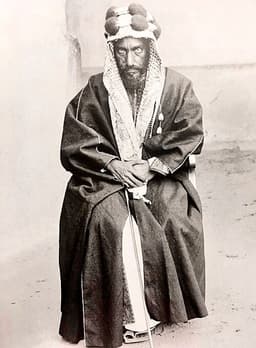
Ibn Saud
Emperor · Modern
66.1Total

Ovonramwen Nogbaisi
Emperor · Modern
47.8Total
Basic Information
Born
1875
1857
Died
1953
1914
Era
Modern
Modern
Nationality
Saudi Arabia
Benin Kingdom
Occupation
Emperor
Emperor
Civilization
Middle Eastern
Other
Score Comparison
Military (10%)
78.5
25.9
Political (20%)
85.0
43.7
Influence (20%)
68.0
57.2
Legacy (20%)
40.0
45.8
Leadership (15%)
78.0
62.2
Strategy (15%)
68.1
35.7
TOTAL
66.1
47.8
Ibn Saud — Complete Timeline
1902 AD
Capture of RiyadhWar
Ibn Saud led a small force of 40 men in a daring night raid to recapture Riyadh from the Al Rashid clan. This victory re-established the House of Saud in the Najd region and marked the beginning of his campaign to unify Arabia.
ConquestUnificationRaid
Impact: regional
1929 AD
Battle of SabillaWar◆ Major
Ibn Saud's forces defeated the Ikhwan rebels at the Battle of Sabilla, ending the Ikhwan uprising. This battle solidified his control over the Arabian Peninsula and allowed him to consolidate power under a centralized state.
Civil WarRebellionConsolidation
Impact: regionaldestructive
1932 AD
Proclamation of the Kingdom of Saudi ArabiaPolitical Action
Ibn Saud formally unified the regions of Najd, Hejaz, and other territories into the Kingdom of Saudi Arabia. He declared himself king, establishing a hereditary monarchy that has ruled the country ever since.
State FormationUnificationMonarchy
Impact: globalconstructive
1933 AD
Signing of the Saudi Aramco concessionPolitical Action
Ibn Saud granted Standard Oil of California (SOCAL) a 60-year oil concession in eastern Saudi Arabia. This agreement led to the discovery of vast oil reserves, transforming the kingdom's economy and geopolitical standing.
OilEconomic TransformationForeign Investment
Impact: globalconstructive
Ovonramwen Nogbaisi — Complete Timeline
1892 AD
Resistance to British trade demandsPolitical Action◆ Major
Ovonramwen refused British demands to sign a treaty granting exclusive trading rights and extraterritorial jurisdiction. He maintained Benin's independence and restricted European access to the kingdom's interior.
ResistanceTradeBenin
Impact: regional
1897 AD
Punitive Expedition of 1897War◆ Major
British forces launched a punitive expedition against Benin City after the killing of a British delegation. The expedition captured and burned the city, looting thousands of bronze and ivory artworks from the royal palace.
Punitive ExpeditionLootingBenin Bronzes
Impact: globaldestructive
Exile to CalabarPolitical Action◆ Major
Ovonramwen was captured by British forces and deposed as Oba of Benin. He was exiled to Calabar in southeastern Nigeria, where he lived under British supervision until his death in 1914.
ExileColonialismBenin
Impact: regionaltragic
End of independent Benin KingdomPolitical Action◆ Major
Following Ovonramwen's exile, the British incorporated Benin into the Niger Coast Protectorate. The ancient kingdom lost its sovereignty and became part of British colonial Nigeria, ending centuries of independence.
ColonialismEnd of KingdomBenin
Impact: regionaltragic
This comparison has not been analyzed yet.
One-time AI generation (~1 minute). Scores and timeline are already available below.
Rankings
🥇
Ibn SaudLeader
Mil: 78.5Pol: 85.0Inf: 68.0
66.1
🥈
Ovonramwen Nogbaisi
Mil: 25.9Pol: 43.7Inf: 57.2
47.8
+18.3 behind
How This Comparison Works
Algorithm
Each figure is scored on 6 dimensions (0—100 scale) based on structured historical data: Military (10%), Political (20%), Influence (20%), Legacy (20%), Leadership (15%), Strategy (15%). The weighted total produces the final ranking.
Data Sources
Scores are computed from structured sub-indicators in the database. Scale factors adjust for era (Ancient ×0.85, Modern ×1.0) and civilization size (Eastern ×1.05, Other ×0.80) to account for differences in population and military scale.
Maximum 3 Figures
Comparisons are limited to 2—3 figures to ensure readability and statistical meaningfulness.
Error Margins
±5 points per dimension — Sub-scores are derived from historical records with inherent uncertainty. Two figures within 5 points on a dimension should be considered roughly equivalent in that area.
Total Score Accuracy
±3 points overall — The weighted combination of 6 dimensions produces a total score with approximately ±3 points of uncertainty. Differences of less than 3 points are not statistically significant— the figures are effectively tied.
Known Limitations
- Historical records are incomplete and uneven across civilizations
- Figures from oral-tradition societies may be underrepresented
- Occupation labels can misclassify multi-role figures
- Scores measure capability and impact, not moral character
- Quantitative scoring is a comparison tool, not absolute truth
Capability Radar
Military (10%) — Battles & Warfare
Battles
85
20
Win Rate
90
10
Expansion
90
10
Political (20%) — Governance & Reform
Reform
80
30
Diplomacy
85
25
Economy
70
35
Influence (20%) — Cultural & Global Reach
Cultural
70
45
Global
75
30
Legacy (20%) — Historical Impact
Historical
85
40
Longevity
80
35
Leadership (15%) — Power & Stability
Tenure
85
40
Stability
75
20
Strategy (15%) — Tactics & Innovation
Strategy
85
20
Tactics
75
25
Reform
80
15
Similar Comparisons
Comments & Discussion
No comments yet. Be the first to share your thoughts!