Loading...
Ivan VI of Russia vs Napoleon Bonaparte
Napoleon Bonaparte leads by 10.1 pts · 2 figures compared
…
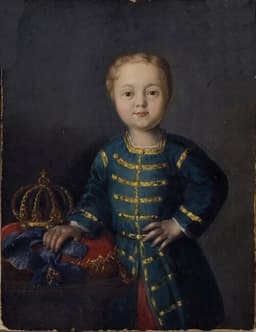
Ivan VI of Russia
Emperor · Modern
60.8Total

Napoleon Bonaparte
General · Modern
70.9Total
Basic Information
Born
1740
1769
Died
1764
1821
Era
Modern
Modern
Nationality
Russia
France
Occupation
Emperor
General
Civilization
Western
Western
Score Comparison
Military (10%)
11.0
94.0
Political (20%)
62.0
72.0
Influence (20%)
81.8
40.0
Legacy (20%)
52.0
80.0
Leadership (15%)
72.8
78.0
Strategy (15%)
60.0
90.0
TOTAL
60.8
70.9
Ivan VI of Russia — Complete Timeline
1740 AD
Proclaimed Emperor of Russia as Ivan VIPolitical Action◆ Major
The two-month-old Ivan VI was proclaimed Emperor of Russia following the death of Empress Anna. His mother Anna Leopoldovna served as regent, but the infant tsar never exercised any power.
SuccessionInfant Tsar
Impact: national
1741 AD
Deposed and imprisoned by Elizabeth PetrovnaPolitical Action◆ Major
A coup led by Elizabeth Petrovna overthrew the regency of Anna Leopoldovna. Ivan VI was deposed and imprisoned, first in Kholmogory and later in the Shlisselburg Fortress, where he spent the rest of his life.
CoupImprisonment
Impact: nationaltragic
1764 AD
Killed during an escape attemptOther◆ Major
While imprisoned in Shlisselburg Fortress, a failed rescue attempt by Lieutenant Vasily Mirovich led to Ivan VI being killed by his guards on orders to prevent his escape. He was 23 years old.
DeathEscape Attempt
Impact: nationaltragic
Napoleon Bonaparte — Complete Timeline
1799 AD
Coup of 18 BrumaireOther◆ Major
Napoleon Bonaparte, with support from his brother Lucien and key political figures, overthrew the Directory in a bloodless coup. He established the Consulate with himself as First Consul, effectively becoming the ruler of France. This event ended the French Revolution's most unstable period.
French RevolutionCoupRise to Power
Impact: regional
1804 AD
Promulgation of the Napoleonic CodeOther◆ Major
Napoleon enacted the Civil Code of the French, known as the Napoleonic Code, a comprehensive set of laws that replaced the fragmented feudal legal systems. The code established legal equality, protected property rights, and secularized law. It became the basis for legal systems in many European and world countries.
Legal ReformNapoleonic CodeCivil Law
Impact: globalconstructive
1805 AD
Battle of AusterlitzWar◆ Major
Napoleon's Grande Arm
Napoleonic WarsBattleDecisive Victory
Impact: global
1812 AD
Invasion of RussiaWar◆ Major
Napoleon led the Grande Arm
Napoleonic WarsInvasionDisaster
Impact: globaldestructive
1815 AD
Battle of WaterlooWar◆ Major
Napoleon's French army was defeated by the combined forces of the Duke of Wellington's Anglo-Allied army and Gebhard Leberecht von Bl
Napoleonic WarsBattleFinal Defeat
Impact: globaldestructive
Expert Analysis
ivan-vi-of-russia-vs-napoleon-bonaparte
# The Emperor Who Never Ruled
On a December morning in 1764, a young man lay dead in the damp stone corridors of Shlisselburg Fortress, his body pierced by bayonets. He was twenty-three years old, had spent nearly his entire life in captivity, and had never once exercised the power that was rightfully his. Across the continent, another young man was rising through the ranks of a revolutionary army, his name already spoken with a mixture of fear and admiration. One was Ivan VI of Russia, an infant emperor who became a ghost; the other, Napoleon Bonaparte, a Corsican artillery officer who would soon make Europe tremble. Their lives could not have been more different, yet both were shaped by the same brutal logic of power—one who seized it, and one who was erased by it.
Origins
Napoleon Bonaparte was born in 1769 on the island of Corsica, a place that had only recently become French. His family was minor nobility, but they were poor and spoke Italian-accented French. This outsider status would fuel his ambition. He entered military school at nine, where he was mocked for his accent and small stature, but excelled in mathematics and history. The French Revolution, which erupted when he was twenty, shattered the old order and opened paths that would have been unthinkable under the monarchy.
Ivan VI was born in 1740 in St. Petersburg, the capital of an empire that stretched from the Baltic to the Pacific. His father was a German prince, his mother a niece of Empress Anna. When Anna died that same year, the two-month-old Ivan was proclaimed emperor. He was not a person but a symbol—a pawn in the brutal game of Russian court politics. His very existence was a threat to those who held power, and from his first breath, he was a target.
Rise to Power
Napoleon’s rise was a masterclass in seizing opportunity. At twenty-four, he saved the revolutionary government from a royalist uprising in Paris, firing cannon into the crowd—a tactic that earned him the nickname “General Vendémiaire.” By twenty-six, he was commanding the French army in Italy, where his lightning campaigns defeated the Austrians and made him a national hero. He understood that in revolutionary France, merit mattered more than birth. He was not born to power; he took it.
Ivan VI’s rise was a tragedy of birth. At two months old, he was proclaimed emperor not because of any ability, but because his great-aunt, Empress Anna, had chosen him to spite her rivals. His mother, Anna Leopoldovna, became regent, but she was weak and unpopular. Within thirteen months, a coup led by Elizabeth Petrovna, Anna’s daughter, swept them from power. Ivan was deposed and imprisoned. He would never see the throne again.
Leadership & Governance
Napoleon’s leadership was defined by energy, intelligence, and an almost supernatural ability to read men and terrain. He reorganized France’s legal system with the Napoleonic Code, a rational framework that influenced civil law across Europe. He centralized the government, created the Bank of France, and restored relations with the Catholic Church. His military reforms were equally profound: he made armies faster, more flexible, and more lethal. He believed that “a leader is a dealer in hope,” and his soldiers followed him across the Alps and into the sands of Egypt.
Ivan VI never led anyone. After his deposition, he was moved from fortress to fortress, kept in complete isolation. His guards were forbidden to speak to him, and he was known only as “the nameless prisoner.” He was taught to read and write, but his education was minimal. By the time he was a teenager, he knew he was a former emperor, but he had no experience of command, no knowledge of governance, no sense of what it meant to rule. He was a man who existed only as a threat.
Triumph & Tragedy
Napoleon’s greatest triumph was the Empire he built. By 1810, he controlled or dominated most of Europe. His victories at Austerlitz in 1805 and Jena in 1806 were masterpieces of strategy. He placed his brothers on thrones and redrew the map of the continent. But his greatest tragedy was his own ambition. The invasion of Russia in 1812 destroyed his Grand Army, and his refusal to compromise led to his first abdication in 1814. He returned from exile in 1815, only to be defeated at Waterloo, a battle that ended his era.
Ivan VI’s tragedy was quieter but no less devastating. For twenty-three years, he lived in a cage. In 1764, a lieutenant named Vasily Mirovich attempted to rescue him, hoping to use him as a figurehead for a coup. The guards, following standing orders, killed Ivan rather than let him escape. He died not as an emperor, but as a prisoner, his body left in the snow. He had never known freedom, never known power, never known anything but the walls of his cell.
Character & Destiny
Napoleon’s character was a furnace of will. He was supremely confident, ruthlessly pragmatic, and endlessly ambitious. He once said, “Impossible is a word to be found only in the dictionary of fools.” This drive made him great, but it also made him blind to his limits. He could not stop, could not share power, could not accept that even genius has boundaries.
Ivan VI’s character is unknowable. We have no letters, no memoirs, no record of his thoughts. He was shaped not by his choices but by his circumstances—a boy who became a threat simply by being born. His destiny was not to rule, but to be erased.
Legacy
Napoleon’s legacy is immense. The Napoleonic Code remains the basis of civil law in many countries. His military innovations influenced warfare for a century. His name is synonymous with ambition, genius, and hubris. He is remembered as both a liberator who spread revolutionary ideals and a tyrant who drowned Europe in blood.
Ivan VI’s legacy is a footnote. He is remembered, if at all, as the infant emperor who never reigned. His story is a cautionary tale about the cruelty of dynastic politics, where a child can be a king one day and a ghost the next.
Conclusion
Napoleon and Ivan VI represent the two poles of historical fate: the man who made his own destiny and the man who had no destiny at all. One conquered Europe; the other was conquered by a prison. One shaped the modern world; the other was shaped by its indifference. Their stories remind us that history is not just about the great and the powerful, but also about the forgotten—the ones who, through no fault of their own, were never given a chance to be anything at all.
Rankings
🥇
Napoleon BonaparteLeader
Mil: 94.0Pol: 72.0Inf: 40.0
70.9
🥈
Ivan VI of Russia
Mil: 11.0Pol: 62.0Inf: 81.8
60.8
+10.1 behind
How This Comparison Works
Algorithm
Each figure is scored on 6 dimensions (0—100 scale) based on structured historical data: Military (10%), Political (20%), Influence (20%), Legacy (20%), Leadership (15%), Strategy (15%). The weighted total produces the final ranking.
Data Sources
Scores are computed from structured sub-indicators in the database. Scale factors adjust for era (Ancient ×0.85, Modern ×1.0) and civilization size (Eastern ×1.05, Other ×0.80) to account for differences in population and military scale.
Maximum 3 Figures
Comparisons are limited to 2—3 figures to ensure readability and statistical meaningfulness.
Error Margins
±5 points per dimension — Sub-scores are derived from historical records with inherent uncertainty. Two figures within 5 points on a dimension should be considered roughly equivalent in that area.
Total Score Accuracy
±3 points overall — The weighted combination of 6 dimensions produces a total score with approximately ±3 points of uncertainty. Differences of less than 3 points are not statistically significant— the figures are effectively tied.
Known Limitations
- Historical records are incomplete and uneven across civilizations
- Figures from oral-tradition societies may be underrepresented
- Occupation labels can misclassify multi-role figures
- Scores measure capability and impact, not moral character
- Quantitative scoring is a comparison tool, not absolute truth
Capability Radar
Military (10%) — Battles & Warfare
Battles
38
95
Win Rate
40
90
Expansion
42
95
Political (20%) — Governance & Reform
Reform
60
95
Diplomacy
62
80
Economy
66
85
Influence (20%) — Cultural & Global Reach
Cultural
64
85
Global
76
90
Legacy (20%) — Historical Impact
Historical
72
95
Longevity
71
90
Leadership (15%) — Power & Stability
Tenure
58
85
Stability
67
70
Strategy (15%) — Tactics & Innovation
Strategy
43
95
Tactics
46
98
Reform
53
92
Similar Comparisons
Comments & Discussion
PRISONER'S GHOST6/17/2026
The real tragedy isn't that Ivan VI never ruled - it's that he was erased so thoroughly that for decades, Russians weren't even sure he'd existed. Napoleon at least got to shape his own legend. Ivan got a cell, a bayonet, and an order to destroy every coin, portrait, and document bearing his name. That's not just a sad life - that's a state-sponsored existential deletion.
锁链皇帝6/17/2026
把拿破仑和伊凡六世放在一起比较,简直是在侮辱权力斗争的残酷性。拿破仑踩着千万人的尸体爬上皇位,而伊凡六世连第一顿饭都是狱卒喂的。你们是不是觉得"都是皇帝"就能拿来比?那我也和爱因斯坦一样有头发呢。关键差别在于:一个选择了历史,另一个被历史选择去死。
DECREE BURNER6/17/2026
This comparison misses the core irony: Napoleon's entire career proved that birthright meant nothing in the new era, while Ivan VI's tragedy proved it meant everything in the old one. The Corsican upstart had to conquer legitimacy; the Romanov infant had it beaten out of him. One created a new aristocracy, the other had his very name erased from the aristocracy's records. Both were exceptions that proved opposite rules.
数据狂人6/17/2026
你们这群浪漫主义者,只知道比惨。让我说点实在的:拿破仑在位时法国人口约2900万,伊凡六世的俄国人口约2400万。拿破仑的战争导致了超过300万军人死亡,而伊凡六世只牵连了大概十来个卫兵的死。从统计学角度,前者造成的伤亡是后者的三十万倍。所以别拿"悲剧"这种模糊词来忽悠人,把数字摆出来看看谁才是真正的历史重量级。
PROFESSOR OF FAILED EMPIRES6/17/2026
What fascinates me is the counterfactual: had Ivan VI somehow escaped, he'd have been a pathetic figure - a German-speaking puppet with no real connection to Russia. Napoleon's rule, for all its flaws, grew organically from revolutionary energy. Ivan was a dynastic accident; Napoleon was a historical force. The comparison teaches us that legitimacy isn't about blood or birth - it's about whether history gives you a stage to perform on.