Loading...
Joaquim Chissano vs Lee Huan
Joaquim Chissano leads by 15.8 pts · 2 figures compared
…
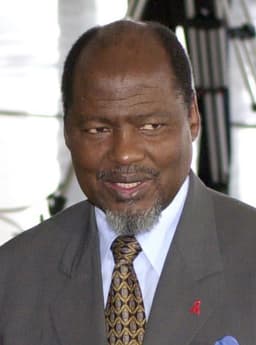
Joaquim Chissano
Politician · Modern
59.8Total

Lee Huan
Politician · Modern
44.0Total
Basic Information
Born
1939
1917
Died
—
2010
Era
Modern
Modern
Nationality
Mozambique
China
Occupation
Politician
Politician
Civilization
Other
Eastern
Score Comparison
Military (10%)
36.6
23.2
Political (20%)
78.0
39.4
Influence (20%)
58.0
47.1
Legacy (20%)
50.0
37.5
Leadership (15%)
80.0
58.8
Strategy (15%)
54.3
57.8
TOTAL
59.8
44.0
Joaquim Chissano — Complete Timeline
1992 AD
Rome General Peace AccordsPolitical Action◆ Major
As President of Mozambique, Joaquim Chissano signed the Rome General Peace Accords with the rebel group RENAMO, ending the 16-year Mozambican Civil War. The agreement established a multiparty democracy and led to UN-supervised elections in 1994, which Chissano won.
Peace AgreementCivil War EndDemocratization
Impact: nationalconstructive
1994 AD
Economic reform and growthReform◆ Major
Chissano implemented market-oriented economic reforms, including privatization, trade liberalization, and fiscal discipline, supported by the IMF and World Bank. Mozambique experienced sustained GDP growth averaging 8% annually from 1994 to 2004, reducing poverty but also increasing inequality.
Economic ReformGrowthPoverty Reduction
Impact: nationalconstructive
1994 Mozambican general electionPolitical Action◆ Major
Chissano won the first multiparty elections in Mozambique's history, securing 53.3% of the presidential vote against RENAMO's Afonso Dhlakama. His FRELIMO party also won a majority in parliament. The election marked the successful transition from war to democracy.
ElectionDemocracyTransition
Impact: nationalprogressive
2000 AD
HIV/AIDS responseReform◆ Major
Chissano's government launched a national HIV/AIDS strategy, including prevention campaigns and antiretroviral treatment programs. Mozambique had one of the highest HIV prevalence rates in the world, and the response helped slow the epidemic, though challenges remained.
Public HealthHIV/AIDSTreatment
Impact: nationalconstructive
2004 AD
2004 Mozambican general electionPolitical Action◆ Major
Chissano stepped down after two terms, respecting constitutional term limits. He oversaw peaceful elections that brought his successor, Armando Guebuza, to power. This peaceful transfer of power was a milestone for democratic consolidation in Mozambique.
ElectionDemocratic TransitionTerm Limits
Impact: nationalprogressive
Lee Huan — Complete Timeline
1989 AD
Premiership of the Republic of ChinaPolitical Action◆ Major
Lee Huan served as Premier of the Republic of China from 1989 to 1990 under President Lee Teng-hui. He oversaw the continuation of economic reforms and the early stages of democratization.
PremierROCLee Teng-hui
Impact: national
1990 AD
Resignation after Political CrisisPolitical Action
Lee Huan resigned as Premier following the 1990 Wild Lily student protests and internal KMT power struggles. His resignation paved the way for a more reformist cabinet under Hau Pei-tsun.
ResignationPolitical CrisisDemocratization
Impact: national
1993 AD
Role in KMT ReformPolitical Action
Lee Huan served as a senior advisor to the Kuomintang, advocating for internal party reform and democratization. He supported Lee Teng-hui's efforts to transform the KMT from a Leninist party to a democratic one.
KMTParty ReformDemocratization
Impact: nationalconstructive
Expert Analysis
Origins
Joaquim Chissano was born on October 22, 1939, in Malehice, Gaza Province, Portuguese Mozambique. He studied medicine at the University of Lisbon but left to join the Mozambican independence movement. He became a founding member of the Mozambique Liberation Front (FRELIMO) in 1962, training in Tanzania and Algeria. Chissano's early diplomatic work involved representing FRELIMO in various African capitals, gaining experience in negotiation and international relations.
Lee Huan was born on June 20, 1917, in Wuhan, Hubei, Republic of China. He studied at National Central University and later at the Central Training Group of the Kuomintang (KMT). Lee served as a Nationalist party official in Taiwan after the KMT retreat, working in propaganda and organizational roles. He rose through the party ranks, becoming a key figure in the KMT's youth and education departments.
Rise to Power
Chissano's rise was tied to FRELIMO's struggle for independence. After Mozambique gained independence in 1975, he served as Foreign Minister under President Samora Machel. He negotiated with South Africa and other neighbors, building a reputation as a pragmatic diplomat. When Machel died in a plane crash in 1986, Chissano succeeded him as president. He inherited a civil war against RENAMO, a rebel group backed by apartheid South Africa and Rhodesia. Chissano shifted from Marxist policies to engage in peace talks, leading to the Rome General Peace Accords in 1992.
Lee Huan's rise came through the KMT apparatus. He served as Minister of Education (1984-1987) and then as Secretary-General of the KMT (1987-1989). In 1989, President Lee Teng-hui appointed him Premier of the Republic of China (Taiwan). His premiership coincided with the Tiananmen Square protests in China and growing democratization in Taiwan. Lee Huan oversaw continued economic liberalization and political reforms, but faced challenges from both conservative KMT factions and pro-democracy activists.
Leadership & Governance
Chissano's leadership was defined by his commitment to peace and reconciliation. After signing the peace accords, he demobilized both government and rebel forces, integrating RENAMO into the political system. He won the 1994 multiparty elections with 53.3% of the vote, a stark contrast to the one-party rule that preceded. Economically, Chissano implemented IMF-backed reforms: privatizing state enterprises, liberalizing trade, and stabilizing the currency. Mozambique's GDP grew at an average of 8% per year in the late 1990s. However, his government struggled with corruption and bureaucratic inefficiency.
Lee Huan's governance focused on managing Taiwan's transition from authoritarianism to democracy. As premier, he continued economic reforms that had made Taiwan an export powerhouse. Politically, he supported Lee Teng-hui's democratization efforts, including the lifting of martial law (1987) and allowing opposition parties. However, his tenure was short (1989-1990) and marked by the Wild Lily student protests in 1990, which demanded direct presidential elections and an end to KMT dominance. Lee Huan resigned to take responsibility for the crisis, scoring 57.8 in strategy for his handling of the situation.
Triumph & Tragedy
Chissano's greatest triumph was ending the Mozambican Civil War, which had killed over one million people and displaced millions. The Rome Accords of 1992 were a masterclass in negotiation, with Chissano accepting power-sharing and amnesty for RENAMO. He also stepped down voluntarily in 2004 after two terms, setting a precedent for peaceful transitions in Africa. His HIV/AIDS response was also notable: Mozambique's infection rate stabilized around 12% due to prevention and treatment programs.
His tragedy was the slow pace of poverty reduction. Despite economic growth, Mozambique remained one of the world's poorest countries, with a 2003 GDP per capita of $250. Corruption scandals, such as the 2001 hidden debt crisis, tarnished his legacy. Additionally, the peace was fragile: RENAMO resumed low-level violence in 2013, though a new agreement was reached in 2019.
Lee Huan's triumph was his role in Taiwan's political reform. As KMT secretary-general, he helped push through internal democratization, allowing for competitive elections. He also maintained Taiwan's economic stability during a turbulent period, with GDP growth averaging 7% in the late 1980s.
His tragedy was the brevity and impact of his premiership. He resigned after just 14 months, unable to fully implement his agenda. The Wild Lily protests exposed deep divisions within the KMT and society, and Lee Huan's resignation did not resolve them. He later served as a senior advisor but never regained executive power. His political score of 39.4 reflects his limited influence compared to Chissano's 78.0.
Character & Destiny
Chissano was a pragmatist and conciliator. He shifted FRELIMO from Marxism to social democracy, prioritizing stability over ideology. His willingness to negotiate with RENAMO, despite years of war, showed strategic patience. He scored 54.3 in strategy, reflecting his ability to navigate complex transitions. His character was shaped by his diplomatic background; he was soft-spoken and deliberative, earning the nickname "Mr. Clean" for his anti-corruption stance, though later scandals challenged this.
Lee Huan was a party loyalist who believed in reform from within. He was cautious and consensus-driven, which allowed him to rise but limited his boldness. His decision to resign after the protests was seen as honorable but also as a failure of nerve. He lacked the political maneuvering skills of Lee Teng-hui, who sidelined him. Lee Huan's destiny was to be a transitional figure, bridging the old KMT and the new democracy, but not leading it.
Legacy
Chissano's legacy is as a peacemaker who ended a devastating civil war and transitioned Mozambique to multiparty democracy. He is one of few African leaders to voluntarily step down, earning him respect internationally. He served as a UN envoy and chair of the African Union. However, his economic reforms did not lift all boats, and the hidden debt crisis of 2016 (under his successor) raised questions about oversight. His total score of 59.8 reflects a balanced but not extraordinary impact.
Lee Huan's legacy is more modest. He is remembered as a reformist premier who oversaw a critical period in Taiwan's democratization, but his influence was overshadowed by Lee Teng-hui and later leaders. He died in 2017, with obituaries noting his role in education and party reform. His total score of 44.0 underlines his secondary status.
Conclusion
Joaquim Chissano had a greater impact than Lee Huan. Chissano's peace accords ended a war that killed over a million people, while Lee Huan's reforms were part of a broader democratic wave. Chissano's political score of 78.0 dwarfs Lee Huan's 39.4, and his leadership score of 80.0 versus 58.8 shows a more decisive influence. Chissano's legacy is tangible: a peaceful Mozambique with democratic institutions. Lee Huan's contributions, while real, were those of a supporting actor in Taiwan's transformation. The data supports Chissano as the more consequential figure.
Rankings
🥇
Joaquim ChissanoLeader
Mil: 36.6Pol: 78.0Inf: 58.0
59.8
🥈
Lee Huan
Mil: 23.2Pol: 39.4Inf: 47.1
44.0
+15.8 behind
How This Comparison Works
Algorithm
Each figure is scored on 6 dimensions (0—100 scale) based on structured historical data: Military (10%), Political (20%), Influence (20%), Legacy (20%), Leadership (15%), Strategy (15%). The weighted total produces the final ranking.
Data Sources
Scores are computed from structured sub-indicators in the database. Scale factors adjust for era (Ancient ×0.85, Modern ×1.0) and civilization size (Eastern ×1.05, Other ×0.80) to account for differences in population and military scale.
Maximum 3 Figures
Comparisons are limited to 2—3 figures to ensure readability and statistical meaningfulness.
Error Margins
±5 points per dimension — Sub-scores are derived from historical records with inherent uncertainty. Two figures within 5 points on a dimension should be considered roughly equivalent in that area.
Total Score Accuracy
±3 points overall — The weighted combination of 6 dimensions produces a total score with approximately ±3 points of uncertainty. Differences of less than 3 points are not statistically significant— the figures are effectively tied.
Known Limitations
- Historical records are incomplete and uneven across civilizations
- Figures from oral-tradition societies may be underrepresented
- Occupation labels can misclassify multi-role figures
- Scores measure capability and impact, not moral character
- Quantitative scoring is a comparison tool, not absolute truth
Capability Radar
Military (10%) — Battles & Warfare
Battles
5
53
Win Rate
5
54
Expansion
5
59
Political (20%) — Governance & Reform
Reform
80
25
Diplomacy
85
35
Economy
65
30
Influence (20%) — Cultural & Global Reach
Cultural
40
10
Global
50
10
Legacy (20%) — Historical Impact
Historical
55
15
Longevity
45
10
Leadership (15%) — Power & Stability
Tenure
75
30
Stability
80
25
Strategy (15%) — Tactics & Innovation
Strategy
10
60
Tactics
5
64
Reform
15
66
Similar Comparisons
Comments & Discussion
No comments yet. Be the first to share your thoughts!