Loading...
Joaquim Chissano vs Mulayam Singh Yadav
Joaquim Chissano leads by 1.9 pts · 2 figures compared
…
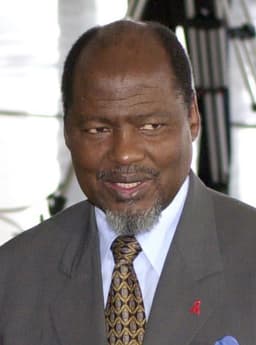
Joaquim Chissano
Politician · Modern
59.8Total

Mulayam Singh Yadav
Politician · Modern
57.9Total
Basic Information
Born
1939
1939
Died
—
—
Era
Modern
Modern
Nationality
Mozambique
India
Occupation
Politician
Politician
Civilization
Other
Indian
Score Comparison
Military (10%)
36.6
40.0
Political (20%)
78.0
68.0
Influence (20%)
58.0
60.0
Legacy (20%)
50.0
50.0
Leadership (15%)
80.0
68.0
Strategy (15%)
54.3
60.0
TOTAL
59.8
57.9
Joaquim Chissano — Complete Timeline
1992 AD
Rome General Peace AccordsPolitical Action◆ Major
As President of Mozambique, Joaquim Chissano signed the Rome General Peace Accords with the rebel group RENAMO, ending the 16-year Mozambican Civil War. The agreement established a multiparty democracy and led to UN-supervised elections in 1994, which Chissano won.
Peace AgreementCivil War EndDemocratization
Impact: nationalconstructive
1994 AD
Economic reform and growthReform◆ Major
Chissano implemented market-oriented economic reforms, including privatization, trade liberalization, and fiscal discipline, supported by the IMF and World Bank. Mozambique experienced sustained GDP growth averaging 8% annually from 1994 to 2004, reducing poverty but also increasing inequality.
Economic ReformGrowthPoverty Reduction
Impact: nationalconstructive
1994 Mozambican general electionPolitical Action◆ Major
Chissano won the first multiparty elections in Mozambique's history, securing 53.3% of the presidential vote against RENAMO's Afonso Dhlakama. His FRELIMO party also won a majority in parliament. The election marked the successful transition from war to democracy.
ElectionDemocracyTransition
Impact: nationalprogressive
2000 AD
HIV/AIDS responseReform◆ Major
Chissano's government launched a national HIV/AIDS strategy, including prevention campaigns and antiretroviral treatment programs. Mozambique had one of the highest HIV prevalence rates in the world, and the response helped slow the epidemic, though challenges remained.
Public HealthHIV/AIDSTreatment
Impact: nationalconstructive
2004 AD
2004 Mozambican general electionPolitical Action◆ Major
Chissano stepped down after two terms, respecting constitutional term limits. He oversaw peaceful elections that brought his successor, Armando Guebuza, to power. This peaceful transfer of power was a milestone for democratic consolidation in Mozambique.
ElectionDemocratic TransitionTerm Limits
Impact: nationalprogressive
Mulayam Singh Yadav — Complete Timeline
1989 AD
First term as Chief Minister of Uttar PradeshPolitical Action◆ Major
Mulayam Singh Yadav became Chief Minister of Uttar Pradesh for the first time as a Janata Dal leader. His government faced the Babri Masjid crisis. He ordered police to fire on kar sevaks attempting to demolish the mosque in 1990, which defined his secular image.
Chief MinisterBabri MasjidSecularism
Impact: regional
1990 AD
Ordered firing on kar sevaks at Babri Masjid (1990)Political Action◆ Major
As UP chief minister, Mulayam Singh Yadav ordered police to open fire on Hindu activists (kar sevaks) attempting to attack the Babri Masjid in Ayodhya. Several activists were killed. This action earned him the label of a secular leader but also made him a target of Hindu nationalist anger.
Babri MasjidAyodhyaSecularism
Impact: nationaltragic
1992 AD
Founded Samajwadi Party (SP)Political Action◆ Major
Mulayam Singh Yadav founded the Samajwadi Party after splitting from the Janata Dal. The party aimed to represent socialists, backward castes, and Muslims in Uttar Pradesh. It became a major political force in the state and a key player in national coalition politics.
Party FormationSocialismUttar Pradesh
Impact: nationalconstructive
1996 AD
Served as Defence Minister of IndiaPolitical Action
Mulayam Singh Yadav served as India's Defence Minister in the United Front government under Prime Minister H.D. Deve Gowda. He held the portfolio for about a year. This was his highest national office, though his tenure was brief.
Defence MinisterUnited FrontNational Politics
Impact: nationalconstructive
2003 AD
Third term as Chief Minister (2003-2007)Political Action◆ Major
Mulayam Singh Yadav returned as UP chief minister after the 2002 election, leading a coalition government. His third term saw improved law and order but also allegations of corruption and criminalization of politics. He lost the 2007 election to Mayawati.
Chief MinisterUttar PradeshSP
Impact: regional
Expert Analysis
Origins
Joaquim Chissano was born on October 22, 1939, in Malehice, Portuguese Mozambique. He studied at the University of Lisbon and later at the University of Coimbra in Portugal. He joined the Mozambican Liberation Front (FRELIMO) in 1962 and trained in Tanzania. Mulayam Singh Yadav was born on November 22, 1939, in Saifai, Uttar Pradesh, India, into a farmer family. He earned a B.A. from K.K. College and a B.Ed. from Agra University. He joined the socialist movement under Ram Manohar Lohia.
Rise to Power
Chissano rose through FRELIMO, becoming a key diplomat after independence in 1975. He served as Foreign Minister from 1975 to 1986. After President Samora Machel's death in a plane crash in 1986, Chissano became president. He led Mozambique during the civil war with RENAMO. Mulayam Singh Yadav rose as a socialist leader in Uttar Pradesh. He was first elected to the state assembly in 1967. He became Chief Minister of Uttar Pradesh in 1989 as a Janata Dal leader. He founded the Samajwadi Party in 1992 after splitting from Janata Dal.
Leadership & Governance
Chissano's leadership focused on ending the civil war and democratizing Mozambique. He signed the Rome General Peace Accords in 1992 with RENAMO. He won the 1994 multiparty election with 53.3% of the vote. He implemented economic reforms, including privatization and trade liberalization, with IMF support. He stepped down after two terms in 2004, respecting term limits. Mulayam Singh Yadav's governance emphasized social justice for backward castes and Muslims. He ordered police to fire on kar sevaks at the Babri Masjid in 1990, preventing its demolition at the time. His third term (2003-2007) improved law and order but faced corruption allegations. He served as India's Defence Minister in 1996-1998.
Triumph & Tragedy
Chissano's greatest triumph was ending the 16-year civil war through the Rome Peace Accords, earning him international acclaim. He also oversaw peaceful transitions of power. His tragedy includes the country's continued poverty and high HIV/AIDS prevalence, though his government launched a national strategy. Mulayam Singh Yadav's triumph was championing backward castes and Muslims, giving them political representation. His tragedy includes the Babri Masjid demolition in 1992 despite his firing orders, and his party's declining influence after 2007.
Character & Destiny
Chissano was known as pragmatic and conciliatory, willing to negotiate with RENAMO. His leadership score of 80.0 reflects his ability to unite a divided nation. He avoided personal aggrandizement, stepping down voluntarily. Mulayam Singh Yadav was a socialist ideologue, often seen as controversial due to his secular stance and caste-based politics. His leadership score of 68.0 indicates effectiveness in mobilizing support but less success in governance.
Legacy
Chissano's legacy is as the peacemaker who ended a brutal civil war and established democracy in Mozambique. His economic reforms set the stage for growth, though challenges remain. Mulayam Singh Yadav's legacy is as a social justice champion who empowered backward castes in India's most populous state. However, his political dynasty and corruption scandals have tarnished his reputation.
Conclusion
Joaquim Chissano had a greater impact due to his role in ending a civil war and transitioning Mozambique to democracy. His total score of 59.8 is slightly higher than Mulayam Singh Yadav's 57.9. Chissano's accomplishments in peacebuilding and democratic consolidation are more transformative than Yadav's regional social justice work. While Yadav's influence on Indian politics is significant, Chissano's achievements on a national scale in a war-torn country are more consequential. Therefore, Chissano is the more impactful figure.
Rankings
🥇
Joaquim ChissanoLeader
Mil: 36.6Pol: 78.0Inf: 58.0
59.8
🥈
Mulayam Singh Yadav
Mil: 40.0Pol: 68.0Inf: 60.0
57.9
+1.9 behind
How This Comparison Works
Algorithm
Each figure is scored on 6 dimensions (0—100 scale) based on structured historical data: Military (10%), Political (20%), Influence (20%), Legacy (20%), Leadership (15%), Strategy (15%). The weighted total produces the final ranking.
Data Sources
Scores are computed from structured sub-indicators in the database. Scale factors adjust for era (Ancient ×0.85, Modern ×1.0) and civilization size (Eastern ×1.05, Other ×0.80) to account for differences in population and military scale.
Maximum 3 Figures
Comparisons are limited to 2—3 figures to ensure readability and statistical meaningfulness.
Error Margins
±5 points per dimension — Sub-scores are derived from historical records with inherent uncertainty. Two figures within 5 points on a dimension should be considered roughly equivalent in that area.
Total Score Accuracy
±3 points overall — The weighted combination of 6 dimensions produces a total score with approximately ±3 points of uncertainty. Differences of less than 3 points are not statistically significant— the figures are effectively tied.
Known Limitations
- Historical records are incomplete and uneven across civilizations
- Figures from oral-tradition societies may be underrepresented
- Occupation labels can misclassify multi-role figures
- Scores measure capability and impact, not moral character
- Quantitative scoring is a comparison tool, not absolute truth
Capability Radar
Military (10%) — Battles & Warfare
Battles
5
42
Win Rate
5
46
Expansion
5
52
Political (20%) — Governance & Reform
Reform
80
55
Diplomacy
85
60
Economy
65
45
Influence (20%) — Cultural & Global Reach
Cultural
40
50
Global
50
40
Legacy (20%) — Historical Impact
Historical
55
55
Longevity
45
50
Leadership (15%) — Power & Stability
Tenure
75
65
Stability
80
40
Strategy (15%) — Tactics & Innovation
Strategy
10
52
Tactics
5
53
Reform
15
56
Similar Comparisons
Comments & Discussion
No comments yet. Be the first to share your thoughts!