Loading...
John Frederick I of Saxony vs Napoleon Bonaparte
Napoleon Bonaparte leads by 24.4 pts · 2 figures compared
…
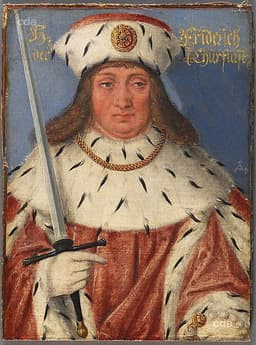
John Frederick I of Saxony
Emperor · Modern
46.5Total

Napoleon Bonaparte
General · Modern
70.9Total
Basic Information
Born
1503
1769
Died
1554
1821
Era
Modern
Modern
Nationality
Saxony
France
Occupation
Emperor
General
Civilization
Western
Western
Score Comparison
Military (10%)
50.0
94.0
Political (20%)
39.4
72.0
Influence (20%)
51.8
40.0
Legacy (20%)
43.3
80.0
Leadership (15%)
62.2
78.0
Strategy (15%)
25.0
90.0
TOTAL
46.5
70.9
John Frederick I of Saxony — Complete Timeline
1532 AD
Became Elector of SaxonyPolitical Action◆ Major
John Frederick I succeeded his father John the Constant as Elector of Saxony, becoming the head of the Ernestine line. He inherited a leading role in the Schmalkaldic League and the defense of Lutheranism in the Holy Roman Empire.
ElectorateSuccession
Impact: regional
1542 AD
Led the Schmalkaldic LeaguePolitical Action◆ Major
John Frederick I became the military leader of the Schmalkaldic League, the Protestant alliance against Emperor Charles V. He commanded the league's forces in several campaigns, including the conquest of the Duchy of Brunswick-Wolfenb
Schmalkaldic LeagueLeadership
Impact: regional
1547 AD
Defeated at the Battle of MühlbergWar◆ Major
John Frederick I was decisively defeated and captured by Imperial forces under Charles V at the Battle of M
Schmalkaldic WarDefeat
Impact: regionaltragic
Lost the Electorate to Maurice of SaxonyPolitical Action◆ Major
After his capture at M
Capitulation of WittenbergLoss of Power
Impact: regionaldestructive
Imprisoned by Charles VPolitical Action◆ Major
John Frederick I was imprisoned by Emperor Charles V after the Battle of M
ImprisonmentReligious Conviction
Impact: regionaltragic
1552 AD
Released under the Treaty of PassauPolitical Action◆ Major
John Frederick I was released from Imperial imprisonment as part of the Treaty of Passau, which granted religious toleration to Lutherans. He returned to his reduced territories but never regained the electoral title, dying in 1554.
Treaty of PassauRelease
Impact: regionalconstructive
Napoleon Bonaparte — Complete Timeline
1799 AD
Coup of 18 BrumaireOther◆ Major
Napoleon Bonaparte, with support from his brother Lucien and key political figures, overthrew the Directory in a bloodless coup. He established the Consulate with himself as First Consul, effectively becoming the ruler of France. This event ended the French Revolution's most unstable period.
French RevolutionCoupRise to Power
Impact: regional
1804 AD
Promulgation of the Napoleonic CodeOther◆ Major
Napoleon enacted the Civil Code of the French, known as the Napoleonic Code, a comprehensive set of laws that replaced the fragmented feudal legal systems. The code established legal equality, protected property rights, and secularized law. It became the basis for legal systems in many European and world countries.
Legal ReformNapoleonic CodeCivil Law
Impact: globalconstructive
1805 AD
Battle of AusterlitzWar◆ Major
Napoleon's Grande Arm
Napoleonic WarsBattleDecisive Victory
Impact: global
1812 AD
Invasion of RussiaWar◆ Major
Napoleon led the Grande Arm
Napoleonic WarsInvasionDisaster
Impact: globaldestructive
1815 AD
Battle of WaterlooWar◆ Major
Napoleon's French army was defeated by the combined forces of the Duke of Wellington's Anglo-Allied army and Gebhard Leberecht von Bl
Napoleonic WarsBattleFinal Defeat
Impact: globaldestructive
Expert Analysis
john-frederick-i-of-saxony-vs-napoleon-bonaparte
### The Conqueror and the Confessor
In the spring of 1547, a defeated German prince knelt in the mud before the most powerful man in Europe. Five years earlier, he had led a league of Protestant states against the Catholic Emperor Charles V. Now, stripped of his armor, he was a prisoner. Two centuries later, another man would stand atop the Alps, pointing his army toward Italy, and declare himself master of his own destiny. One man lost everything for a faith he could not abandon. The other lost everything for an ambition he could not satisfy. Why did John Frederick I of Saxony, the Magnanimous, end his days a diminished footnote, while Napoleon Bonaparte, the Corsican corporal, became a titan whose shadow still falls across the modern world? The answer lies not in luck, but in the very different soils in which their ambitions were rooted.
### Origins
Napoleon Bonaparte was born in 1769 on the island of Corsica, a place conquered by France only the year before. His family was minor nobility, but poor. This outsider status—neither fully French nor fully Italian—forged a restless hunger. He grew up in a world of revolutionary upheaval, where old certainties were being guillotined. The French Revolution tore down the aristocracy and opened a path for talent. For a brilliant young artillery officer, the chaos was opportunity.
John Frederick I was born in 1503 in Torgau, into the heart of the Holy Roman Empire. His world was one of ancient titles, fixed hierarchies, and a single, unifying faith that was about to shatter. He was the heir of the Ernestine line of the House of Wettin, rulers of Saxony. His father, John the Constant, had been a close ally of Martin Luther. John Frederick was raised not on battlefield tactics, but on theology. His identity was inseparable from the Lutheran Reformation. He was, from birth, a prince of the Church as much as a prince of the state. His ambition was not to conquer, but to confess.
### Rise to Power
Napoleon’s rise was a rocket. In 1793, at just 24, he drove the British from Toulon. By 1796, he was commanding the Army of Italy, turning a starving, ragged force into a victorious machine. He did not inherit power; he seized it. In 1799, he overthrew the Directory in a coup d'état. By 1804, he crowned himself Emperor of the French, taking the crown from the Pope’s hands and placing it on his own head. The message was clear: his authority came from his will, not from God or birth.
John Frederick’s path was a slow, dignified march. In 1532, he became Elector of Saxony, inheriting his father’s title and his father’s fight. He did not create the Schmalkaldic League; he became its leader in 1542. He was the champion of the Protestant cause, but he was also a prince bound by the complex laws of the Empire. He could not simply declare war on the Emperor. He had to wait for the Emperor to move. His authority came from tradition, from the consent of his fellow princes, and from a faith that demanded patience as much as courage.
### Leadership & Governance
Napoleon governed with the speed of a cannonball. He centralized the French state, created the Bank of France, and, most enduringly, codified the Napoleonic Code—a system of civil law that enshrined equality before the law, property rights, and secular authority. His military genius was a thing of terrifying beauty. He used speed, mass, and deception to shatter his enemies at Austerlitz in 1805 and Jena in 1806. He was a master of strategy, with a score of 93, but his political score of 75 reflects a fatal flaw: he could conquer, but he could not consolidate. He placed his brothers on thrones, but he never built a lasting system of alliances. He was the sole engine of his empire, and when that engine sputtered, the empire collapsed.
John Frederick governed with the caution of a scholar. His military score of 34 and strategy of 52 tell the story of a man who was a leader, not a general. He was brave, but he was not brilliant on the battlefield. His true strength was his political and spiritual leadership. He was the defender of the Lutheran faith, and his court at Wittenberg was a center of Reformation thought. He founded the University of Jena and protected artists like Lucas Cranach the Elder. His governance was about preserving a way of life, not expanding an empire. When he faced Charles V at the Battle of Mühlberg in 1547, he fought with courage but without tactical genius. He was defeated, captured, and forced to sign the Capitulation of Wittenberg, ceding his electorate to his treacherous cousin, Maurice.
### Triumph & Tragedy
Napoleon’s greatest triumph was Austerlitz, where he crushed the combined armies of Russia and Austria. His greatest tragedy was the invasion of Russia in 1812. It was a catastrophic overreach. He marched 600,000 men into the snow; fewer than 100,000 came back. He was exiled to Elba, escaped, and raised one last army. At Waterloo in 1815, he came within a hair of victory, but the Prussians arrived, and his dream died. He spent his final years on the remote island of Saint Helena, dictating his memoirs and dying of stomach cancer in 1821.
John Frederick’s greatest triumph was not a battle, but a stand. After his capture at Mühlberg, he was imprisoned by Charles V for five years. The Emperor offered him freedom if he would abandon the Lutheran faith. He refused. He was not a martyr, but he was a confessor. His greatest tragedy was the loss of his electorate. He watched his own cousin, Maurice, wear his title. He was released in 1552 under the Treaty of Passau, which granted religious toleration. He returned to his remaining lands, a broken prince, and died in 1554.
### Character & Destiny
Napoleon’s character was a furnace of ambition. He once said, “Power is my mistress.” He was brilliant, arrogant, and utterly convinced of his own destiny. He could inspire men to die for him, but he could not inspire them to build for him. His personality drove him to conquer, but it also drove him to exceed his limits. He could not stop. His destiny was to rise higher than any man of his age, and to fall harder.
John Frederick’s character was a fortress of principle. He was called “the Magnanimous” for a reason. He was generous, loyal, and stubborn. He could have saved his throne by bending his faith. He chose to lose everything instead. His personality drove him to endure, not to conquer. His destiny was to be a symbol, not a sovereign.
### Legacy
Napoleon’s legacy is a paradox. He is remembered as a tyrant and a reformer. The Napoleonic Code still shapes the legal systems of Europe and beyond. He modernized warfare and redefined the nation-state. But he also left a trail of corpses and a continent scarred by war. His legacy score of 78 reflects a man who changed the world, but left it deeply unsettled.
John Frederick’s legacy is quieter, but profound. He is remembered as a defender of the Reformation. His resistance helped ensure that Lutheranism survived as a political force. He lost his crown, but he kept his faith. His legacy score of 59.5 does not capture the moral weight of his stand. He is a reminder that history is not only made by conquerors, but by those who refuse to bend.
### Conclusion
Napoleon Bonaparte and John Frederick I of Saxony lived in different centuries, but they faced the same fundamental question: What is the price of power? Napoleon answered with ambition, John Frederick with faith. One built an empire that crumbled in a decade. The other lost an empire but left a testament that lasted centuries. In the end, the conqueror died alone on a rock in the Atlantic, while the confessor died in his own land, remembered as magnanimous. Perhaps the true measure of a leader is not how high he rises, but what he is willing to lose.
Rankings
🥇
Napoleon BonaparteLeader
Mil: 94.0Pol: 72.0Inf: 40.0
70.9
🥈
John Frederick I of Saxony
Mil: 50.0Pol: 39.4Inf: 51.8
46.5
+24.4 behind
How This Comparison Works
Algorithm
Each figure is scored on 6 dimensions (0—100 scale) based on structured historical data: Military (10%), Political (20%), Influence (20%), Legacy (20%), Leadership (15%), Strategy (15%). The weighted total produces the final ranking.
Data Sources
Scores are computed from structured sub-indicators in the database. Scale factors adjust for era (Ancient ×0.85, Modern ×1.0) and civilization size (Eastern ×1.05, Other ×0.80) to account for differences in population and military scale.
Maximum 3 Figures
Comparisons are limited to 2—3 figures to ensure readability and statistical meaningfulness.
Error Margins
±5 points per dimension — Sub-scores are derived from historical records with inherent uncertainty. Two figures within 5 points on a dimension should be considered roughly equivalent in that area.
Total Score Accuracy
±3 points overall — The weighted combination of 6 dimensions produces a total score with approximately ±3 points of uncertainty. Differences of less than 3 points are not statistically significant— the figures are effectively tied.
Known Limitations
- Historical records are incomplete and uneven across civilizations
- Figures from oral-tradition societies may be underrepresented
- Occupation labels can misclassify multi-role figures
- Scores measure capability and impact, not moral character
- Quantitative scoring is a comparison tool, not absolute truth
Capability Radar
Military (10%) — Battles & Warfare
Battles
25
95
Win Rate
20
90
Expansion
10
95
Political (20%) — Governance & Reform
Reform
30
95
Diplomacy
30
80
Economy
30
85
Influence (20%) — Cultural & Global Reach
Cultural
30
85
Global
20
90
Legacy (20%) — Historical Impact
Historical
40
95
Longevity
30
90
Leadership (15%) — Power & Stability
Tenure
40
85
Stability
20
70
Strategy (15%) — Tactics & Innovation
Strategy
20
95
Tactics
20
98
Reform
10
92
Similar Comparisons
Comments & Discussion
The Confessor's Chain6/17/2026
John Frederick died a prisoner because he fought for *faith*, not conquest. Napoleon understood power as flexible—build coalitions, break them, adapt. The Elector clung to his Lutheran creed while Charles V's Spanish tercios crushed him at Mühlberg. Hard to admire a man who let theology dictate military tactics. Ambition beats dogma every time if you want to leave footprints.
拿破仑的现代性6/17/2026
拿破仑把战争当成了数学问题,而约翰·弗里德里希却把它当成神学考试。一在1806年耶拿战役里用军团系统粉碎普鲁士旧秩序,一在1547年带着封建骑士硬扛西班牙火枪队。谁更聪明?前者改写欧洲地图后还整出了《拿破仑法典》,后者连萨克森都没保住。信仰很伟大,但输家毕竟还是输家。