Loading...
Jomo Kenyatta vs Narayan Datt Tiwari
Jomo Kenyatta leads by 9.0 pts · 2 figures compared
…
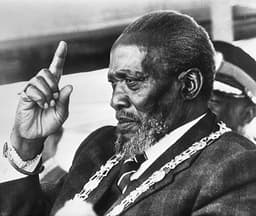
Jomo Kenyatta
Politician · Modern
58.1Total

Narayan Datt Tiwari
Politician · Modern
49.1Total
Basic Information
Born
1897
1925
Died
1978
—
Era
Modern
Modern
Nationality
Kenya
India
Occupation
Politician
Politician
Civilization
Other
Indian
Score Comparison
Military (10%)
25.9
47.2
Political (20%)
72.0
68.0
Influence (20%)
65.0
48.6
Legacy (20%)
55.0
40.0
Leadership (15%)
72.0
40.0
Strategy (15%)
39.3
60.0
TOTAL
58.1
49.1
Jomo Kenyatta — Complete Timeline
1952 AD
Mau Mau Uprising and DetentionPolitical Action◆ Major
Kenyatta was arrested and tried for his alleged involvement in the Mau Mau rebellion against British rule. He was sentenced to seven years' imprisonment, becoming a symbol of African nationalism. His detention galvanized support for independence.
Mau MauImprisonmentNationalism
Impact: regional
1963 AD
Kenya IndependencePolitical Action
Jomo Kenyatta became the first Prime Minister of independent Kenya after negotiations with British colonial authorities. His leadership marked the end of British rule and the beginning of Kenya's sovereignty, with Kenyatta advocating for racial reconciliation and economic development.
IndependenceDecolonizationPrime Minister
Impact: nationalconstructive
1964 AD
Presidency and One-Party StatePolitical Action◆ Major
Kenyatta became the first President of Kenya and established a de facto one-party state under the Kenya African National Union (KANU). He consolidated power, suppressed opposition, and promoted a capitalist economy, diverging from the socialist paths of other African leaders.
PresidencyOne-Party StateKANU
Impact: national
1965 AD
Land Redistribution PoliciesReform◆ Major
Kenyatta implemented land redistribution programs that transferred large tracts of land from white settlers to Africans. However, the policies favored his political allies and ethnic Kikuyu supporters, leading to land inequality and ethnic tensions that persisted for decades.
Land ReformEthnic PoliticsEconomic Policy
Impact: national
Narayan Datt Tiwari — Complete Timeline
1976 AD
Became Chief Minister of Uttar Pradesh for the first timePolitical Action◆ Major
Narayan Datt Tiwari was sworn in as the Chief Minister of Uttar Pradesh, leading the Congress government. His first tenure focused on land reforms and education, but was cut short by the fall of the Congress government at the centre.
Chief MinisterUttar PradeshCongress
Impact: regionalconstructive
1988 AD
Second term as Chief Minister of Uttar PradeshPolitical Action◆ Major
Tiwari returned as Chief Minister of Uttar Pradesh for a second term. His tenure saw the implementation of the Mandal Commission recommendations and faced challenges from the Ram Janmabhoomi movement.
Chief MinisterUttar PradeshCongress
Impact: regionalconstructive
2002 AD
Became Chief Minister of UttarakhandPolitical Action◆ Major
After the creation of Uttarakhand, Tiwari was appointed as the first Chief Minister of the new state. He oversaw the initial development and infrastructure projects in the hill state.
Chief MinisterUttarakhandCongress
Impact: regionalconstructive
2014 AD
Paternity scandal at age 89Political Action
At the age of 89, Tiwari was embroiled in a paternity scandal when a woman claimed he was the father of her child. DNA tests confirmed his paternity, leading to public controversy and damage to his reputation.
ScandalPaternityControversy
Impact: nationaltragic
Expert Analysis
Origins
**Jomo Kenyatta** was born around 1891 in Gatundu, British East Africa (now Kenya), to a Kikuyu farming family. He attended a mission school and later moved to Nairobi, where he became involved in African politics. In 1929, he traveled to London to lobby for Kikuyu land rights, and he remained abroad for 15 years, studying at the London School of Economics and writing an anthropological study of the Kikuyu. This period shaped his diplomatic skills and nationalist ideology.
**Narayan Datt Tiwari** was born on October 18, 1925, in Nainital, United Provinces, British India, into a Brahmin family. He studied at Allahabad University and became involved in student politics. After India's independence, he joined the Indian National Congress and quickly rose through the ranks, serving as a member of the Uttar Pradesh Legislative Assembly from 1952 onward. His early career was marked by loyalty to the Congress party and a focus on administrative roles.
Rise to Power
Kenyatta returned to Kenya in 1946 and became president of the Kenya African Union (KAU), advocating for independence. His involvement in the Mau Mau uprising led to his arrest in 1952; he was convicted and imprisoned until 1961. Despite his detention, he became a symbol of the independence movement. Upon release, he negotiated Kenya's independence with the British, becoming Prime Minister in 1963 and President in 1964 when Kenya became a republic.
Tiwari's rise was more conventional within India's democratic framework. He was elected to the Uttar Pradesh Legislative Assembly in 1952 and held various ministerial positions. His first term as Chief Minister of Uttar Pradesh began in 1976 during the Emergency, a period of authoritarian rule. He was appointed by Prime Minister Indira Gandhi and served until 1977. His second term came in 1984 after Indira Gandhi's assassination, and he focused on consolidating Congress power. He later became Chief Minister of Uttarakhand in 2002, overseeing the state's early development.
Leadership & Governance
Kenyatta's leadership style was pragmatic and authoritarian. He consolidated power under the Kenya African National Union (KANU), effectively creating a one-party state. His land redistribution policies favored the Kikuyu elite and loyalists, leading to economic growth but also ethnic tension. He pursued a capitalist path, encouraging foreign investment and maintaining close ties with the West. His government scored 72.0 in political leadership, reflecting his ability to maintain stability but also his suppression of opposition.
Tiwari's governance was characterized by adherence to Congress party policies and administrative competence. In Uttar Pradesh, he implemented land reforms and supported the Mandal Commission recommendations, which aimed to increase reservations for backward castes. His leadership style was less confrontational, but he faced criticism for corruption and inefficiency. His political score of 68.0 reflects his long tenure but limited transformative impact. In Uttarakhand, he focused on infrastructure but his legacy was tarnished by the paternity scandal.
Triumph & Tragedy
Kenyatta's greatest triumph was leading Kenya to independence and fostering economic growth in the 1960s and 1970s, with GDP growth averaging 6% annually. His tragedy was the entrenchment of authoritarian rule and ethnic favoritism, which sowed seeds for future conflicts. The 1969 assassination of Tom Mboya, a prominent Luo politician, and the subsequent ethnic tensions are part of his mixed legacy.
Tiwari's triumphs include his long career in Indian politics, serving three terms as Chief Minister of India's most populous state. He played a role in implementing affirmative action policies. His tragedy is the paternity scandal at age 89, which revealed a child born out of wedlock and damaged his reputation. Additionally, his tenures were marked by limited substantive reforms and allegations of corruption.
Character & Destiny
Kenyatta was a shrewd, patient, and authoritative figure. He used his diplomatic skills to negotiate with the British while maintaining a firm grip on domestic politics. His character combined a visionary nationalist with a pragmatic autocrat. His destiny was to shape Kenya's early years, but his authoritarian tendencies limited democratic development.
Tiwari was a loyal Congress party man, known for his administrative experience and lack of ideological rigidity. He was a survivor in a turbulent political environment. His character was more that of a career politician than a transformative leader. His destiny was to be a foot soldier in India's Congress dominance, but his legacy was overshadowed by personal scandal.
Legacy
Kenyatta is revered as the "Father of the Nation" in Kenya, with his image on currency and numerous institutions named after him. However, his legacy is contested due to his authoritarian rule and ethnic bias. He established a political culture of patronage and centralization that persisted after his death in 1978. His influence score of 65.0 reflects his foundational role but also the mixed outcomes.
Tiwari's legacy is more modest. He is remembered as a three-time Chief Minister who oversaw routine administration but failed to leave a lasting mark on policy or governance. The paternity scandal is a defining feature of his later years. His legacy score of 40.0 reflects his limited impact beyond his state and the taint of scandal.
Conclusion
Jomo Kenyatta had a greater impact than Narayan Datt Tiwari. Kenyatta's role in leading Kenya to independence and shaping its early political and economic trajectory is historically significant. His total score of 58.1 compared to Tiwari's 49.1 reflects this. While Tiwari had a long career in India's largest state, his achievements were incremental and his legacy overshadowed by scandal. Kenyatta's actions had national and continental implications, whereas Tiwari's influence remained confined to state-level politics. Thus, Kenyatta is the more consequential figure.
Rankings
🥇
Jomo KenyattaLeader
Mil: 25.9Pol: 72.0Inf: 65.0
58.1
🥈
Narayan Datt Tiwari
Mil: 47.2Pol: 68.0Inf: 48.6
49.1
+9.0 behind
How This Comparison Works
Algorithm
Each figure is scored on 6 dimensions (0—100 scale) based on structured historical data: Military (10%), Political (20%), Influence (20%), Legacy (20%), Leadership (15%), Strategy (15%). The weighted total produces the final ranking.
Data Sources
Scores are computed from structured sub-indicators in the database. Scale factors adjust for era (Ancient ×0.85, Modern ×1.0) and civilization size (Eastern ×1.05, Other ×0.80) to account for differences in population and military scale.
Maximum 3 Figures
Comparisons are limited to 2—3 figures to ensure readability and statistical meaningfulness.
Error Margins
±5 points per dimension — Sub-scores are derived from historical records with inherent uncertainty. Two figures within 5 points on a dimension should be considered roughly equivalent in that area.
Total Score Accuracy
±3 points overall — The weighted combination of 6 dimensions produces a total score with approximately ±3 points of uncertainty. Differences of less than 3 points are not statistically significant— the figures are effectively tied.
Known Limitations
- Historical records are incomplete and uneven across civilizations
- Figures from oral-tradition societies may be underrepresented
- Occupation labels can misclassify multi-role figures
- Scores measure capability and impact, not moral character
- Quantitative scoring is a comparison tool, not absolute truth
Capability Radar
Military (10%) — Battles & Warfare
Battles
20
41
Win Rate
26
45
Expansion
24
52
Political (20%) — Governance & Reform
Reform
65
40
Diplomacy
70
50
Economy
55
45
Influence (20%) — Cultural & Global Reach
Cultural
65
20
Global
55
10
Legacy (20%) — Historical Impact
Historical
70
25
Longevity
60
15
Leadership (15%) — Power & Stability
Tenure
60
60
Stability
50
35
Strategy (15%) — Tactics & Innovation
Strategy
33
52
Tactics
34
58
Reform
38
59
Similar Comparisons
Comments & Discussion
No comments yet. Be the first to share your thoughts!