Loading...
Kamehameha I vs Napoleon Bonaparte
Napoleon Bonaparte leads by 11.0 pts · 2 figures compared
…
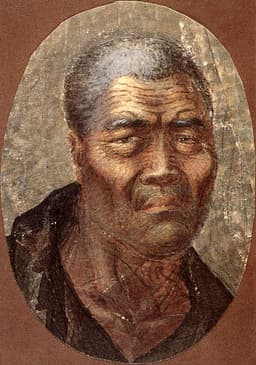
Kamehameha I
Emperor · Modern
59.9Total

Napoleon Bonaparte
General · Modern
70.9Total
Basic Information
Born
1758
1769
Died
1819
1821
Era
Modern
Modern
Nationality
Hawaii
France
Occupation
Emperor
General
Civilization
Other
Western
Score Comparison
Military (10%)
60.0
94.0
Political (20%)
59.3
72.0
Influence (20%)
60.0
40.0
Legacy (20%)
49.2
80.0
Leadership (15%)
85.0
78.0
Strategy (15%)
50.0
90.0
TOTAL
59.9
70.9
Kamehameha I — Complete Timeline
1778 AD
Opened Hawaii to foreign tradePolitical Action◆ Major
Following the arrival of Captain James Cook in 1778, Kamehameha I engaged with European explorers and traders. He acquired firearms and ships, which he used to conquer and unify the islands, while also establishing trade relations with the West.
HawaiiTradeEuropean Contact
Impact: regional
1797 AD
Implemented the Law of the Splintered PaddleReform◆ Major
After a near-fatal incident where he was struck by a paddle, Kamehameha I enacted a law protecting civilians during wartime. The law stated that women, children, and the elderly should not be harmed in conflicts, reflecting a humanitarian code.
HawaiiLawHuman Rights
Impact: regionalconstructive
1804 AD
Established the Kingdom of Hawaii's capital at HonoluluPolitical Action◆ Major
Kamehameha I moved his court to Honolulu on O'ahu, establishing it as the political and economic center of the unified Hawaiian Kingdom. This decision shaped Hawaii's development as a central port for trade.
HawaiiCapitalUrbanization
Impact: regionalconstructive
1810 AD
Unified the Hawaiian IslandsWar
Kamehameha I completed the unification of the Hawaiian Islands after a series of battles, including the Battle of Nu'uanu in 1795 and the peaceful cession of Kaua'i in 1810. He established the Kingdom of Hawaii as a single political entity.
HawaiiUnificationKingdom
Impact: regionalconstructive
Napoleon Bonaparte — Complete Timeline
1799 AD
Coup of 18 BrumaireOther◆ Major
Napoleon Bonaparte, with support from his brother Lucien and key political figures, overthrew the Directory in a bloodless coup. He established the Consulate with himself as First Consul, effectively becoming the ruler of France. This event ended the French Revolution's most unstable period.
French RevolutionCoupRise to Power
Impact: regional
1804 AD
Promulgation of the Napoleonic CodeOther◆ Major
Napoleon enacted the Civil Code of the French, known as the Napoleonic Code, a comprehensive set of laws that replaced the fragmented feudal legal systems. The code established legal equality, protected property rights, and secularized law. It became the basis for legal systems in many European and world countries.
Legal ReformNapoleonic CodeCivil Law
Impact: globalconstructive
1805 AD
Battle of AusterlitzWar◆ Major
Napoleon's Grande Arm
Napoleonic WarsBattleDecisive Victory
Impact: global
1812 AD
Invasion of RussiaWar◆ Major
Napoleon led the Grande Arm
Napoleonic WarsInvasionDisaster
Impact: globaldestructive
1815 AD
Battle of WaterlooWar◆ Major
Napoleon's French army was defeated by the combined forces of the Duke of Wellington's Anglo-Allied army and Gebhard Leberecht von Bl
Napoleonic WarsBattleFinal Defeat
Impact: globaldestructive
Expert Analysis
kamehameha-i-vs-napoleon-bonaparte
# The Conqueror and the Unifier: Napoleon and Kamehameha
On a summer morning in 1810, two men stood at the apex of their power, worlds apart yet pursuing remarkably similar dreams. In the tropical paradise of Hawaii, Kamehameha I watched his war canoes glide into calm waters, the last independent island chief having finally submitted to his authority. Across the globe, Napoleon Bonaparte prepared for his wedding to Marie Louise of Austria, his empire stretching from Spain to Poland. Both had risen from obscure beginnings to forge kingdoms through blood and will. Yet one would die in exile on a remote Atlantic island, his empire scattered to the winds, while the other would breathe his last on the land he had united, his kingdom intact. What explains the difference between triumph and tragedy when the ambitions were so alike?
Origins
Napoleon Bonaparte was born in 1769 on Corsica, an island that had become French only months before his birth. His family were minor nobility, but in the rigid hierarchies of pre-revolutionary France, they were outsiders—Corsicans who spoke Italian-accented French and harbored resentments against their conquerors. Young Napoleon channeled his alienation into ferocious ambition, devouring military history and mathematics at military academies where his poor background marked him as an oddity among aristocratic cadets.
Kamehameha I entered the world around 1758, his birth shrouded in prophecy. Legends held that a light in the sky—perhaps Halley's Comet—announced the coming of a great unifier. Unlike Napoleon, he was born into the highest echelons of Hawaiian society, a grandson of the ruling chief of the Big Island. But Hawaiian politics were brutal: his birth occurred during a period of civil war, and threats from rival chiefs forced his family to hide him in secret. Where Napoleon learned to fight with his intellect against a hostile social order, Kamehameha learned to fight with his body, becoming a warrior of legendary strength who could overturn massive stone boulders.
Rise to Power
The French Revolution created Napoleon's opportunity. When the old order collapsed in 1789, the Corsican outsider found himself perfectly positioned: a talented artillery officer with no ties to the discredited aristocracy. His meteoric rise came through sheer competence. In 1795, he saved the revolutionary government from a royalist uprising with a "whiff of grapeshot"—a brutal cannonade that cleared the streets of Paris. By 1804, at age thirty-five, he crowned himself Emperor of the French.
Kamehameha's path was slower and more treacherous. When Captain James Cook arrived in 1778, opening Hawaii to foreign trade, Kamehameha recognized immediately that Western weapons could tip the balance of power. He acquired muskets and cannons, learning their use from European sailors who stayed on his islands. Unlike Napoleon, who rose through institutional chaos, Kamehameha rose through careful accumulation of alliances and technology. He spent nearly thirty years conquering the Hawaiian Islands, one by one, his campaign culminating in the 1804 Battle of Nu'uan, where he drove hundreds of enemy warriors off a cliff to their deaths.
Leadership & Governance
Napoleon governed through a paradox: he was a military dictator who gave France its most enduring legal system. The Napoleonic Code, implemented in 1804, standardized French law, abolished feudal privileges, and established merit-based advancement. It was a revolutionary document wrapped in authoritarian packaging. As a military commander, Napoleon was a genius of speed and deception, winning legendary victories at Austerlitz in 1805 and Jena in 1806. But his political wisdom failed him in his greatest weakness: he could conquer nations but could not hold them.
Kamehameha governed with a different philosophy. After a near-fatal accident during battle in 1797, when a fisherman struck him with a paddle, he enacted the Law of the Splintered Paddle, which protected civilians during wartime. This was not weakness but strategic wisdom: he understood that a unified kingdom required the loyalty of the conquered, not just their fear. His leadership style was paternalistic and inclusive. He married high-ranking women from conquered islands to bind their people to his rule. Where Napoleon centralized power in Paris, Kamehameha moved his court to Honolulu in 1804, establishing a capital that balanced the interests of all islands.
Triumph & Tragedy
Napoleon's greatest moment came in 1805 at Austerlitz, where he destroyed a combined Russian and Austrian army in what military historians still study as a masterpiece of tactical brilliance. His greatest failure followed a decade later at Waterloo in 1815, where a combination of Allied resilience, Prussian intervention, and his own tactical mistakes ended his empire. He died in 1821 on Saint Helena, a British prisoner, his final years consumed by bitterness and self-justification.
Kamehameha's triumph was complete unification in 1810. Unlike Napoleon, he knew when to stop. He did not attempt to conquer Tahiti or California. He consolidated his kingdom, established trade relationships with European powers, and maintained Hawaii's independence. When he died in 1819, he passed a stable kingdom to his son. There was no Waterloo, no exile—only a peaceful transition and a legacy that would endure for another seventy-four years.
Character & Destiny
Napoleon's personality was driven by insatiable ambition. "Power is my mistress," he once said, and he meant it. He could not stop conquering because his identity required constant validation through victory. This psychological need drove him to invade Russia in 1812, a catastrophic decision that destroyed his Grand Army and began his downfall. His genius was real, but his character contained the seeds of his destruction.
Kamehameha's personality was more measured. He was ambitious but patient, ruthless but strategic. He understood that power required restraint. When he could have exterminated defeated enemies, he integrated them. When he could have waged endless war, he built peace. His destiny was shaped not by the magnitude of his dreams but by the wisdom of their limits.
Legacy
Napoleon's legacy is contradictory. He is remembered as both liberator and tyrant, the man who spread revolutionary ideals across Europe and the man who caused millions of deaths. The Napoleonic Code influences legal systems worldwide. His military innovations are still studied. But his empire vanished within years of his death, leaving only memories and monuments.
Kamehameha's legacy is simpler and more enduring. He is remembered as the father of modern Hawaii, the unifier who created a kingdom that survived until its annexation by the United States in 1893. His statue stands in Honolulu, and his Law of the Splintered Paddle remains a symbol of compassionate governance. He did not change the world, but he changed his world permanently.
Conclusion
The difference between Napoleon and Kamehameha is not a matter of talent or courage. Both possessed these in abundance. The difference lies in their relationship with power itself. Napoleon saw power as an end, a force to be accumulated infinitely. Kamehameha saw power as a means, a tool to be used until its purpose was fulfilled. One conquered until he collapsed under the weight of his own ambition. The other conquered until he could stop. In the end, the greatest lesson from these two lives may be that the most difficult victory is not over others, but over the hunger within oneself.
Rankings
🥇
Napoleon BonaparteLeader
Mil: 94.0Pol: 72.0Inf: 40.0
70.9
🥈
Kamehameha I
Mil: 60.0Pol: 59.3Inf: 60.0
59.9
+11.0 behind
How This Comparison Works
Algorithm
Each figure is scored on 6 dimensions (0—100 scale) based on structured historical data: Military (10%), Political (20%), Influence (20%), Legacy (20%), Leadership (15%), Strategy (15%). The weighted total produces the final ranking.
Data Sources
Scores are computed from structured sub-indicators in the database. Scale factors adjust for era (Ancient ×0.85, Modern ×1.0) and civilization size (Eastern ×1.05, Other ×0.80) to account for differences in population and military scale.
Maximum 3 Figures
Comparisons are limited to 2—3 figures to ensure readability and statistical meaningfulness.
Error Margins
±5 points per dimension — Sub-scores are derived from historical records with inherent uncertainty. Two figures within 5 points on a dimension should be considered roughly equivalent in that area.
Total Score Accuracy
±3 points overall — The weighted combination of 6 dimensions produces a total score with approximately ±3 points of uncertainty. Differences of less than 3 points are not statistically significant— the figures are effectively tied.
Known Limitations
- Historical records are incomplete and uneven across civilizations
- Figures from oral-tradition societies may be underrepresented
- Occupation labels can misclassify multi-role figures
- Scores measure capability and impact, not moral character
- Quantitative scoring is a comparison tool, not absolute truth
Capability Radar
Military (10%) — Battles & Warfare
Battles
45
95
Win Rate
70
90
Expansion
55
95
Political (20%) — Governance & Reform
Reform
65
95
Diplomacy
60
80
Economy
55
85
Influence (20%) — Cultural & Global Reach
Cultural
55
85
Global
45
90
Legacy (20%) — Historical Impact
Historical
55
95
Longevity
50
90
Leadership (15%) — Power & Stability
Tenure
60
85
Stability
60
70
Strategy (15%) — Tactics & Innovation
Strategy
65
95
Tactics
60
98
Reform
55
92
Similar Comparisons
Comments & Discussion
NapoleonFanboy6/17/2026
Kamehameha was impressive, but Napoleon conquered a continent, not a few islands. Bonaparte rewrote the rules of warfare with mass conscription and the corps system, while Kamehameha used cannons from European traders to beat guys with clubs. One legacy is the Napoleonic Code, the other is a beach vacation spot. Scale matters. Napoleon by a mile.|
历史侦探6/17/2026
拿破仑是欧洲的流星,卡美哈梅哈是太平洋的磐石。前者靠军事天才打天下,后者靠外交智慧稳住王国。拿破仑滑铁卢后两次流放,夏威夷国王却寿终正寝。数据说话:拿破仑征战20年,死亡数百万人,王国却没撑过百年;卡美哈梅哈统一后,夏威夷王国独立了近一个世纪。谁更成功?看结果就行。|
ClassicsGuy6/17/2026
You're all missing the real point: Kamehameha fulfilled the prophecy of the 'warrior king who would unite all islands,' while Napoleon was just a lucky general after the Revolution's chaos destroyed the old order. Napoleon's 'genius' was timing—France was a powder keg, and he lit the match. Kamehameha faced tougher odds: a fractured archipelago with no central authority, and he used marriage alliances, not just cannons. Give me the unifier over the destroyer.|
数据狂人6/17/2026
纯军事实力对比太无聊。拿破仑的军队规模大100倍,但卡美哈梅哈的疆域维持率100%——他死后王国没分裂。拿破仑呢?帝国在他死后5年就碎成渣。再看人均:卡美哈梅哈统治30万人口,零外敌入侵成功;拿破仑统治7000万人,最后被联军打进巴黎。效率上,小岛国王完胜大陆皇帝。别拿大炮说事,看持久度。|
RevisionistEye6/17/2026
Everyone romanticizes Kamehameha as the noble unifier, but he was just as brutal as Napoleon. He slaughtered civilians at the Battle of Nu'uanu, driving them off cliffs. Napoleon at least had some legitimacy from the Revolution and the Code. Kamehameha's kingdom was still a feudal mess with human sacrifice until his son abandoned it. Both conquered through blood, but only one left a legal legacy that lasted. Stop the islander hype.