Loading...
Kamehameha V vs Napoleon Bonaparte
Napoleon Bonaparte leads by 25.9 pts · 2 figures compared
…
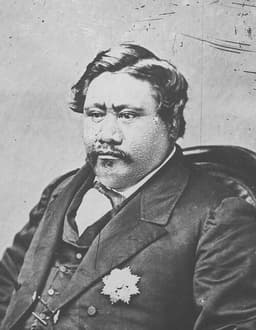
Kamehameha V
Emperor · Modern
45.0Total

Napoleon Bonaparte
General · Modern
70.9Total
Basic Information
Born
1830
1769
Died
1872
1821
Era
Modern
Modern
Nationality
Hawaii
France
Occupation
Emperor
General
Civilization
Other
Western
Score Comparison
Military (10%)
11.3
94.0
Political (20%)
46.6
72.0
Influence (20%)
50.2
40.0
Legacy (20%)
42.5
80.0
Leadership (15%)
74.0
78.0
Strategy (15%)
26.5
90.0
TOTAL
45.0
70.9
Kamehameha V — Complete Timeline
1863 AD
Ascended to the Throne as Kamehameha VPolitical Action◆ Major
Lot Kapuāiwa became King Kamehameha V after the death of his brother Kamehameha IV. He was the last monarch of the Kamehameha dynasty.
Impact: national
1864 AD
Promulgated the 1864 ConstitutionReform◆ Major
Kamehameha V abrogated the 1852 constitution and promulgated a new one that increased royal power. The 1864 constitution abolished the office of kuhina nui (premier), gave the king veto power, and restricted suffrage to property owners.
Impact: national
1865 AD
Oversaw Economic Growth and Public WorksReform
Kamehameha V promoted economic development, including the expansion of the sugar industry, construction of roads and harbors, and the establishment of the Hawaiian Board of Health. His reign saw increased foreign investment and trade.
Impact: nationalconstructive
1867 AD
Refused to Sign the Reciprocity TreatyPolitical Action◆ Major
Kamehameha V refused to sign a reciprocity treaty with the United States that would have reduced tariffs on Hawaiian sugar. He believed the treaty would compromise Hawaiian sovereignty and lead to American domination.
Impact: national
1872 AD
Died Without an HeirOther◆ Major
Kamehameha V died without naming an heir, ending the Kamehameha dynasty. His death triggered a succession crisis that led to the election of Lunalilo as the next king.
Impact: nationaltragic
Napoleon Bonaparte — Complete Timeline
1799 AD
Coup of 18 BrumaireOther◆ Major
Napoleon Bonaparte, with support from his brother Lucien and key political figures, overthrew the Directory in a bloodless coup. He established the Consulate with himself as First Consul, effectively becoming the ruler of France. This event ended the French Revolution's most unstable period.
French RevolutionCoupRise to Power
Impact: regional
1804 AD
Promulgation of the Napoleonic CodeOther◆ Major
Napoleon enacted the Civil Code of the French, known as the Napoleonic Code, a comprehensive set of laws that replaced the fragmented feudal legal systems. The code established legal equality, protected property rights, and secularized law. It became the basis for legal systems in many European and world countries.
Legal ReformNapoleonic CodeCivil Law
Impact: globalconstructive
1805 AD
Battle of AusterlitzWar◆ Major
Napoleon's Grande Arm
Napoleonic WarsBattleDecisive Victory
Impact: global
1812 AD
Invasion of RussiaWar◆ Major
Napoleon led the Grande Arm
Napoleonic WarsInvasionDisaster
Impact: globaldestructive
1815 AD
Battle of WaterlooWar◆ Major
Napoleon's French army was defeated by the combined forces of the Duke of Wellington's Anglo-Allied army and Gebhard Leberecht von Bl
Napoleonic WarsBattleFinal Defeat
Impact: globaldestructive
Expert Analysis
kamehameha-v-vs-napoleon-bonaparte
# The Emperor and the King: Napoleon Bonaparte and Kamehameha V
In the summer of 1815, Napoleon Bonaparte stood on the deck of the *Bellerophon*, watching the coast of France slip beneath the horizon for the last time. Half a century later, on the other side of the world, another monarch—Kamehameha V—sat in his palace in Honolulu, contemplating a constitution that would either preserve his kingdom or doom it. Both men inherited thrones. Both believed in absolute authority. But one conquered an empire and lost it; the other ruled a fragile island kingdom and let it slip away. Why did their paths diverge so dramatically?
Origins
Napoleon was born in 1769 on Corsica, a Mediterranean island that had just become French. His family was minor nobility, but his education was French and his ambition immense. He came of age in the chaos of the French Revolution, a time when old hierarchies were shattered and a young artillery officer could rise on talent alone. He studied the campaigns of Alexander and Caesar, and he learned that war was not merely a clash of armies but a contest of will.
Kamehameha V was born Lot Kapuāiwa in 1830, a prince of the Hawaiian royal line. His grandfather, Kamehameha the Great, had unified the islands through conquest in the 1790s. But by Lot's time, the kingdom was being reshaped by forces he could not control: American missionaries, European traders, and the slow erosion of Hawaiian sovereignty. He was educated by missionaries, fluent in English, and deeply aware that his people were caught between tradition and a modern world that did not respect them.
Rise to Power
Napoleon's rise was a military career of breathtaking speed. In 1793, at age twenty-four, he drove the British from Toulon. By 1796, he commanded the Army of Italy and won a series of victories that made him a national hero. In 1799, he overthrew the Directory in a coup and made himself First Consul. He was crowned Emperor in 1804. His path was forged by gunpowder and audacity.
Kamehameha V ascended the throne in 1863 upon the death of his brother, Kamehameha IV. He had no military conquest to claim. His power came from birthright, not battle. Where Napoleon seized his crown, Lot simply inherited it. And he inherited a kingdom already in crisis: the American Civil War had cut off Southern sugar, briefly enriching Hawaii, but the long-term threat of foreign domination loomed.
Leadership & Governance
Napoleon governed with a vision that reshaped Europe. He codified French law in the Napoleonic Code, centralized the bureaucracy, and established the Bank of France. He built roads, bridges, and schools. His military genius was matched by his political cunning: he knew how to reward loyalty, crush opposition, and present himself as the savior of the Revolution. But his ambition was limitless, and that would be his undoing.
Kamehameha V governed with a different kind of stubbornness. In 1864, he abrogated the liberal constitution of 1852 and promulgated a new one that concentrated power in the monarchy. He believed that only a strong king could protect Hawaii from foreign influence. He promoted economic growth—expanding the sugar industry, building roads and harbors. But in 1867, he refused to sign a reciprocity treaty with the United States that would have lowered tariffs on Hawaiian sugar. He feared the treaty would give America too much influence. It was a principled stand, but it left Hawaii economically vulnerable.
Triumph & Tragedy
Napoleon's greatest moment was Austerlitz in 1805, where he destroyed a combined Russian and Austrian army with a masterpiece of deception and maneuver. His worst was the invasion of Russia in 1812, a catastrophic miscalculation that cost half a million men. He was exiled to Elba, escaped, and raised another army—only to be defeated at Waterloo in 1815. His tragedy was that he could not stop. Victory was never enough.
Kamehameha V's triumph was quieter: he kept Hawaii independent during his reign, resisting both American annexation and internal rebellion. His tragedy was that he died without an heir in 1872, ending the Kamehameha dynasty. The succession crisis that followed led to a series of weak monarchs, and by 1893, the kingdom was overthrown by American businessmen. His refusal to sign the reciprocity treaty may have delayed annexation, but his failure to secure the succession ensured it.
Character & Destiny
Napoleon was driven by an insatiable hunger for glory. "I live only for posterity," he once said. He believed that will could bend history. And for a time, it did. But his pride, his refusal to compromise, and his contempt for limits brought him down. He died in 1821 on Saint Helena, a prisoner of the British, still dreaming of empires.
Kamehameha V was a different kind of autocrat: cautious, defensive, and deeply aware of his kingdom's fragility. He strengthened the crown but did not prepare for its survival. He was a king who tried to hold back the tide, not ride it. When he died, he left no heir, no plan, and a kingdom that could not stand alone.
Legacy
Napoleon's legacy is written across Europe: the Napoleonic Code, the modern state, the very idea of the nation in arms. He is remembered as a genius and a tyrant, a liberator and a conqueror. His name still stirs debate.
Kamehameha V is remembered in Hawaii as a defender of sovereignty, a king who tried to preserve his people's independence. But his legacy is also one of missed opportunities. He could have built alliances, reformed the economy, or secured the succession. He did none of these. Today, his name is known mostly to historians and Hawaiians.
Conclusion
What separates these two rulers is not ambition—both had that in abundance. It is not intelligence or courage. It is the scale of their stage and the nature of their times. Napoleon lived in an era when one man with an army could remake the world. Kamehameha V lived in an era when small kingdoms were being swallowed by empires, and no amount of royal will could stop the tide. One burned too brightly and was consumed. One held on too tightly and let go too late. Both remind us that history is not kind to those who mistake power for permanence.
Rankings
🥇
Napoleon BonaparteLeader
Mil: 94.0Pol: 72.0Inf: 40.0
70.9
🥈
Kamehameha V
Mil: 11.3Pol: 46.6Inf: 50.2
45.0
+25.9 behind
How This Comparison Works
Algorithm
Each figure is scored on 6 dimensions (0—100 scale) based on structured historical data: Military (10%), Political (20%), Influence (20%), Legacy (20%), Leadership (15%), Strategy (15%). The weighted total produces the final ranking.
Data Sources
Scores are computed from structured sub-indicators in the database. Scale factors adjust for era (Ancient ×0.85, Modern ×1.0) and civilization size (Eastern ×1.05, Other ×0.80) to account for differences in population and military scale.
Maximum 3 Figures
Comparisons are limited to 2—3 figures to ensure readability and statistical meaningfulness.
Error Margins
±5 points per dimension — Sub-scores are derived from historical records with inherent uncertainty. Two figures within 5 points on a dimension should be considered roughly equivalent in that area.
Total Score Accuracy
±3 points overall — The weighted combination of 6 dimensions produces a total score with approximately ±3 points of uncertainty. Differences of less than 3 points are not statistically significant— the figures are effectively tied.
Known Limitations
- Historical records are incomplete and uneven across civilizations
- Figures from oral-tradition societies may be underrepresented
- Occupation labels can misclassify multi-role figures
- Scores measure capability and impact, not moral character
- Quantitative scoring is a comparison tool, not absolute truth
Capability Radar
Military (10%) — Battles & Warfare
Battles
4
95
Win Rate
9
90
Expansion
11
95
Political (20%) — Governance & Reform
Reform
20
95
Diplomacy
30
80
Economy
35
85
Influence (20%) — Cultural & Global Reach
Cultural
30
85
Global
10
90
Legacy (20%) — Historical Impact
Historical
35
95
Longevity
20
90
Leadership (15%) — Power & Stability
Tenure
40
85
Stability
25
70
Strategy (15%) — Tactics & Innovation
Strategy
15
95
Tactics
15
98
Reform
21
92
Similar Comparisons
Comments & Discussion
CANNONBALL COMPARATOR6/17/2026
This matchup is absurd. Napoleon fought 60 major battles, conquered most of Europe, and directly reshaped modern warfare with the corps system. Kamehameha V presided over a tiny archipelago where the biggest "invasion" was his own birth. One man left a continent bleeding; the other argued about sugar tariffs. Comparing their leadership is like comparing a lion to a housecat—both are felines, but only one hunts empires.
数据侦探6/17/2026
光看人口就知道这对比毫无意义。1815年法国有近3000万人,而1860年代夏威夷仅约8万。拿破仑指挥过数十万大军横跨整个欧洲,卡美哈梅哈五世最重大的军事行动大概是防止传教士吵得太厉害。这不是贬低夏威夷国王,而是说历史比较应该有基本的前提条件——你得先有对手可打,才有资格谈军事成就。
CLASSICS SCHOLAR6/17/2026
Napoleon modeled himself on Caesar and Alexander, consciously performing ancient imperial ambition. Kamehameha V inherited a kingdom his grandfather had literally built with spears and canoes. The irony is sharp: the Corsican emperor copied antiquity while the Hawaiian king lived its realities. Romantics love Napoleon's self-mythology, but he was a brilliant actor. Kamehameha V faced the harder drama: how to be a sovereign when your entire culture is being rewritten by missionaries.
隐秘的国王6/17/2026
拿破仑用枪炮夺取权力,卡美哈梅哈五世则是用墨水失去权力。后者最关键的决策是1874年拒绝签署一部他向传教士们抗争后起草的宪法。他没有打仗,而是试图在伊奥拉尼宫的书房里用文件保卫王国。结果呢?美国人用糖业信托和投毒般的商业条约吞并了他无力用武力保卫的地方。谁更愚蠢?让敌人用钢笔毁灭你的君王。
PRAGMATIC SOVEREIGN6/17/2026
Here's what nobody tells you: Kamehameha V ruled Hawaii for only 11 years before dying at 42, childless. His whole reign was a desperate rear-guard action against demographics and disease. Napoleon ruled France for 15 years, conquered half of Europe, and still outlived his own legend. If you want to judge imperial success, count how long your legacy survives your death. Napoleon's nephew ruled for 18 years; the Hawaiian monarchy collapsed 12 years after Lot's death. Both lost—just on different s