Loading...
Kodandera M. Cariappa vs Napoleon Bonaparte
Napoleon Bonaparte leads by 13.9 pts · 2 figures compared
…
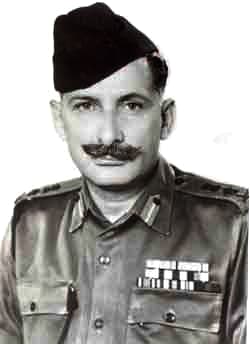
Kodandera M. Cariappa
General · Modern
57.0Total

Napoleon Bonaparte
General · Modern
70.9Total
Basic Information
Born
1899
1769
Died
1993
1821
Era
Modern
Modern
Nationality
India
France
Occupation
General
General
Civilization
Indian
Western
Score Comparison
Military (10%)
50.0
94.0
Political (20%)
62.7
72.0
Influence (20%)
55.0
40.0
Legacy (20%)
54.0
80.0
Leadership (15%)
62.0
78.0
Strategy (15%)
60.0
90.0
TOTAL
57.0
70.9
Kodandera M. Cariappa — Complete Timeline
1919 AD
Commissioned into Indian ArmyPolitical Action◆ Major
Kodandera M. Cariappa was commissioned as a temporary second lieutenant in the British Indian Army. He served in the 2nd Battalion, 88th Carnatic Infantry, beginning a long military career.
Indian ArmyCommissionMilitary career
Impact: national
1939 AD
Service in World War IIWar◆ Major
Cariappa served in the Middle East and Burma during World War II. He commanded the 7th Indian Infantry Brigade in the Burma Campaign, earning a reputation for leadership and tactical skill.
World War IIBurmaMilitary service
Impact: regional
1947 AD
Command in Indo-Pakistani War of 1947-48War◆ Major
Cariappa commanded Indian forces in the Kashmir operations during the Indo-Pakistani War of 1947-48. He led the successful defense of Srinagar and the capture of key positions in Jammu and Kashmir.
Kashmir1947 warMilitary operations
Impact: regionalconstructive
1949 AD
Appointment as first Indian Commander-in-ChiefPolitical Action
Cariappa was appointed as the first Indian Commander-in-Chief of the Indian Army in January 1949, succeeding General Sir Roy Bucher. He oversaw the Indianization of the army's officer corps.
Indian ArmyCommander-in-ChiefIndianization
Impact: nationalconstructive
1953 AD
Retirement and diplomatic servicePolitical Action
Cariappa retired from the Indian Army in 1953. He later served as High Commissioner to Australia and New Zealand from 1953 to 1956, representing India diplomatically.
RetirementDiplomacyHigh Commissioner
Impact: national
Napoleon Bonaparte — Complete Timeline
1799 AD
Coup of 18 BrumaireOther◆ Major
Napoleon Bonaparte, with support from his brother Lucien and key political figures, overthrew the Directory in a bloodless coup. He established the Consulate with himself as First Consul, effectively becoming the ruler of France. This event ended the French Revolution's most unstable period.
French RevolutionCoupRise to Power
Impact: regional
1804 AD
Promulgation of the Napoleonic CodeOther◆ Major
Napoleon enacted the Civil Code of the French, known as the Napoleonic Code, a comprehensive set of laws that replaced the fragmented feudal legal systems. The code established legal equality, protected property rights, and secularized law. It became the basis for legal systems in many European and world countries.
Legal ReformNapoleonic CodeCivil Law
Impact: globalconstructive
1805 AD
Battle of AusterlitzWar◆ Major
Napoleon's Grande Arm
Napoleonic WarsBattleDecisive Victory
Impact: global
1812 AD
Invasion of RussiaWar◆ Major
Napoleon led the Grande Arm
Napoleonic WarsInvasionDisaster
Impact: globaldestructive
1815 AD
Battle of WaterlooWar◆ Major
Napoleon's French army was defeated by the combined forces of the Duke of Wellington's Anglo-Allied army and Gebhard Leberecht von Bl
Napoleonic WarsBattleFinal Defeat
Impact: globaldestructive
Expert Analysis
kodandera-m-cariappa-vs-napoleon-bonaparte
# The Emperor and the General: Two Paths to Power, Two Destinies
On a June morning in 1815, Napoleon Bonaparte surveyed the muddy fields of Waterloo, his Grande Armée poised for what would be his final gamble. Across time and continents, another scene unfolds: in January 1949, Kodandera M. Cariappa stands before the Indian Parliament, receiving the baton of command as the first Indian to lead his nation's army. One man had conquered an empire and lost it; the other had never sought conquest, yet built something that would endure. How did two soldiers, both products of their turbulent times, arrive at such different ends?
Origins
Napoleon was born in 1769 on the rugged island of Corsica, a territory only recently annexed by France. His family was minor nobility, but poor—and fiercely resentful of French rule. Young Napoleon spoke Italian before French, and carried the chip of a provincial outsider into the military academies of Brienne and Paris. The French Revolution, which erupted when he was twenty, shattered the old order and opened paths that aristocratic birth had once blocked. For a gifted artillery officer with nothing to lose, the chaos was opportunity.
Cariappa entered the world in 1899, in the coffee-growing hills of Coorg, southern India. His family were prosperous landowners, but they lived under British colonial rule. The Indian Army of his youth was a segregated institution: Indian soldiers served under British officers, and the highest rank an Indian could hope for was that of a junior commissioned officer. Cariappa’s commission as a temporary second lieutenant in 1919 was a political act as much as a military one—a grudging concession by the British Empire after World War I had revealed its dependence on Indian manpower.
The fundamental difference is this: Napoleon rose in a world where the old certainties had collapsed, where a man could rewrite the map of Europe. Cariappa rose in a world where the certainties of empire were still intact—but beginning to crack.
Rise to Power
Napoleon’s ascent was meteoric and violent. At twenty-four, he drove the British out of Toulon. At twenty-six, he suppressed a royalist uprising in Paris with a “whiff of grapeshot.” At twenty-seven, he led a ragged army across the Alps into Italy and won six battles in as many weeks. By 1804, aged thirty-five, he crowned himself Emperor of the French. Each step was a gamble, each victory a foundation for the next.
Cariappa’s rise was steady, patient, and bureaucratic. He served in Mesopotamia and Burma during World War II, commanding the 7th Indian Infantry Brigade. He learned logistics, diplomacy, and the art of managing men under impossible conditions. His turning point came not on a battlefield but in a political office: in 1947, as India gained independence, Cariappa was given command of the Kashmir operations against Pakistani tribal invaders. He succeeded—but not through brilliant flanking maneuvers. He succeeded by organizing a chaotic supply chain, by coordinating with civilian leaders, and by keeping his troops disciplined in a conflict that could have spiraled into a full war.
Napoleon won by being faster, bolder, and more ruthless than his enemies. Cariappa won by being steadier, more patient, and more politically astute.
Leadership & Governance
As Emperor, Napoleon was a whirlwind. He reformed French law with the Napoleonic Code, standardized education, built roads and canals, and centralized the state. But his genius was also his curse: he could not stop conquering. He placed his brothers on thrones, redrew national borders, and demanded obedience from every capital in Europe. His military strategy was a masterpiece of speed and concentration—he once said, “I may lose a battle, but I shall never lose a minute.” Yet his political wisdom was shallow. He believed that victory would solve everything, and that other nations would accept French domination.
Cariappa governed an army, not a continent. As the first Indian Commander-in-Chief, his task was to transform a colonial force into a national one. He insisted that Indian officers be treated with the same respect as their British predecessors. He promoted merit over caste and region. He built an institution that could survive the transition from empire to democracy. When asked about his philosophy, he said simply: “The army belongs to the nation, not to any government.”
Napoleon’s reforms were imposed from above and collapsed with his fall. Cariappa’s reforms were embedded in an institution and outlasted him by decades.
Triumph & Tragedy
Napoleon’s greatest moment was Austerlitz in 1805, where he crushed the combined armies of Russia and Austria. His worst was the invasion of Russia in 1812: 600,000 men marched east; fewer than 100,000 returned. The disaster broke his aura of invincibility and set the stage for Waterloo.
Cariappa’s greatest moment was the successful integration of Kashmir into India in 1948, achieved without provoking a full-scale war with Pakistan. His tragedy was quieter: he retired in 1953, at the height of his powers, because he believed that military men should not cling to power. He later served as High Commissioner to Australia, a diplomatic post far removed from the roar of battle.
Napoleon’s tragedy was hubris—the belief that his star would never set. Cariappa’s tragedy was obscurity—he did what he did and then stepped aside, leaving history to remember the conquerors.
Character & Destiny
Napoleon was restless, brilliant, and consumed by ambition. “Impossible is a word to be found only in the dictionary of fools,” he declared. He could not sit still, could not delegate, could not tolerate equals. His personality drove him to ever-greater heights—and ultimately to St. Helena, where he died in exile in 1821.
Cariappa was disciplined, unassuming, and deeply conscious of his role as a servant of democracy. He once told a journalist, “A soldier’s greatest duty is to know when to stop.” He had seen what happened when generals confused their own glory with their nation’s good. He chose restraint.
Legacy
Napoleon is remembered as one of history’s greatest commanders—his name synonymous with military genius, his Code still shaping European law. But his legacy is also one of war, destruction, and the limits of ambition. He scored 94.0 in military prowess and 93.0 in strategy, but only 75.0 in politics: the conqueror who could not build a lasting peace.
Cariappa is remembered as the father of the modern Indian Army—a man who ensured that India’s military would remain subordinate to civilian rule. His scores tell a different story: 38.7 in military genius, but 89.5 in political wisdom and 78.5 in leadership. He was not a great strategist; he was a great institution-builder.
Conclusion
Napoleon once said, “History is the version of past events that people have decided to agree upon.” We have agreed to remember the emperor who conquered Europe and lost it all. But perhaps the quieter story of Cariappa is the more instructive one: a soldier who understood that true power lies not in the ability to destroy, but in the discipline to build, to serve, and to let go. Two generals, two worlds, two destinies—one written in fire, the other in stone.
Rankings
🥇
Napoleon BonaparteLeader
Mil: 94.0Pol: 72.0Inf: 40.0
70.9
🥈
Kodandera M. Cariappa
Mil: 50.0Pol: 62.7Inf: 55.0
57.0
+13.9 behind
How This Comparison Works
Algorithm
Each figure is scored on 6 dimensions (0—100 scale) based on structured historical data: Military (10%), Political (20%), Influence (20%), Legacy (20%), Leadership (15%), Strategy (15%). The weighted total produces the final ranking.
Data Sources
Scores are computed from structured sub-indicators in the database. Scale factors adjust for era (Ancient ×0.85, Modern ×1.0) and civilization size (Eastern ×1.05, Other ×0.80) to account for differences in population and military scale.
Maximum 3 Figures
Comparisons are limited to 2—3 figures to ensure readability and statistical meaningfulness.
Error Margins
±5 points per dimension — Sub-scores are derived from historical records with inherent uncertainty. Two figures within 5 points on a dimension should be considered roughly equivalent in that area.
Total Score Accuracy
±3 points overall — The weighted combination of 6 dimensions produces a total score with approximately ±3 points of uncertainty. Differences of less than 3 points are not statistically significant— the figures are effectively tied.
Known Limitations
- Historical records are incomplete and uneven across civilizations
- Figures from oral-tradition societies may be underrepresented
- Occupation labels can misclassify multi-role figures
- Scores measure capability and impact, not moral character
- Quantitative scoring is a comparison tool, not absolute truth
Capability Radar
Military (10%) — Battles & Warfare
Battles
15
95
Win Rate
10
90
Expansion
10
95
Political (20%) — Governance & Reform
Reform
60
95
Diplomacy
65
80
Economy
30
85
Influence (20%) — Cultural & Global Reach
Cultural
40
85
Global
45
90
Legacy (20%) — Historical Impact
Historical
55
95
Longevity
50
90
Leadership (15%) — Power & Stability
Tenure
55
85
Stability
70
70
Strategy (15%) — Tactics & Innovation
Strategy
25
95
Tactics
20
98
Reform
70
92
Similar Comparisons
Comments & Discussion
No comments yet. Be the first to share your thoughts!