Loading...
Kriangsak Chamanan vs Napoleon Bonaparte
Napoleon Bonaparte leads by 18.6 pts · 2 figures compared
…
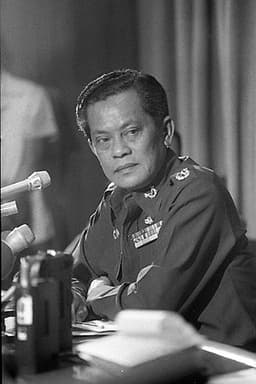
Kriangsak Chamanan
General · Modern
52.3Total

Napoleon Bonaparte
General · Modern
70.9Total
Basic Information
Born
1917
1769
Died
2003
1821
Era
Modern
Modern
Nationality
Thailand
France
Occupation
General
General
Civilization
Eastern
Western
Score Comparison
Military (10%)
25.9
94.0
Political (20%)
72.0
72.0
Influence (20%)
54.9
40.0
Legacy (20%)
46.7
80.0
Leadership (15%)
70.0
78.0
Strategy (15%)
30.3
90.0
TOTAL
52.3
70.9
Kriangsak Chamanan — Complete Timeline
1977 AD
Became Prime Minister of ThailandPolitical Action◆ Major
General Kriangsak Chamanan was appointed Prime Minister after a military coup ousted the civilian government. He led a transitional administration that restored parliamentary democracy and held elections in 1979.
Prime MinisterMilitary RuleDemocracy Transition
Impact: nationalconstructive
1978 AD
Guided the 1978 ConstitutionReform◆ Major
Kriangsak Chamanan oversaw the drafting and promulgation of a new constitution that established a bicameral legislature and paved the way for democratic elections. The constitution remained in effect until 1991.
ConstitutionDemocracyLegal Reform
Impact: nationalconstructive
1979 AD
Held the 1979 General ElectionPolitical Action◆ Major
Under Kriangsak Chamanan's leadership, Thailand held its first general election in three years. The election restored civilian rule, though the military retained significant influence through the appointed Senate.
ElectionDemocracyCivilian Rule
Impact: nationalconstructive
1980 AD
Resigned as Prime MinisterPolitical Action◆ Major
Kriangsak Chamanan resigned as Prime Minister after losing a parliamentary vote of confidence. His resignation allowed for a peaceful transition of power to Prem Tinsulanonda, marking a rare voluntary exit by a military leader.
ResignationPolitical TransitionDemocracy
Impact: national
Napoleon Bonaparte — Complete Timeline
1799 AD
Coup of 18 BrumaireOther◆ Major
Napoleon Bonaparte, with support from his brother Lucien and key political figures, overthrew the Directory in a bloodless coup. He established the Consulate with himself as First Consul, effectively becoming the ruler of France. This event ended the French Revolution's most unstable period.
French RevolutionCoupRise to Power
Impact: regional
1804 AD
Promulgation of the Napoleonic CodeOther◆ Major
Napoleon enacted the Civil Code of the French, known as the Napoleonic Code, a comprehensive set of laws that replaced the fragmented feudal legal systems. The code established legal equality, protected property rights, and secularized law. It became the basis for legal systems in many European and world countries.
Legal ReformNapoleonic CodeCivil Law
Impact: globalconstructive
1805 AD
Battle of AusterlitzWar◆ Major
Napoleon's Grande Arm
Napoleonic WarsBattleDecisive Victory
Impact: global
1812 AD
Invasion of RussiaWar◆ Major
Napoleon led the Grande Arm
Napoleonic WarsInvasionDisaster
Impact: globaldestructive
1815 AD
Battle of WaterlooWar◆ Major
Napoleon's French army was defeated by the combined forces of the Duke of Wellington's Anglo-Allied army and Gebhard Leberecht von Bl
Napoleonic WarsBattleFinal Defeat
Impact: globaldestructive
Expert Analysis
kriangsak-chamanan-vs-napoleon-bonaparte
# The General and the Democrat: Two Paths from the Barracks to Power
On a June evening in 1815, Napoleon Bonaparte stood on a muddy field near Waterloo, watching his Imperial Guard crumble before the British squares. Less than two decades earlier, he had been an obscure Corsican artillery officer. A world away, in December 1977, General Kriangsak Chamanan took the oath of office in Bangkok, inheriting a Thailand exhausted by coups and protests. Two generals, separated by a century and a half, both rose from military command to political supremacy. One conquered an empire and lost it; the other held power for three years and gave it away. Why did their stories diverge so radically?
Origins
Napoleon was born in 1769 on Corsica, a Mediterranean island only recently annexed by France. His family was minor nobility, poor but proud. At nine, he entered a French military academy, where classmates mocked his accent and provincial manners. The humiliation forged a will of iron. He devoured history and military theory, and when the French Revolution erupted in 1789, he saw opportunity: the old aristocracy was crumbling, and talent could rise.
Kriangsak Chamanan was born in 1917 in Samut Sakhon, a coastal province west of Bangkok. Thailand—then Siam—had never been colonized, but it was navigating the treacherous currents of modernization. Kriangsak entered the Chulachomklao Royal Military Academy, a school built to forge a professional officer corps loyal to the monarchy. His world was one of hierarchy, deference, and slow, cautious reform. While Napoleon learned to storm fortresses, Kriangsak learned to negotiate between generals, politicians, and kings.
Rise to Power
Napoleon’s ascent was meteoric. In 1793, at twenty-four, he recaptured the port of Toulon from British forces and was promoted to brigadier general. By 1796, he commanded the French army in Italy, where his lightning campaigns humiliated the Austrians. He was a master of speed, surprise, and psychological warfare—he wrote proclamations that made his soldiers feel like heroes. In 1799, he returned from Egypt to a France in chaos and staged a coup d’état, becoming First Consul. By 1804, he crowned himself Emperor.
Kriangsak’s path was slower and more circuitous. He served in the Korean War in the 1950s, then rose through the ranks during decades of military-dominated politics. In 1977, after a coup overthrew a civilian government, the military junta needed a prime minister who could stabilize the country. Kriangsak was chosen not for battlefield brilliance, but for his reputation as a conciliator. He was fifty-nine when he took power—older, wiser, and far less ambitious than Napoleon at thirty.
Leadership & Governance
Napoleon ruled France with a blend of genius and autocracy. He reformed the legal system with the Napoleonic Code, which enshrined equality before the law but also centralized power in his hands. He built roads, schools, and a modern bureaucracy. But his military brilliance consumed everything. He fought over sixty battles, winning most of them, but each victory stretched his empire thinner. He could not stop. “There is no such thing as a fortunate fool,” he once said, “and there is no such thing as an unfortunate wise man.” Yet his own wisdom failed him in the frozen wastes of Russia in 1812.
Kriangsak governed in an entirely different key. He inherited a Thailand torn by student protests, communist insurgencies, and distrust between the military and civilians. His greatest achievement was the 1978 constitution, which created a bicameral legislature and restored elections. In 1979, Thailand held its first general election in three years—a fragile but real step toward democracy. Kriangsak did not try to become a dictator. He maneuvered, compromised, and kept the army in check. His leadership was not about glory but about balance.
Triumph & Tragedy
Napoleon’s greatest triumph was Austerlitz in 1805, where he destroyed a combined Russian and Austrian army. It was a masterpiece of deception and timing. His greatest tragedy was the invasion of Russia in 1812: 600,000 men marched east; fewer than 100,000 returned. Exiled to Elba, he escaped and raised another army, only to meet final defeat at Waterloo in 1815. He died in British captivity on Saint Helena in 1821, his military genius spent.
Kriangsak’s triumph was more modest but no less significant: he guided Thailand through a peaceful transition of power. In 1980, after losing a confidence vote in parliament, he resigned—an act almost unheard of in a country where generals clung to power. His tragedy was that his reforms were fragile. After his resignation, the military soon reasserted control, and Thailand would endure more coups. But Kriangsak had shown that a general could step aside.
Character & Destiny
Napoleon was driven by an insatiable hunger for control. “I love power,” he said, “as an artist loves his art.” He could charm men and women alike, but he trusted no one completely. His ambition was limitless, and it destroyed him. Kriangsak was a pragmatist. He understood that Thailand’s monarchy, military, and middle class had to coexist. He did not seek to remake the world; he sought to keep his country from breaking apart.
Their destinies were shaped by their eras. Napoleon lived in a Europe of revolution and war, where a general could seize an empire. Kriangsak lived in a Cold War Southeast Asia, where superpowers pressed from all sides, and survival meant flexibility, not conquest.
Legacy
Napoleon is remembered as one of history’s greatest commanders—his name synonymous with ambition, reform, and catastrophic overreach. The Napoleonic Code still influences legal systems across Europe and beyond. Kriangsak is less famous but quietly respected in Thailand. He is remembered as a transitional figure who opened a door to democracy, even if it did not stay open.
Conclusion
Napoleon and Kriangsak both wore uniforms and held supreme power. But one lived for glory, the other for stability. One fell from a great height; the other stepped down with dignity. Their stories remind us that leadership is not just about strength—it is about knowing what you are fighting for. Napoleon fought for himself and lost everything. Kriangsak fought for a fragile idea of democracy and, in his small way, helped it survive. In the end, the quieter legacy may be the more enduring.
Rankings
🥇
Napoleon BonaparteLeader
Mil: 94.0Pol: 72.0Inf: 40.0
70.9
🥈
Kriangsak Chamanan
Mil: 25.9Pol: 72.0Inf: 54.9
52.3
+18.6 behind
How This Comparison Works
Algorithm
Each figure is scored on 6 dimensions (0—100 scale) based on structured historical data: Military (10%), Political (20%), Influence (20%), Legacy (20%), Leadership (15%), Strategy (15%). The weighted total produces the final ranking.
Data Sources
Scores are computed from structured sub-indicators in the database. Scale factors adjust for era (Ancient ×0.85, Modern ×1.0) and civilization size (Eastern ×1.05, Other ×0.80) to account for differences in population and military scale.
Maximum 3 Figures
Comparisons are limited to 2—3 figures to ensure readability and statistical meaningfulness.
Error Margins
±5 points per dimension — Sub-scores are derived from historical records with inherent uncertainty. Two figures within 5 points on a dimension should be considered roughly equivalent in that area.
Total Score Accuracy
±3 points overall — The weighted combination of 6 dimensions produces a total score with approximately ±3 points of uncertainty. Differences of less than 3 points are not statistically significant— the figures are effectively tied.
Known Limitations
- Historical records are incomplete and uneven across civilizations
- Figures from oral-tradition societies may be underrepresented
- Occupation labels can misclassify multi-role figures
- Scores measure capability and impact, not moral character
- Quantitative scoring is a comparison tool, not absolute truth
Capability Radar
Military (10%) — Battles & Warfare
Battles
10
95
Win Rate
10
90
Expansion
10
95
Political (20%) — Governance & Reform
Reform
60
95
Diplomacy
55
80
Economy
40
85
Influence (20%) — Cultural & Global Reach
Cultural
30
85
Global
30
90
Legacy (20%) — Historical Impact
Historical
40
95
Longevity
30
90
Leadership (15%) — Power & Stability
Tenure
50
85
Stability
45
70
Strategy (15%) — Tactics & Innovation
Strategy
10
95
Tactics
10
98
Reform
20
92
Similar Comparisons
Comments & Discussion
Tricorne Traveller6/17/2026
Waterloo wasn't 'grim fate'—it was Napoleon's own overreach. Even as a Corsican outsider clawing his way up, he forgot the revolutionary truth: an army that bleeds for a man, not a nation, will bleed out. Kriangsak understood that. He dressed in civilian suits, handed power back to civilians, and walked away. Napoleon died on St. Helena still believing a map could be erased by cannon fire.
炮兵预言家6/17/2026
拿破仑的失败不是滑铁卢的泥泞,而是他不懂“体制的重量”。他一生打垮了无数王朝,却从没想过自己建立的帝国也逃不过同样的铁律。而克里昂萨作为泰国军人,反而比这位欧洲天才更像政治家:他上台时国家动荡,三年后却主动还政于民。一个幻想永远坐在马鞍上,另一个明白将军得学会卸甲。
Empires & Epaulettes6/17/2026
Let’s call it what it is: Napoleon was a strategic genius who built a continental system of laws and meritocracy, not just battlefields. The Civil Code outlasted every throne he toppled. Kriangsak? He stamped out student protests, stabilized an oil crisis, and then vanished—no legacy, no ideology. Napoleon lost an empire; Kriangsak never built one. The Frenchman changed Europe’s spine; the Thai general changed a footnote.
数据侦探6/17/2026
别被拿破仑的光环骗了——他打过的战役,克里昂萨一场都没有,但他俩在“权力寿命”上的数字一点也不浪漫。拿破仑统治欧洲约14年,克里昂萨只有3年;前者在战略层面光辉灿烂,后者在泰国政治转型中不过是一页过渡章。数据不撒谎:拿破仑推动了现代行政的种子,克里昂萨只是为军政府和平让步留了个“还好没开枪”的注脚.