Loading...
Kublai Khan vs Nyatsimba Mutota
Kublai Khan leads by 17.8 pts · 2 figures compared
…
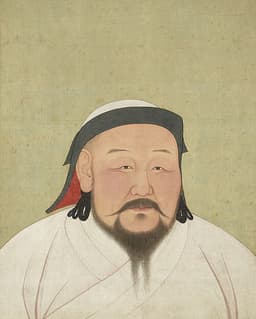
Kublai Khan
Emperor · Medieval
74.3Total

Nyatsimba Mutota
Emperor · Medieval
56.5Total
Basic Information
Born
1215
1400
Died
1294
1450
Era
Medieval
Medieval
Nationality
Mongolia
Mozambique
Occupation
Emperor
Emperor
Civilization
Eastern
Other
Score Comparison
Military (10%)
77.5
72.5
Political (20%)
79.2
68.0
Influence (20%)
75.0
59.0
Legacy (20%)
70.0
50.0
Leadership (15%)
72.0
40.0
Strategy (15%)
76.0
57.5
TOTAL
74.3
56.5
Kublai Khan — Complete Timeline
1260 AD
Adoption of Tibetan Buddhism as State ReligionCultural◆ Major
Kublai Khan appointed the Tibetan lama Drog
Tibetan BuddhismReligionMongol-Tibet Relations
Impact: regional
1271 AD
Proclamation of the Yuan DynastyPolitical Action◆ Major
Kublai Khan officially proclaimed the Yuan dynasty, adopting a Chinese-style dynastic name. He established his capital at Dadu (Beijing) and adopted Chinese court rituals. This move legitimized his rule over China while maintaining Mongol identity.
Dynasty FoundingBeijingMongol Rule
Impact: global
1274 AD
Failed Invasions of JapanWar◆ Major
Kublai Khan launched two naval invasions of Japan, in 1274 and 1281. Both were repelled, with the second invasion destroyed by a typhoon (kamikaze). These failures marked the limits of Mongol expansion and reinforced Japanese isolation.
Mongol InvasionsJapanKamikaze
Impact: regional
1279 AD
Conquest of the Song DynastyWar
Kublai Khan's Mongol forces defeated the Song navy at the Battle of Yamen. The last Song emperor drowned, ending the Song dynasty. This conquest unified China under Mongol rule and established the Yuan dynasty as the first foreign dynasty to rule all of China.
Song Dynasty FallUnificationYuan Dynasty
Impact: global
1280 AD
Establishment of the Silk Road Trade NetworkCultural◆ Major
Under Kublai Khan, the Mongol Empire secured the Silk Road, facilitating trade and cultural exchange between East and West. Marco Polo visited his court. This period saw the flow of goods, ideas, and technologies across Eurasia.
Silk RoadTradeCultural Exchange
Impact: globalconstructive
Nyatsimba Mutota — Complete Timeline
1430 AD
Founding of the Mutapa EmpirePolitical Action
Nyatsimba Mutota led a migration north from Great Zimbabwe and founded the Mutapa Empire in the Zambezi valley. He established a new capital at Zvongombe and began territorial expansion.
Impact: regionalconstructive
1440 AD
Conquest of the TavaraWar◆ Major
Nyatsimba Mutota conquered the Tavara people in the Zambezi valley, incorporating their territory into the Mutapa Empire. This victory secured control over fertile agricultural lands and trade routes.
Impact: regional
1445 AD
Establishment of the Mwenemutapa TitlePolitical Action◆ Major
Nyatsimba Mutota adopted the title Mwenemutapa, meaning 'lord of the conquered lands,' formalizing the imperial structure. This title became hereditary and defined the ruler's authority over conquered peoples.
Impact: regionalconstructive
Expert Analysis
Kublai Khan vs Nyatsimba Mutota
# The Emperor and the Migrant King
In the winter of 1274, a fleet of nearly nine hundred ships carrying some forty thousand Mongol, Chinese, and Korean soldiers set sail across the Sea of Japan. It was the largest naval armada the world had ever seen, and it was the dream of one man: Kublai Khan, grandson of Genghis, master of the largest contiguous land empire in history. Half a world away, some two centuries later, a very different kind of ruler led his people north from the stone ruins of Great Zimbabwe into the unknown reaches of the Zambezi valley. Nyatsimba Mutota carried no fleet, no army of thousands, no ambition to conquer the known world. He carried only a vision of a new kingdom. One man sought to rule the world; the other sought only to find a place for his people. Both succeeded. Both failed. And the difference between them tells us something profound about power, ambition, and the weight of history.
Origins
Kublai Khan was born into the saddle of empire. In 1215, the year of his birth, his grandfather Genghis Khan was already reshaping the world with fire and horsemen. Kublai grew up in a world where conquest was the family business, where the sky was no limit, and where the only question was how far the Mongol banner would fly. He was not the eldest son, not the obvious heir, but he was educated in both Mongol warrior traditions and Chinese statecraft—a rare combination that would define his rule.
Nyatsimba Mutota emerged from a different kind of world entirely. Born around 1400 in what is now Mozambique, he was a prince of Great Zimbabwe, a civilization of stone-walled cities and gold trade that had dominated southeastern Africa for centuries. But by Mutota's time, Great Zimbabwe was in decline—its resources strained, its population pressing against the limits of its valley. Mutota did not inherit an empire; he inherited a problem. And he chose to solve it not by conquest but by migration.
Rise to Power
Kublai Khan's path to power was a brutal family drama. In 1259, his brother Möngke Khan died while campaigning in China, and Kublai rushed to claim the throne before his younger brother Ariq Böke could seize it in Mongolia. The resulting civil war lasted four years and left Mongol fighting Mongol across the steppes. Kublai won, but the empire was fractured. From that moment, he understood that unity required not just military strength but political legitimacy—and he would find that legitimacy in China.
Mutota's rise was quieter but no less decisive. Around 1430, he led a group of followers north from Great Zimbabwe into the Zambezi valley, a region rich in gold and ivory but inhabited by the Tavara people. He did not claim to be the rightful ruler of all he surveyed. He simply claimed the land he could take. By 1440, he had conquered the Tavara and established a new capital. By 1445, he had adopted the title *Mwenemutapa*—"lord of the conquered lands." The name itself reveals his philosophy: power was not inherited from heaven; it was taken from the earth.
Leadership & Governance
Kublai Khan governed as a Mongol emperor who wanted to be a Chinese sage. He proclaimed the Yuan Dynasty in 1271, adopting a Chinese-style dynastic name and moving his capital to what is now Beijing. He rebuilt the Grand Canal, standardized the currency, and patronized scholars, artists, and merchants. But he also maintained Mongol customs, kept Chinese out of the highest military posts, and imposed a rigid ethnic hierarchy that placed Mongols at the top. His was a hybrid empire, brilliantly practical but never fully trusted by either side.
Mutota's governance was simpler and more direct. He did not build a bureaucracy or a capital city of stone. He ruled through a network of provincial chiefs, collecting tribute in gold and ivory, and maintaining control through marriage alliances and military intimidation. His empire was less a machine than a living organism—decentralized, adaptable, and deeply personal. Where Kublai built walls and canals, Mutota built relationships. Both systems worked, but they worked for different reasons: Kublai's empire was a structure; Mutota's was a family.
Triumph & Tragedy
Kublai Khan's greatest triumph was the conquest of the Song Dynasty in 1279. At the Battle of Yamen, his fleet destroyed the Song navy, and the last Song emperor drowned, clutching a jade seal to his chest. China was united under Mongol rule for the first time in history. It was a staggering achievement, but it came at a terrible cost—millions dead, cities razed, and a culture nearly extinguished.
His greatest tragedy was the invasion of Japan. In 1274 and again in 1281, he launched massive naval expeditions across the Sea of Japan. Both failed. The second invasion was destroyed by a typhoon—the *kamikaze*, or "divine wind," that the Japanese believed protected their islands. Kublai never understood why the sea refused to obey him. He had conquered the world; why could he not conquer an island?
Mutota's triumph was more modest but more enduring. He founded an empire that would last for centuries, outliving Great Zimbabwe and becoming a major power in southeastern Africa. His tragedy was that he never saw its full flowering. He died around 1450, leaving his son Matope to expand the empire further. Mutota's story is not one of catastrophic failure but of quiet, steady success—and perhaps that is why history remembers him less vividly.
Character & Destiny
Kublai Khan was a man of immense ambition and immense loneliness. He trusted no one completely, not even his own family. He surrounded himself with foreign advisors—Persian astronomers, Tibetan lamas, Venetian merchants—because he could not trust his own people. Marco Polo described his court as a place of unimaginable splendor, but also of constant intrigue. Kublai's character was forged in the crucible of Mongol politics: ruthless, pragmatic, and always calculating.
Mutota was a different kind of ruler. He was a founder, not a conqueror—a man who built something new rather than seizing something old. His character was shaped by necessity: he had to persuade people to follow him into the unknown, to trust his vision of a better land. That requires charisma, patience, and a deep understanding of human nature. Where Kublai commanded through fear, Mutota led through loyalty.
Legacy
Kublai Khan's legacy is written in stone and silk. The Yuan Dynasty lasted less than a century, but it reshaped China forever—unifying it, connecting it to the wider world, and establishing Beijing as the capital. The Silk Road flourished under his reign, carrying goods, ideas, and diseases across Eurasia. Marco Polo's tales of his court inspired generations of European explorers. But Kublai also left a darker legacy: the destruction of the Song, the failed invasions, the ethnic hierarchies that sowed resentment.
Mutota's legacy is less visible but no less real. The Mutapa Empire controlled the gold trade that connected the interior of Africa to the Indian Ocean world. Its influence spread across modern-day Zimbabwe, Mozambique, and Zambia. But because the Mutapa left no written records of their own, their history is often told by others—Portuguese traders, Arab chroniclers, European scholars. Mutota's empire is a shadow in the historical record, present but barely seen.
Conclusion
Two emperors, two worlds. Kublai Khan built an empire that stretched from the Pacific to the Black Sea, yet he died believing he had failed. Nyatsimba Mutota built an empire that never saw the ocean, yet he died knowing he had succeeded. One sought to rule the world; the other sought only to find a home for his people. And perhaps that is the deepest difference of all: Kublai Khan wanted to be remembered; Nyatsimba Mutota wanted to be followed. In the end, both got what they wanted—but only one of them understood what he was building. The other was too busy conquering to notice that he had already lost.
Rankings
🥇
Kublai KhanLeader
Mil: 77.5Pol: 79.2Inf: 75.0
74.3
🥈
Nyatsimba Mutota
Mil: 72.5Pol: 68.0Inf: 59.0
56.5
+17.8 behind
How This Comparison Works
Algorithm
Each figure is scored on 6 dimensions (0—100 scale) based on structured historical data: Military (10%), Political (20%), Influence (20%), Legacy (20%), Leadership (15%), Strategy (15%). The weighted total produces the final ranking.
Data Sources
Scores are computed from structured sub-indicators in the database. Scale factors adjust for era (Ancient ×0.85, Modern ×1.0) and civilization size (Eastern ×1.05, Other ×0.80) to account for differences in population and military scale.
Maximum 3 Figures
Comparisons are limited to 2—3 figures to ensure readability and statistical meaningfulness.
Error Margins
±5 points per dimension — Sub-scores are derived from historical records with inherent uncertainty. Two figures within 5 points on a dimension should be considered roughly equivalent in that area.
Total Score Accuracy
±3 points overall — The weighted combination of 6 dimensions produces a total score with approximately ±3 points of uncertainty. Differences of less than 3 points are not statistically significant— the figures are effectively tied.
Known Limitations
- Historical records are incomplete and uneven across civilizations
- Figures from oral-tradition societies may be underrepresented
- Occupation labels can misclassify multi-role figures
- Scores measure capability and impact, not moral character
- Quantitative scoring is a comparison tool, not absolute truth
Capability Radar
Military (10%) — Battles & Warfare
Battles
95
55
Win Rate
90
60
Expansion
95
65
Political (20%) — Governance & Reform
Reform
88
50
Diplomacy
85
55
Economy
90
50
Influence (20%) — Cultural & Global Reach
Cultural
85
45
Global
85
40
Legacy (20%) — Historical Impact
Historical
90
55
Longevity
80
50
Leadership (15%) — Power & Stability
Tenure
90
60
Stability
80
55
Strategy (15%) — Tactics & Innovation
Strategy
92
55
Tactics
85
50
Reform
88
40
Similar Comparisons
Comments & Discussion
KHANSTOMPER6/16/2026
Mutota was just a glorified migration manager. He walked north with some cattle herders. Kublai tried to invade Japan with a fleet bigger than any navy until the 1500s. Mutota's "expansion" is tiny by Mongol standards. The Mongol Empire's postal system alone, the Yam, covered more ground than Mutota ever saw. Comparing them is like comparing an ocean liner to a canoe.
沙漠行军6/16/2026
穆托塔算什么国王?他就是个带着族人逃荒的难民头目,还吹什么"伟大迁徙"。史书记载他离开大津巴布韦时,身边不过几十个亲信。而忽必烈的舰队在1274年就有900艘战船,4万大军!拿穆托塔和忽必烈比,简直是拿芝麻比西瓜。数据不会撒谎。
MONGOLOPS6/16/2026
You revisionists love romanticizing Mutota because it's a rare African success story. Fine. But let's keep perspective. Kublai finished the conquest of China, unified a civilization of 100 million people, and built a capital that became Beijing. Mutota's "kingdom" barely influenced the wider world. The Mongols tied the Silk Road together; Mutota's people left barely a written record. Scale matters in history.
孤骑帝国6/16/2026
我是古典学出身,看人要看核心遗产。忽必烈留下了北京城、元朝制度、纸币体系,还让马可·波罗来开了眼。穆托塔呢?他带人走到赞比西河谷,建了个姆韦尼·马塔帕王国,最后呢?今天有几个人知道?一个是世界级遗产,一个是地区级故事。差值就像长城和土墙的区别,客观事实。