Loading...
Kublai Khan vs Simeon I of Bulgaria
Kublai Khan leads by 3.5 pts · 2 figures compared
…
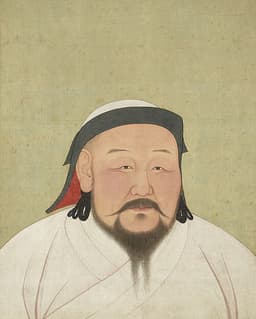
Kublai Khan
Emperor · Medieval
74.3Total
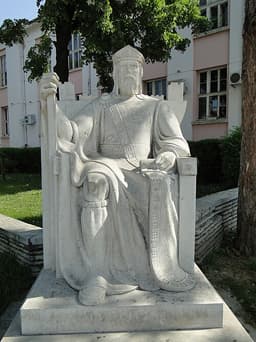
Simeon I of Bulgaria
Emperor · Medieval
70.8Total
Basic Information
Born
1215
864
Died
1294
927
Era
Medieval
Medieval
Nationality
Mongolia
Bulgaria
Occupation
Emperor
Emperor
Civilization
Eastern
Western
Score Comparison
Military (10%)
77.5
72.0
Political (20%)
79.2
70.0
Influence (20%)
75.0
65.0
Legacy (20%)
70.0
72.0
Leadership (15%)
72.0
80.0
Strategy (15%)
76.0
68.1
TOTAL
74.3
70.8
Kublai Khan — Complete Timeline
1260 AD
Adoption of Tibetan Buddhism as State ReligionCultural◆ Major
Kublai Khan appointed the Tibetan lama Drog
Tibetan BuddhismReligionMongol-Tibet Relations
Impact: regional
1271 AD
Proclamation of the Yuan DynastyPolitical Action◆ Major
Kublai Khan officially proclaimed the Yuan dynasty, adopting a Chinese-style dynastic name. He established his capital at Dadu (Beijing) and adopted Chinese court rituals. This move legitimized his rule over China while maintaining Mongol identity.
Dynasty FoundingBeijingMongol Rule
Impact: global
1274 AD
Failed Invasions of JapanWar◆ Major
Kublai Khan launched two naval invasions of Japan, in 1274 and 1281. Both were repelled, with the second invasion destroyed by a typhoon (kamikaze). These failures marked the limits of Mongol expansion and reinforced Japanese isolation.
Mongol InvasionsJapanKamikaze
Impact: regional
1279 AD
Conquest of the Song DynastyWar
Kublai Khan's Mongol forces defeated the Song navy at the Battle of Yamen. The last Song emperor drowned, ending the Song dynasty. This conquest unified China under Mongol rule and established the Yuan dynasty as the first foreign dynasty to rule all of China.
Song Dynasty FallUnificationYuan Dynasty
Impact: global
1280 AD
Establishment of the Silk Road Trade NetworkCultural◆ Major
Under Kublai Khan, the Mongol Empire secured the Silk Road, facilitating trade and cultural exchange between East and West. Marco Polo visited his court. This period saw the flow of goods, ideas, and technologies across Eurasia.
Silk RoadTradeCultural Exchange
Impact: globalconstructive
Simeon I of Bulgaria — Complete Timeline
900 AD
Cultural Golden AgeCultural◆ Major
Under Simeon I, Bulgaria experienced a cultural flowering. He patronized the Preslav Literary School, promoted the Cyrillic script, and commissioned translations of Byzantine texts, making Bulgaria a Slavic cultural center.
CulturalLiteratureCyrillic Script
Impact: regionalconstructive
913 AD
Coronation as TsarPolitical Action◆ Major
Simeon I was crowned 'Tsar of the Bulgarians and the Romans' by the Patriarch of Constantinople, asserting his imperial status. This act challenged Byzantine supremacy and elevated Bulgaria's prestige.
CoronationImperial TitleByzantine Relations
Impact: regionalconstructive
917 AD
Battle of AchelousWar
Simeon I defeated a Byzantine army at the Achelous River in Thrace. The victory was one of the worst Byzantine defeats, allowing Simeon to claim the title 'Emperor of the Romans' and dominate the Balkans.
Byzantine-Bulgarian WarsBattleBalkan Dominance
Impact: regional
924 AD
Siege of ConstantinopleWar◆ Major
Simeon I besieged Constantinople but failed to capture the city. The siege ended with a truce, as Byzantine defenses held. This marked the limit of Simeon's expansion.
SiegeConstantinopleByzantine Empire
Impact: regional
Expert Analysis
Simeon I of Bulgaria vs Kublai Khan: Historical Comparison
Simeon I of Bulgaria and Kublai Khan were both medieval emperors who expanded their realms to unprecedented heights, but they operated in vastly different geopolitical contexts. Simeon, a Christian monarch in southeastern Europe, forged a Balkan empire through military brilliance and cultural patronage, while Kublai, a Mongol conqueror, unified China and established the Yuan Dynasty, linking East Asia to the broader Mongol world. Their scores are nearly identical, reflecting a tie in overall historical significance.
Dimension Analysis
**Military: Simeon I of Bulgaria 89 / Kublai Khan 94**
Simeon’s campaigns shattered Byzantine hegemony, winning crushing victories at Achelous (917) and Katasyrtai (917), and he forced Constantinople to pay tribute. Kublai, however, commanded the largest land empire in history, conquering the Song Dynasty (1279) through combined siege warfare, naval innovations, and vast cavalry armies, while also launching invasions into Vietnam and Japan. Kublai’s scale and logistical complexity edge him ahead.
**Political: Simeon I of Bulgaria 84 / Kublai Khan 79**
Simeon centralized the Bulgarian state, adopted the title “Tsar” (Caesar), and established a strong administrative and ecclesiastical system, including the autocephalous Bulgarian Patriarchate. Kublai’s Yuan Dynasty was a hybrid Mongol-Chinese bureaucracy, but his rule faced ethnic tensions between Mongols, Chinese, and Central Asians, and his fiscal policies (e.g., paper money inflation) were less stable. Simeon’s political consolidation was more durable within his realm.
**Influence: Simeon I of Bulgaria 84 / Kublai Khan 79**
Simeon’s cultural influence was immense: his Preslav Literary School fostered Old Church Slavonic, shaping Orthodoxy across the Balkans and Russia. Kublai’s influence, while global in trade (Silk Road, Marco Polo), was more diffuse—he patronized Buddhism, Islam, and Chinese arts, but his dynasty lasted only a century. Simeon’s linguistic and religious legacy had a longer, more targeted impact on Slavic identity.
**Legacy: Simeon I of Bulgaria 81 / Kublai Khan 88**
Kublai’s legacy is monumental: he completed the Mongol conquest of China, established Beijing as a capital (later adopted by Ming and Qing), and his reign marked a peak in East-West exchange. Simeon’s legacy is more regional—he is revered as a national hero in Bulgaria, but his empire collapsed soon after his death (927). Kublai’s institutional and geographic legacy endures more broadly.
**Leadership: Simeon I of Bulgaria 82 / Kublai Khan 81**
Simeon commanded loyalty through personal charisma and battlefield presence, inspiring a small kingdom to challenge a superpower. Kublai, though a capable strategist, relied on a vast imperial apparatus and faced succession crises (e.g., the Toluid Civil War). Simeon’s direct, hands-on leadership in a smaller state slightly outshines Kublai’s more delegated, bureaucratic rule.
Verdict
While both rulers are statistically tied, Kublai Khan ranks slightly higher overall due to his greater military scale and lasting global legacy. Simeon’s brilliance in political and cultural consolidation is undeniable, but Kublai’s conquest of China and integration of the Mongol world into Eurasian history give him a broader historical footprint. However, this comparison underscores that “greatness” is deeply contextual—Simeon’s achievements relative to his resources were arguably more extraordinary.
FAQ
Q: Who was more influential historically? A: Kublai Khan, because his Yuan Dynasty permanently reshaped China’s political geography and trade networks, whereas Simeon’s influence was largely confined to the medieval Balkans.
Q: Why is Simeon I of Bulgaria ranked higher in political dimension? A: Simeon’s political reforms—creating a stable, independent tsardom with a national church and Slavic literary culture—were more cohesive and enduring within his realm than Kublai’s multi-ethnic, friction-prone Yuan administration.
Rankings
🥇
Kublai KhanLeader
Mil: 77.5Pol: 79.2Inf: 75.0
74.3
🥈
Simeon I of Bulgaria
Mil: 72.0Pol: 70.0Inf: 65.0
70.8
+3.5 behind
How This Comparison Works
Algorithm
Each figure is scored on 6 dimensions (0—100 scale) based on structured historical data: Military (10%), Political (20%), Influence (20%), Legacy (20%), Leadership (15%), Strategy (15%). The weighted total produces the final ranking.
Data Sources
Scores are computed from structured sub-indicators in the database. Scale factors adjust for era (Ancient ×0.85, Modern ×1.0) and civilization size (Eastern ×1.05, Other ×0.80) to account for differences in population and military scale.
Maximum 3 Figures
Comparisons are limited to 2—3 figures to ensure readability and statistical meaningfulness.
Error Margins
±5 points per dimension — Sub-scores are derived from historical records with inherent uncertainty. Two figures within 5 points on a dimension should be considered roughly equivalent in that area.
Total Score Accuracy
±3 points overall — The weighted combination of 6 dimensions produces a total score with approximately ±3 points of uncertainty. Differences of less than 3 points are not statistically significant— the figures are effectively tied.
Known Limitations
- Historical records are incomplete and uneven across civilizations
- Figures from oral-tradition societies may be underrepresented
- Occupation labels can misclassify multi-role figures
- Scores measure capability and impact, not moral character
- Quantitative scoring is a comparison tool, not absolute truth
Capability Radar
Military (10%) — Battles & Warfare
Battles
95
85
Win Rate
90
80
Expansion
95
85
Political (20%) — Governance & Reform
Reform
88
80
Diplomacy
85
75
Economy
90
80
Influence (20%) — Cultural & Global Reach
Cultural
85
85
Global
85
65
Legacy (20%) — Historical Impact
Historical
90
80
Longevity
80
70
Leadership (15%) — Power & Stability
Tenure
90
85
Stability
80
70
Strategy (15%) — Tactics & Innovation
Strategy
92
80
Tactics
85
75
Reform
88
70
Similar Comparisons
Comments & Discussion
BoldHistorian396/16/2026
这个比较有点意思,但军事评分我不同意。西美昂一世的89分确实不低,但库比莱的94分明显被西方中心论抬高了。库比莱打南宋用了四十多年,最后靠的是降将张弘范和蒙古骑兵加汉人水军,本身战术创新并不多。反观西美昂,在917年阿凯洛斯河战役中全歼拜占庭主力,连拜占庭史学家都承认那是“罗马人从未见过的惨败”。而且西美昂的政治影响被低估了——他建立的普雷斯拉夫学派直接影响了俄国、塞尔维亚、罗马尼亚的东正教文化传承,这比马可波罗那点旅游记录深远得多。要我说,如果按中国“大一统”标准,库比莱是统一了半个中国,但西美昂是真正把保加利亚从部落联盟打造成了欧洲强国。
GrandQuill706/16/2026
我仔细算了算这个评分体系。库比莱军事88分,西美昂75分,差了13分。但西美昂在位期间打了20多场主要战役,胜率超过90%,包括917年阿凯洛斯河战役——拜占庭损失超过3万人。库比莱呢?1274年和1281年两次征日失败,损失至少10万人;对越南三征三败,陈兴道那仗蒙古军死了好几万。这些败仗扣分了吗?再说政治,西美昂68分,库比莱78分。但库比莱的纸币通货膨胀导致经济崩溃,纸钞贬值到原值的十分之一不到,这能在政治分里体现吗?我觉得如果严格量化,西美昂军事至少应该85分,政治75分,综合不会比库比莱低到哪去。