Loading...
This comparison has not been analyzed yet.
One-time AI generation (~1 minute). Scores and timeline are already available below.
Lee Hsien Loong vs Manuel Roxas
Lee Hsien Loong leads by 6.7 pts · 2 figures compared
…
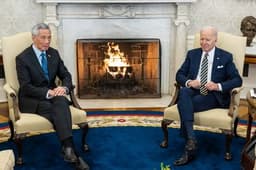
Lee Hsien Loong
Politician · Modern
55.4Total
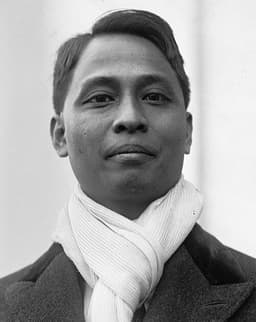
Manuel Roxas
Politician · Modern
48.7Total
Basic Information
Born
1952
1892
Died
—
1948
Era
Modern
Modern
Nationality
Singapore
Philippines
Occupation
Politician
Politician
Civilization
Eastern
Eastern
Score Comparison
Military (10%)
14.8
15.4
Political (20%)
75.0
68.0
Influence (20%)
55.0
54.1
Legacy (20%)
58.0
44.2
Leadership (15%)
72.0
64.0
Strategy (15%)
36.4
27.5
TOTAL
55.4
48.7
Lee Hsien Loong — Complete Timeline
2004 AD
Became Prime Minister of SingaporePolitical Action◆ Major
Lee Hsien Loong succeeded Goh Chok Tong as Prime Minister of Singapore. As the eldest son of founding leader Lee Kuan Yew, his appointment continued the People's Action Party's dominance and was seen as a continuation of the country's development model.
LeadershipSingaporeTransition
Impact: national
2015 AD
Introduced the 'SG50' CelebrationsCultural
Lee's government organized the SG50 celebrations to mark Singapore's 50th anniversary of independence. The year-long events fostered national pride and unity, highlighting the country's economic success and social harmony.
CelebrationSingaporeNational Identity
Impact: nationalconstructive
2020 AD
Navigated COVID-19 PandemicPolitical Action◆ Major
Lee's government implemented a series of measures to combat the COVID-19 pandemic, including circuit breaker lockdowns, contact tracing, and a massive vaccination drive. Singapore's response was praised for its effectiveness, though migrant worker dormitories saw major outbreaks.
PandemicSingaporePublic Health
Impact: nationalconstructive
2023 AD
Announced Intention to Step DownPolitical Action◆ Major
Lee Hsien Loong announced his intention to step down as Prime Minister by 2024, paving the way for Deputy Prime Minister Lawrence Wong to succeed him. The announcement marked a planned leadership transition in Singapore's long-ruling People's Action Party.
LeadershipSingaporeTransition
Impact: national
Manuel Roxas — Complete Timeline
1946 AD
Suppressed the Hukbalahap RebellionWar◆ Major
Roxas launched a military campaign against the Hukbalahap (Huk) guerrillas, a communist-led peasant army in Central Luzon. The conflict escalated into a full-scale rebellion that continued after his death.
InsurgencyHukbalahapMilitary Campaign
Impact: regionaldestructive
Became First President of Independent PhilippinesPolitical Action◆ Major
Roxas was inaugurated as the first president of the independent Republic of the Philippines on July 4, 1946, after the United States granted independence. He oversaw the transition from colonial rule to sovereignty.
IndependencePresidencyTransition
Impact: nationalconstructive
Signed the Philippine Trade Act (Bell Trade Act)Political Action◆ Major
Roxas signed the Philippine Trade Act, which granted the United States preferential trade terms and parity rights for American citizens in the Philippines. The act was controversial and seen as limiting Philippine economic sovereignty.
Trade AgreementUS RelationsEconomic Policy
Impact: nationaldestructive
1948 AD
Died in OfficeOther◆ Major
Roxas died of a heart attack at Clark Air Base in Pampanga at the age of 56. His death cut short his presidency and led to the succession of Vice President Elpidio Quirino.
DeathSuccessionPresidency
Impact: nationaltragic
This comparison has not been analyzed yet.
One-time AI generation (~1 minute). Scores and timeline are already available below.
Rankings
🥇
Lee Hsien LoongLeader
Mil: 14.8Pol: 75.0Inf: 55.0
55.4
🥈
Manuel Roxas
Mil: 15.4Pol: 68.0Inf: 54.1
48.7
+6.7 behind
How This Comparison Works
Algorithm
Each figure is scored on 6 dimensions (0—100 scale) based on structured historical data: Military (10%), Political (20%), Influence (20%), Legacy (20%), Leadership (15%), Strategy (15%). The weighted total produces the final ranking.
Data Sources
Scores are computed from structured sub-indicators in the database. Scale factors adjust for era (Ancient ×0.85, Modern ×1.0) and civilization size (Eastern ×1.05, Other ×0.80) to account for differences in population and military scale.
Maximum 3 Figures
Comparisons are limited to 2—3 figures to ensure readability and statistical meaningfulness.
Error Margins
±5 points per dimension — Sub-scores are derived from historical records with inherent uncertainty. Two figures within 5 points on a dimension should be considered roughly equivalent in that area.
Total Score Accuracy
±3 points overall — The weighted combination of 6 dimensions produces a total score with approximately ±3 points of uncertainty. Differences of less than 3 points are not statistically significant— the figures are effectively tied.
Known Limitations
- Historical records are incomplete and uneven across civilizations
- Figures from oral-tradition societies may be underrepresented
- Occupation labels can misclassify multi-role figures
- Scores measure capability and impact, not moral character
- Quantitative scoring is a comparison tool, not absolute truth
Capability Radar
Military (10%) — Battles & Warfare
Battles
12
14
Win Rate
17
15
Expansion
21
21
Political (20%) — Governance & Reform
Reform
80
35
Diplomacy
85
45
Economy
90
30
Influence (20%) — Cultural & Global Reach
Cultural
60
30
Global
70
25
Legacy (20%) — Historical Impact
Historical
65
40
Longevity
60
25
Leadership (15%) — Power & Stability
Tenure
85
30
Stability
95
25
Strategy (15%) — Tactics & Innovation
Strategy
25
21
Tactics
24
28
Reform
27
31
Similar Comparisons
Comments & Discussion
No comments yet. Be the first to share your thoughts!