Loading...
Louis-Nicolas Davout vs Napoleon Bonaparte
Napoleon Bonaparte leads by 4.7 pts · 2 figures compared
…
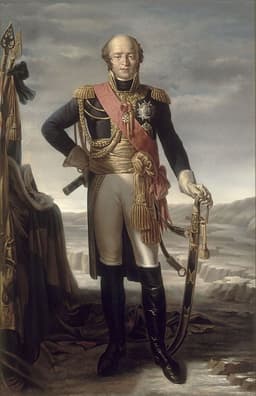
Louis-Nicolas Davout
General · Modern
66.2Total

Napoleon Bonaparte
General · Modern
70.9Total
Basic Information
Born
1770
1769
Died
1823
1821
Era
Modern
Modern
Nationality
France
France
Occupation
General
General
Civilization
Western
Western
Score Comparison
Military (10%)
65.0
94.0
Political (20%)
68.0
72.0
Influence (20%)
55.0
40.0
Legacy (20%)
72.0
80.0
Leadership (15%)
70.0
78.0
Strategy (15%)
72.0
90.0
TOTAL
66.2
70.9
Louis-Nicolas Davout — Complete Timeline
1805 AD
Battle of AusterlitzWar
Davout commanded the III Corps on the right flank, holding off the main Austrian-Russian attack while Napoleon crushed the center. His corps marched 120 km in 48 hours to reach the battlefield. This victory destroyed the Third Coalition and established French dominance in Europe.
Napoleonic WarsBattleDecisive Victory
Impact: global
1806 AD
Battle of AuerstedtWar◆ Major
Davout's single corps of 26,000 men defeated the main Prussian army of 63,000 under the Duke of Brunswick. He used aggressive tactics and superior discipline to rout the Prussians. This victory, on the same day as Napoleon's victory at Jena, led to the collapse of Prussia.
Napoleonic WarsBattlePrussian Campaign
Impact: regional
1807 AD
Governor-General of the Duchy of WarsawPolitical Action
Davout was appointed governor-general of the newly created Duchy of Warsaw. He organized the Polish army and administration, implementing French legal and military reforms. His efficient governance helped secure Polish support for Napoleon's campaigns.
AdministrationPolandReform
Impact: regionalconstructive
1812 AD
Battle of BorodinoWar◆ Major
Davout commanded the I Corps in the center of the French line, leading assaults on the Russian fortifications. He was wounded but continued to command. The battle was a tactical draw but a strategic disaster for Napoleon, as the Russians withdrew and later forced the French retreat.
Napoleonic WarsBattleRussian Campaign
Impact: regional
1813 AD
Defended Hamburg during the War of the Sixth CoalitionWar◆ Major
Davout held Hamburg against a Prussian-Russian siege for over a year, using harsh measures including expelling civilians. He surrendered only after Napoleon's abdication. His defense was militarily competent but criticized for its brutality, tarnishing his reputation.
Napoleonic WarsSiegeControversy
Impact: regionaldestructive
1814 AD
Switched allegiance to Louis XVIII after Napoleon's first abdicationPolitical Action
After Napoleon's abdication, Davout submitted to the Bourbon monarchy and was made a peer of France. He did not join Napoleon during the Hundred Days until ordered to do so by the king. This pragmatic decision allowed him to retain his titles and avoid execution.
Political SurvivalBourbon RestorationAllegiance
Impact: national
Napoleon Bonaparte — Complete Timeline
1799 AD
Coup of 18 BrumaireOther◆ Major
Napoleon Bonaparte, with support from his brother Lucien and key political figures, overthrew the Directory in a bloodless coup. He established the Consulate with himself as First Consul, effectively becoming the ruler of France. This event ended the French Revolution's most unstable period.
French RevolutionCoupRise to Power
Impact: regional
1804 AD
Promulgation of the Napoleonic CodeOther◆ Major
Napoleon enacted the Civil Code of the French, known as the Napoleonic Code, a comprehensive set of laws that replaced the fragmented feudal legal systems. The code established legal equality, protected property rights, and secularized law. It became the basis for legal systems in many European and world countries.
Legal ReformNapoleonic CodeCivil Law
Impact: globalconstructive
1805 AD
Battle of AusterlitzWar◆ Major
Napoleon's Grande Arm
Napoleonic WarsBattleDecisive Victory
Impact: global
1812 AD
Invasion of RussiaWar◆ Major
Napoleon led the Grande Arm
Napoleonic WarsInvasionDisaster
Impact: globaldestructive
1815 AD
Battle of WaterlooWar◆ Major
Napoleon's French army was defeated by the combined forces of the Duke of Wellington's Anglo-Allied army and Gebhard Leberecht von Bl
Napoleonic WarsBattleFinal Defeat
Impact: globaldestructive
Expert Analysis
louis-nicolas-davout-vs-napoleon-bonaparte
# The Iron Marshal and the Emperor: Davout and Napoleon, a Study in Contrasts
On a cold October morning in 1806, two French commanders awoke to very different fates. Napoleon Bonaparte, at Jena, faced a Prussian army he would crush with characteristic brilliance. Thirty kilometers away, his subordinate Louis-Nicolas Davout faced something far worse: the main Prussian force, outnumbering his single corps more than two to one. By nightfall, Davout had achieved what Napoleon himself called the most glorious feat of the war. Yet today, every schoolchild knows the name Napoleon, while Davout remains a footnote. Why did one man become legend and the other merely a footnote to that legend?
Origins
Napoleon Bonaparte was born in 1769 on Corsica, an island that had just been sold to France by Genoa. His family was minor nobility—impoverished, resentful, and fiercely ambitious. Young Napoleon spoke Italian before French, wore his foreignness like armor, and channeled his outsider's rage into ruthless self-advancement. At the military academy of Brienne, he was teased for his accent and small stature; he responded by outstudying everyone.
Louis-Nicolas Davout, born a year later in 1770, came from Burgundian aristocracy—genuine, established nobility. His family had served French kings for generations. Where Napoleon had to claw his way up, Davout was born near the top. Yet this advantage came with its own burden: the French Revolution would target men of his class. Davout survived by embracing the Revolution with the same discipline he would later show on the battlefield. While Napoleon learned to charm and manipulate, Davout learned to endure.
Rise to Power
Napoleon's rise was a series of calculated gambles. At twenty-four, he drove the British from Toulon. At twenty-six, he saved the Directory from a royalist mob with a "whiff of grapeshot." At twenty-seven, he conquered Italy. Each victory was accompanied by brilliant self-promotion—bulletins, propaganda, the careful cultivation of his own myth. Napoleon understood that power flowed not just from victory but from the *story* of victory.
Davout's path was quieter. He served in the revolutionary armies, distinguished himself at the Battle of Neerwinden in 1793, and caught Napoleon's eye during the Egyptian campaign. But Davout never sought the spotlight. When Napoleon made him a Marshal of the Empire in 1804, Davout was thirty-four—young for such an honor, but he had earned it through competence, not charisma. He was, in a sense, promoted because he was reliable, not because he was dazzling.
Leadership & Governance
Napoleon ruled as a force of nature. His military genius—scoring 94 in military skill and 93 in strategy—was matched by his political acumen, rated 75. He reorganized France's legal system with the Napoleonic Code, centralized the administration, and created a meritocracy that rewarded talent over birth. But he also centralized power in himself, brooked no dissent, and treated Europe as a chessboard for his ambition.
Davout governed differently. As Governor-General of the Duchy of Warsaw in 1807, he organized the Polish army and administration with methodical precision. He was harsh but fair—the "Iron Marshal" earned his nickname not just for battlefield toughness but for unyielding integrity. Unlike Napoleon, who could be mercurial and vindictive, Davout was consistent. He punished corruption, protected civilians when possible, and enforced discipline even on himself.
On the battlefield, their styles diverged sharply. Napoleon was the grand strategist, moving armies like pieces on a map, seeking the decisive battle that would destroy his enemy in a single blow. Davout was the tactical executor—the man who took Napoleon's plans and made them work. At Austerlitz in 1805, Davout's III Corps held the right flank against the main Austrian-Russian attack, buying time for Napoleon's decisive stroke. At Auerstedt in 1806, Davout's single corps of 26,000 defeated the main Prussian army of 63,000 through aggressive, coordinated assaults that exploited every gap in the enemy line. He never lost a major battle—a record Napoleon himself could not claim.
Triumph & Tragedy
Napoleon's greatest triumph was Austerlitz, where he destroyed a larger allied army and crowned himself master of Europe. His greatest tragedy was the 1812 invasion of Russia, where he lost his Grande Armée to the Russian winter and his own hubris. The retreat from Moscow broke his aura of invincibility and set the stage for his downfall.
Davout's triumphs were quieter but no less real. Auerstedt was his Austerlitz—a victory so complete that it shocked Europe. His defense of Hamburg in 1813-1814, holding the city against a Prussian-Russian siege for over a year, was a masterpiece of determination. But his tragedy came in 1814, when Napoleon first abdicated. Davout, ever the pragmatist, swore allegiance to the restored Bourbon king Louis XVIII. He did not join Napoleon during the Hundred Days until the emperor's return seemed inevitable. This act of political survival cost him his place in the Napoleonic legend—the pure hero does not compromise.
Character & Destiny
Napoleon was driven by an insatiable hunger for glory. "I live only for posterity," he once said. He could be charming, generous, and visionary, but also ruthless, paranoid, and self-destructive. His personality was the engine of his rise and the cause of his fall—he could not stop conquering, could not share power, could not admit limits.
Davout was the opposite. Reserved, austere, and intensely loyal to duty, he was respected rather than loved. His soldiers called him "the Iron Marshal" for his discipline; his enemies respected him for his competence. Where Napoleon burned bright and fast, Davout burned steady and long. But Davout lacked the charisma to inspire devotion, the political instinct to navigate court intrigues, and the ambition to seek supreme power. He was, in the end, a perfect instrument—but instruments are forgotten when the master is gone.
Legacy
Napoleon's legacy is immense and contradictory. He is remembered as a military genius who reshaped Europe, a reformer who spread revolutionary ideals, and a tyrant who caused millions of deaths. His Napoleonic Code influenced legal systems worldwide. His name is synonymous with ambition, brilliance, and ultimate failure.
Davout's legacy is narrower but purer. Military historians rank him among history's greatest corps commanders—the man who never lost a battle. He is remembered as the epitome of the professional soldier: competent, disciplined, and loyal. But his political score of 72 and influence score of 66.7 reflect his limitations. He was a great general but not a great man in the Napoleonic sense—he changed tactics, not history.
Conclusion
The contrast between Napoleon and Davout is the contrast between the sun and the moon. Napoleon generated his own light, blazing across the sky, illuminating and scorching everything in his path. Davout reflected that light, steady and reliable, but never casting his own shadow. Both were necessary for the Napoleonic era—the visionary who dreamed the impossible and the executor who made dreams real. But history remembers the dreamers, not the doers. Napoleon's total score of 82.4 versus Davout's 73.9 captures this difference, but numbers cannot convey the deeper truth: that greatness is not merely about what one achieves, but about how one's story is told. Davout may have been the better soldier, but Napoleon was the better storyteller—and in the end, the storyteller always wins.
Rankings
🥇
Napoleon BonaparteLeader
Mil: 94.0Pol: 72.0Inf: 40.0
70.9
🥈
Louis-Nicolas Davout
Mil: 65.0Pol: 68.0Inf: 55.0
66.2
+4.7 behind
How This Comparison Works
Algorithm
Each figure is scored on 6 dimensions (0—100 scale) based on structured historical data: Military (10%), Political (20%), Influence (20%), Legacy (20%), Leadership (15%), Strategy (15%). The weighted total produces the final ranking.
Data Sources
Scores are computed from structured sub-indicators in the database. Scale factors adjust for era (Ancient ×0.85, Modern ×1.0) and civilization size (Eastern ×1.05, Other ×0.80) to account for differences in population and military scale.
Maximum 3 Figures
Comparisons are limited to 2—3 figures to ensure readability and statistical meaningfulness.
Error Margins
±5 points per dimension — Sub-scores are derived from historical records with inherent uncertainty. Two figures within 5 points on a dimension should be considered roughly equivalent in that area.
Total Score Accuracy
±3 points overall — The weighted combination of 6 dimensions produces a total score with approximately ±3 points of uncertainty. Differences of less than 3 points are not statistically significant— the figures are effectively tied.
Known Limitations
- Historical records are incomplete and uneven across civilizations
- Figures from oral-tradition societies may be underrepresented
- Occupation labels can misclassify multi-role figures
- Scores measure capability and impact, not moral character
- Quantitative scoring is a comparison tool, not absolute truth
Capability Radar
Military (10%) — Battles & Warfare
Battles
85
95
Win Rate
95
90
Expansion
80
95
Political (20%) — Governance & Reform
Reform
55
95
Diplomacy
50
80
Economy
45
85
Influence (20%) — Cultural & Global Reach
Cultural
60
85
Global
60
90
Legacy (20%) — Historical Impact
Historical
75
95
Longevity
65
90
Leadership (15%) — Power & Stability
Tenure
60
85
Stability
55
70
Strategy (15%) — Tactics & Innovation
Strategy
88
95
Tactics
92
98
Reform
75
92
Similar Comparisons
Comments & Discussion
Auerstädt的幽灵6/17/2026
别给达武贴“忠臣”标签了。他是拿破仑帝国里唯一没输过战役的元帅,结果呢?1814年拿破仑宁可信任马尔蒙的谄媚,也不听达武的防守建议。奥尔斯塔特是运气?去问问布吕歇尔在1813年怎么被达武按在汉堡打吧。皇帝嫉妒手下太能打,这才是真相。
MarshalMonocle6/17/2026
Davout was a tactical glitch in Napoleon’s system—an actual meritocrat who didn’t need charisma to win. At Auerstädt, he routed the Prussians with 26,000 men against 63,000, while Napoleon was busy crushing a phantom force at Jena. Without theatrical bull, just precision. If Bonaparte was the rockstar, Davout was the studio engineer—essential, boring, and erased from the poster.
DataSceptic6/17/2026
Let’s talk numbers. Napoleon’s record is propped up by sheer scale—he outnumbered opponents in 60% of his major battles. Davout at Auerstädt had a force ratio of 1:2.4 against him and still crushed them. That’s a higher effectiveness ratio than most of Napoleon’s “genius” victories. If we normalize for odds, Davout’s performance is statistically superior. Yet history rewards the grand narrative, not the spreadsheet.
Arrogance&Ink6/17/2026
达武的弱点恰恰是他的“忠诚”——拿破仑在1815年复辟时,达武居然接受了陆军大臣职位,成了百日皇朝的帮凶。一个真正伟大的将领应该在滑铁卢前就警告皇帝战术过时,而不是事后写回忆录撇清关系。他是拿破仑的影子,却不敢做皇帝没有的镜子。
CorsicanCritic6/17/2026
Stop mythifying Davout as an underdog. He was a noble who profited from the Revolution by switching sides at the right time. Napoleon earned his marshals in blood and betrayal—Davout got his through survival. Sure, Auerstädt was impressive, but let’s not pretend he could have held the Grand Army together after Moscow. The Emperor’s genius was in building and inspiring, not just fighting. Davout was a tool, not a creator.