Loading...
Louis XIII of France vs Napoleon Bonaparte
Napoleon Bonaparte leads by 9.1 pts · 2 figures compared
…
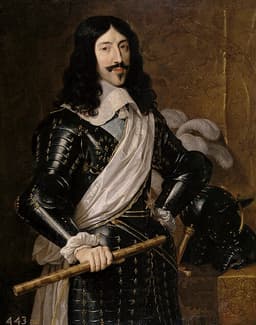
Louis XIII of France
Emperor · Modern
61.8Total

Napoleon Bonaparte
General · Modern
70.9Total
Basic Information
Born
1601
1769
Died
1643
1821
Era
Modern
Modern
Nationality
France
France
Occupation
Emperor
General
Civilization
Western
Western
Score Comparison
Military (10%)
55.0
94.0
Political (20%)
70.0
72.0
Influence (20%)
62.0
40.0
Legacy (20%)
54.0
80.0
Leadership (15%)
72.0
78.0
Strategy (15%)
60.0
90.0
TOTAL
61.8
70.9
Louis XIII of France — Complete Timeline
1624 AD
Appointment of Cardinal Richelieu as Chief MinisterPolitical Action◆ Major
Louis XIII appointed Armand Jean du Plessis, Cardinal Richelieu, as his chief minister. This decision established a partnership that centralized royal authority, suppressed Huguenot political power, and involved France in the Thirty Years' War against the Habsburgs.
RichelieuCentralizationThirty Years' War
Impact: national
1627 AD
Siege of La RochelleWar◆ Major
Louis XIII and Richelieu besieged the Huguenot stronghold of La Rochelle for 14 months. The city surrendered in October 1628, ending Huguenot political and military autonomy in France and consolidating royal power.
HuguenotsReligious WarsSiege
Impact: nationaldestructive
1630 AD
Day of the DupesPolitical Action◆ Major
Louis XIII's mother, Marie de' Medici, and other nobles attempted to force the dismissal of Richelieu. Louis XIII publicly sided with Richelieu, exiling his mother and confirming Richelieu's position as the dominant minister, solidifying absolutist rule.
RichelieuCourt IntrigueAbsolutism
Impact: national
1635 AD
French Entry into the Thirty Years' WarWar◆ Major
Louis XIII declared war on Spain, bringing France openly into the Thirty Years' War. This intervention shifted the balance of power, leading to French victories and the eventual weakening of Habsburg dominance in Europe.
Thirty Years' WarHabsburgForeign Policy
Impact: global
1638 AD
Birth of Louis XIVOther◆ Major
After 23 years of childless marriage, Louis XIII's wife Anne of Austria gave birth to a son, the future Louis XIV. This event secured the Bourbon succession and ended a potential succession crisis.
SuccessionBourbon Dynasty
Impact: nationalconstructive
Napoleon Bonaparte — Complete Timeline
1799 AD
Coup of 18 BrumaireOther◆ Major
Napoleon Bonaparte, with support from his brother Lucien and key political figures, overthrew the Directory in a bloodless coup. He established the Consulate with himself as First Consul, effectively becoming the ruler of France. This event ended the French Revolution's most unstable period.
French RevolutionCoupRise to Power
Impact: regional
1804 AD
Promulgation of the Napoleonic CodeOther◆ Major
Napoleon enacted the Civil Code of the French, known as the Napoleonic Code, a comprehensive set of laws that replaced the fragmented feudal legal systems. The code established legal equality, protected property rights, and secularized law. It became the basis for legal systems in many European and world countries.
Legal ReformNapoleonic CodeCivil Law
Impact: globalconstructive
1805 AD
Battle of AusterlitzWar◆ Major
Napoleon's Grande Arm
Napoleonic WarsBattleDecisive Victory
Impact: global
1812 AD
Invasion of RussiaWar◆ Major
Napoleon led the Grande Arm
Napoleonic WarsInvasionDisaster
Impact: globaldestructive
1815 AD
Battle of WaterlooWar◆ Major
Napoleon's French army was defeated by the combined forces of the Duke of Wellington's Anglo-Allied army and Gebhard Leberecht von Bl
Napoleonic WarsBattleFinal Defeat
Impact: globaldestructive
Expert Analysis
louis-xiii-of-france-vs-napoleon-bonaparte
# The King and the Emperor: Two Faces of French Power
On a winter morning in 1643, Louis XIII lay dying in his gilded chamber at the Louvre, a king who had spent thirty-three years on the throne yet seemed almost a ghost in his own court. Less than two centuries later, another French ruler would stride across Europe with an ambition so vast that it redrew the map of a continent. One man ruled through a minister; the other ruled through sheer force of will. Both were French, both were sovereigns, yet they inhabited such different worlds that comparing them feels less like examining two rulers and more like studying two species of power. How did Louis XIII, the reluctant king, and Napoleon Bonaparte, the self-made emperor, come to embody such radically different visions of leadership—and what drove their vastly different outcomes?
Origins
Louis XIII was born into the throne itself, a Bourbon prince who became king at the age of eight in 1610, inheriting a realm fractured by religious wars and noble conspiracies. His father, Henri IV, had been assassinated, and the young king grew up in the shadow of his formidable mother, Marie de' Medici, who ruled as regent. Louis was shy, stuttering, and prone to melancholy—a boy who loved falconry and locksmithing more than courtly intrigue. He was shaped by an era when kingship was still sacred, when power flowed from blood and tradition, and when a monarch's primary duty was to hold together a kingdom perpetually on the verge of collapse.
Napoleon Bonaparte, born in 1769 on the island of Corsica, entered a world already in upheaval. His family were minor nobles, but he was a child of the Enlightenment and the Revolution, a time when old certainties were being shattered. His father had fought for Corsican independence, and young Napoleon grew up speaking Italian-accented French, an outsider in a nation that would one day worship him. Where Louis inherited a crown, Napoleon clawed his way up through military academies and artillery batteries. He was short, intense, and driven—a man who believed that destiny was something you seized, not something you were given.
Rise to Power
Louis XIII’s ascent was not a rise but a slow awakening. His mother ruled for him until 1617, when the seventeen-year-old king, tired of being a puppet, engineered the assassination of her favorite, Concino Concini, and seized control. Yet even then, Louis lacked the confidence to rule alone. His true rise began in 1624, when he appointed Armand Jean du Plessis—Cardinal Richelieu—as his chief minister. This was the key turning point: Louis recognized that he needed a genius to execute his will, and he had the wisdom to trust one. Together, they forged a partnership that would define the reign.
Napoleon’s rise was a thunderbolt. He became a general at twenty-four, crushed royalist uprisings in Paris, and by thirty had staged a coup d'état in 1799, making himself First Consul. His path was forged in the chaos of revolution, where merit could outrank birth and a Corsican outsider could become the master of France. By 1804, he crowned himself Emperor in Notre-Dame, taking the crown from the Pope’s hands and placing it on his own head—a gesture Louis XIII would have found both blasphemous and incomprehensible.
Leadership & Governance
Louis XIII governed through delegation. He was not a military commander—his Military score of 55 reflects a king who rarely led armies himself—but he had the political acumen to let Richelieu centralize power, crush the Huguenot stronghold at La Rochelle in 1628, and bring France into the Thirty Years' War in 1635. The Siege of La Rochelle, a fourteen-month campaign, was Richelieu’s triumph, but it was Louis who backed him when nobles and even the king’s own mother tried to force the cardinal’s dismissal during the Day of the Dupes in 1630. Louis chose the minister over his mother, a decision that required a quiet, stubborn courage.
Napoleon governed through personal dominance. His military score of 94 tells the story: he led armies from the front, winning battles like Austerlitz in 1805 with tactical brilliance that still studied today. He reformed France through the Napoleonic Code, a legal framework that modernized property rights and civil law. But where Louis shared power, Napoleon hoarded it. His political score of 75 reflects a leader who could inspire loyalty but also demanded absolute control, a trait that would ultimately isolate him.
Triumph & Tragedy
Louis XIII’s greatest triumph was survival. He held the kingdom together through war, religious strife, and the machinations of his own family. In 1638, after twenty-three years of childless marriage, his wife Anne of Austria gave birth to the future Louis XIV—the Sun King who would fulfill the absolutist dream his father had only begun. Louis XIII died in 1643, just as France was becoming the dominant power in Europe. His tragedy was that he never fully lived: he was a king overshadowed by his minister, his wife, and eventually his son.
Napoleon’s triumph was the conquest of Europe. He redrew borders, toppled thrones, and spread revolutionary ideals across the continent. His tragedy was the Russian campaign of 1812, where the Grand Army was destroyed by winter and distance, and his final defeat at Waterloo in 1815. Exiled to Saint Helena, he died at fifty-one, a prisoner of the British, his empire reduced to memory.
Character & Destiny
Louis XIII’s character was one of restraint. He was pious, dutiful, and self-effacing—a man who understood that his role was to embody the state, not to dominate it. His destiny was to be a bridge between the chaos of the religious wars and the glory of his son’s reign. He was, in a sense, the perfect constitutional monarch for an absolute age: he knew when to step aside and let others act.
Napoleon’s character was one of relentless ambition. He once said, “Impossible is a word to be found only in the dictionary of fools.” His destiny was to test the limits of human will, to see how far one man could bend history to his desires. But that same ambition led to overreach. He could not stop, could not share power, and so he fell.
Legacy
Louis XIII is remembered today as the king who made Louis XIV possible. His Legacy score of 67.6 reflects a ruler whose name is often forgotten, yet whose reign laid the foundations for French absolutism. The Louvre, the Académie Française, and the consolidation of royal power all trace back to his era.
Napoleon’s legacy is a paradox. His Influence score of 82 and Legacy of 78 capture a man who reshaped modern Europe: the Napoleonic Code, the metric system, the very idea of a citizen army. Yet he is also a cautionary tale about the cost of unchecked ambition. He is remembered in statues and streets, in law codes and battlefields, but also in the graves of half a million soldiers.
Conclusion
Standing at the foot of Napoleon’s tomb at Les Invalides, one feels the weight of glory. But walking through the quiet corridors of the Louvre, where Louis XIII once hunted falcons in the gardens, one senses a different kind of power—the power of patience, of partnership, of knowing when to rule through others. Napoleon burned like a comet; Louis XIII glowed like a steady ember. Both were French, both were rulers, but they teach us that leadership is not one thing. It is a choice—between the flame and the foundation, between the self and the state. And perhaps, in the end, the quieter king built something that lasted longer than the emperor’s empire.
Rankings
🥇
Napoleon BonaparteLeader
Mil: 94.0Pol: 72.0Inf: 40.0
70.9
🥈
Louis XIII of France
Mil: 55.0Pol: 70.0Inf: 62.0
61.8
+9.1 behind
How This Comparison Works
Algorithm
Each figure is scored on 6 dimensions (0—100 scale) based on structured historical data: Military (10%), Political (20%), Influence (20%), Legacy (20%), Leadership (15%), Strategy (15%). The weighted total produces the final ranking.
Data Sources
Scores are computed from structured sub-indicators in the database. Scale factors adjust for era (Ancient ×0.85, Modern ×1.0) and civilization size (Eastern ×1.05, Other ×0.80) to account for differences in population and military scale.
Maximum 3 Figures
Comparisons are limited to 2—3 figures to ensure readability and statistical meaningfulness.
Error Margins
±5 points per dimension — Sub-scores are derived from historical records with inherent uncertainty. Two figures within 5 points on a dimension should be considered roughly equivalent in that area.
Total Score Accuracy
±3 points overall — The weighted combination of 6 dimensions produces a total score with approximately ±3 points of uncertainty. Differences of less than 3 points are not statistically significant— the figures are effectively tied.
Known Limitations
- Historical records are incomplete and uneven across civilizations
- Figures from oral-tradition societies may be underrepresented
- Occupation labels can misclassify multi-role figures
- Scores measure capability and impact, not moral character
- Quantitative scoring is a comparison tool, not absolute truth
Capability Radar
Military (10%) — Battles & Warfare
Battles
45
95
Win Rate
50
90
Expansion
50
95
Political (20%) — Governance & Reform
Reform
65
95
Diplomacy
75
80
Economy
60
85
Influence (20%) — Cultural & Global Reach
Cultural
50
85
Global
50
90
Legacy (20%) — Historical Impact
Historical
60
95
Longevity
55
90
Leadership (15%) — Power & Stability
Tenure
70
85
Stability
55
70
Strategy (15%) — Tactics & Innovation
Strategy
55
95
Tactics
40
98
Reform
60
92
Similar Comparisons
Comments & Discussion
Cardinal's Shadow6/17/2026
Louis XIII wasn't a weak king—he was a strategic genius who understood power delegation better than Napoleon ever did. While Napoleon micromanaged the entire Grande Armée down to rations, Louis picked Richelieu and let him work. Results? Louis crushed the Habsburgs and laid the groundwork for French hegemony. Napoleon's ego got him exiled twice. Give me the quiet king who reads the room over the emperor who burns it down every time.
历史拆解师6/17/2026
说拿破仑是军事天才?那你怎么解释他丢掉了法国自路易十三时代起在欧洲积累的所有战略优势?路易十三时期法国拿下了阿尔萨斯和鲁西永,真正建立起对哈布斯堡的包围圈。而拿破仑呢?莱比锡一战就把各代国王攒下的家底败得精光。一个靠世代外交稳扎稳打,一个靠个人冒险赌国运。你要说谁真正扩张了法国,我站红衣主教背后的那个沉默国王。
Corsican Meteor6/17/2026
Comparing Louis XIII to Napoleon is like comparing a candle to a supernova. Napoleon reshaped not just France, but the entire Western legal system with the Napoleonic Code. Louis XIII couldn't even control his own mother's regency for a decade. The Bourbon was a puppet who happened to have a brilliant minister; Napoleon was the puppet master who conquered from Madrid to Moscow. One died in his own bed surrounded by courtiers, the other still haunts European history.
虚实皆鉴6/17/2026
等一下,你们都在谈外交和战争,可法国的权力核心问题被忽略了。路易十三时代的绝对君主制其实是个谎言——他本人不过是个礼仪符号,真正的权力始终在红衣主教们和贵族网络之间流动。而拿破仑才是真正打破旧制度的独裁者,他不是继承王位,他在战场上亲手"挣"来了整个帝国。一个是被王冠压着的孩子,一个是把王冠戴在自己头上的男人。这根本是两种政体的对决,不是两个国王的比较。