Loading...
Louis XIII vs Napoleon Bonaparte
Napoleon Bonaparte leads by 10.6 pts · 2 figures compared
…
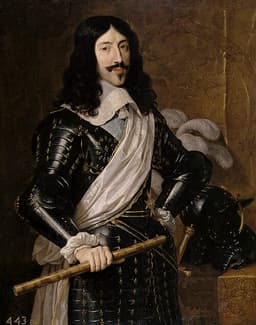
Louis XIII
Emperor · Modern
60.3Total

Napoleon Bonaparte
General · Modern
70.9Total
Basic Information
Born
1601
1769
Died
1643
1821
Era
Modern
Modern
Nationality
France
France
Occupation
Emperor
General
Civilization
Western
Western
Score Comparison
Military (10%)
55.0
94.0
Political (20%)
55.0
72.0
Influence (20%)
61.0
40.0
Legacy (20%)
58.0
80.0
Leadership (15%)
72.0
78.0
Strategy (15%)
60.0
90.0
TOTAL
60.3
70.9
Louis XIII — Complete Timeline
1624 AD
Appointed Cardinal Richelieu as Chief MinisterPolitical Action
Louis XIII appointed Cardinal Richelieu as his chief minister, beginning a partnership that centralized royal power. Richelieu's policies strengthened the monarchy, suppressed noble rebellions, and expanded French influence in Europe.
AppointmentRichelieuCentralization
Impact: national
1627 AD
Siege of La RochelleWar◆ Major
Louis XIII and Richelieu besieged the Huguenot stronghold of La Rochelle for 14 months, forcing its surrender. This victory ended Huguenot political and military power in France, enforcing Catholic unity.
SiegeHuguenotsReligious Conflict
Impact: nationaldestructive
1630 AD
Day of the DupesPolitical Action◆ Major
Louis XIII faced a crisis when his mother Marie de' Medici and other nobles demanded Richelieu's dismissal. Louis chose to support Richelieu, exiling his mother and solidifying the cardinal's power, marking a turning point in French absolutism.
Political CrisisRichelieuRoyal Favor
Impact: national
1635 AD
Entry into the Thirty Years' WarWar◆ Major
Louis XIII declared war on Spain, entering the Thirty Years' War on the Protestant side. This intervention aimed to weaken Habsburg power and expand French influence, leading to significant military campaigns in Germany and the Low Countries.
Thirty Years' WarHabsburgFrench Intervention
Impact: regional
1638 AD
Birth of Louis XIVPolitical Action
The birth of Louis XIV, after 23 years of marriage, secured the Bourbon succession. This event was celebrated as a divine gift and ensured the continuity of the dynasty, later leading to the Sun King's long reign.
SuccessionBourbon DynastyHeir
Impact: nationalconstructive
Napoleon Bonaparte — Complete Timeline
1799 AD
Coup of 18 BrumaireOther◆ Major
Napoleon Bonaparte, with support from his brother Lucien and key political figures, overthrew the Directory in a bloodless coup. He established the Consulate with himself as First Consul, effectively becoming the ruler of France. This event ended the French Revolution's most unstable period.
French RevolutionCoupRise to Power
Impact: regional
1804 AD
Promulgation of the Napoleonic CodeOther◆ Major
Napoleon enacted the Civil Code of the French, known as the Napoleonic Code, a comprehensive set of laws that replaced the fragmented feudal legal systems. The code established legal equality, protected property rights, and secularized law. It became the basis for legal systems in many European and world countries.
Legal ReformNapoleonic CodeCivil Law
Impact: globalconstructive
1805 AD
Battle of AusterlitzWar◆ Major
Napoleon's Grande Arm
Napoleonic WarsBattleDecisive Victory
Impact: global
1812 AD
Invasion of RussiaWar◆ Major
Napoleon led the Grande Arm
Napoleonic WarsInvasionDisaster
Impact: globaldestructive
1815 AD
Battle of WaterlooWar◆ Major
Napoleon's French army was defeated by the combined forces of the Duke of Wellington's Anglo-Allied army and Gebhard Leberecht von Bl
Napoleonic WarsBattleFinal Defeat
Impact: globaldestructive
Expert Analysis
louis-xiii-vs-napoleon-bonaparte
The Crown and the Sword
On a May morning in 1643, a king lay dying in the royal château of Saint-Germain-en-Laye. Louis XIII, pale and wasted after months of tuberculosis, summoned his five-year-old son and spoke of duty, faith, and the burdens of France. Across the Channel, a different kind of ruler was yet to be born—but the contrast was already etched into history. One man inherited a throne and spent his life strengthening it; another seized a throne and spent his life trying to remake the world. Louis XIII and Napoleon Bonaparte: two Frenchmen, two centuries apart, whose names remain inseparable from the nation they led, yet whose paths could not have diverged more sharply. Why did one consolidate while the other conquered? What drove the monkish king to build quietly, and the Corsican artilleryman to burn so brightly?
Origins
Louis XIII entered the world in 1601, the son of Henry IV and Marie de’ Medici, born into a monarchy still scarred by the Wars of Religion. His father was assassinated when Louis was eight, leaving a boy-king raised by a mother who governed as regent, and by a court rife with intrigue. His childhood was lonely, his education rigorous, his health fragile. He learned to distrust, to observe, and to endure.
Napoleon was born in 1769 on the island of Corsica, recently annexed by France, into a minor noble family of Italian origin. He was not French by birth but by circumstance—an outsider who would later remake France in his image. The son of a lawyer, he entered military school at nine and graduated at sixteen, already reading the campaigns of Caesar and Alexander. Where Louis was shaped by court and clergy, Napoleon was shaped by cannon and revolution.
Their eras defined them as much as their blood. Louis ruled in an age of divine right, when kingship was sacred and the church was a pillar of state. Napoleon rose in an age of upheaval, when thrones were smashed and men could rise by talent alone. The seventeenth century demanded patience; the nineteenth rewarded audacity.
Rise to Power
Louis XIII became king at eight, but he did not truly rule until 1624, when he appointed Cardinal Richelieu as his chief minister. This was the turning point. At twenty-three, the young king chose a man of genius over his own mother’s faction—a decision that would define his reign. Richelieu was ruthless, calculating, and devoted to the crown. Together, they broke the power of the Huguenots, besieging La Rochelle for fourteen months in 1627 until the city surrendered. In 1630, during the Day of the Dupes, Louis faced a crisis when his mother and nobles demanded Richelieu’s dismissal. He chose the cardinal. He chose centralization. He chose the state over family.
Napoleon’s rise was faster, more spectacular, and far more personal. He was a young artillery officer during the French Revolution, a man of no name but great ambition. In 1793, at the Siege of Toulon, he drove the British from the port with a plan of such audacity that he was promoted to brigadier general at twenty-four. He married Joséphine de Beauharnais in 1796, then took command of the Army of Italy, winning battle after battle against the Austrians. In 1799, he returned from Egypt to stage a coup d’état, becoming First Consul. By 1804, he crowned himself Emperor of the French. Louis rose by appointment; Napoleon rose by conquest.
Leadership & Governance
Louis XIII governed through delegation. He did not lead armies in the field—his health and temperament forbade it—but he chose Richelieu and backed him absolutely. Together, they centralized royal power, suppressed rebellion, and in 1635 entered the Thirty Years’ War on the Protestant side to weaken the Habsburgs. This was not glory for glory’s sake; it was cold statecraft. Louis’s rule was about order, stability, and the long game. He reformed the administration, curbed the nobility, and laid the foundations for the absolutism of his son, Louis XIV.
Napoleon governed through personal command. He was a military genius—his strategic scores of 93 and military rating of 94 reflect a mind that could read a battlefield like a chessboard. He reformed French law through the Napoleonic Code, establishing principles of equality and merit that outlasted his empire. He built schools, roads, and a centralized bureaucracy. But his governance was inseparable from his ambition. Every reform served his wars; every victory fed his legend. He was a political innovator (75.0) but a restless one, unable to stop.
Triumph & Tragedy
Louis XIII’s greatest triumph was the birth of his son in 1638, after twenty-three years of marriage. The Dauphin, later Louis XIV, secured the Bourbon line. This was celebrated as a divine gift—a quiet victory of patience and faith. His tragedy came in 1642, when Richelieu died, followed by Louis himself a year later, leaving a five-year-old king and a regency that would see the Fronde rebellion.
Napoleon’s triumphs were dazzling: Austerlitz in 1805, the conquest of Prussia in 1806, the creation of a vast European empire. His tragedy was the invasion of Russia in 1812—a catastrophic retreat that destroyed his Grand Army. Exiled to Elba, he returned for a hundred days, only to meet final defeat at Waterloo in 1815. He died in 1821 on Saint Helena, a prisoner of the British.
Character & Destiny
Louis XIII was melancholic, devout, and reserved. He loved hunting and music, not war. He was overshadowed by Richelieu in life and by his son in legend, but he made the choices that enabled both. His character was one of endurance—he held the line.
Napoleon was restless, brilliant, and insatiable. “Impossible,” he once said, “is a word to be found only in the dictionary of fools.” His character drove him to conquer, but also to overreach. He could not stop because he could not imagine limits.
Legacy
Louis XIII is remembered as the king who built the foundations of French absolutism. His scores—military 55.0, political 73.0, influence 74.4, legacy 65.2—reflect a ruler who governed through others, but whose decisions shaped France for a century. He is the architect behind the throne.
Napoleon’s legacy is immense: military 94.0, political 75.0, influence 82.0, legacy 78.0. He is a symbol of ambition, of the modern state, of the power of individual will. His code, his campaigns, his myth—they endure.
Conclusion
Standing at the end of their stories, one sees two different faces of France. Louis XIII built a fortress; Napoleon built a fire. One worked through a minister, the other through his own will. Both shaped history, but in opposite ways: the king who said no to his mother, the emperor who could not say no to himself. Their differences are not merely of era or talent—they are of soul. And perhaps that is the deepest lesson: that power, like a river, can carve canyons or nourish fields, depending on the hand that guides it.
Rankings
🥇
Napoleon BonaparteLeader
Mil: 94.0Pol: 72.0Inf: 40.0
70.9
🥈
Louis XIII
Mil: 55.0Pol: 55.0Inf: 61.0
60.3
+10.6 behind
How This Comparison Works
Algorithm
Each figure is scored on 6 dimensions (0—100 scale) based on structured historical data: Military (10%), Political (20%), Influence (20%), Legacy (20%), Leadership (15%), Strategy (15%). The weighted total produces the final ranking.
Data Sources
Scores are computed from structured sub-indicators in the database. Scale factors adjust for era (Ancient ×0.85, Modern ×1.0) and civilization size (Eastern ×1.05, Other ×0.80) to account for differences in population and military scale.
Maximum 3 Figures
Comparisons are limited to 2—3 figures to ensure readability and statistical meaningfulness.
Error Margins
±5 points per dimension — Sub-scores are derived from historical records with inherent uncertainty. Two figures within 5 points on a dimension should be considered roughly equivalent in that area.
Total Score Accuracy
±3 points overall — The weighted combination of 6 dimensions produces a total score with approximately ±3 points of uncertainty. Differences of less than 3 points are not statistically significant— the figures are effectively tied.
Known Limitations
- Historical records are incomplete and uneven across civilizations
- Figures from oral-tradition societies may be underrepresented
- Occupation labels can misclassify multi-role figures
- Scores measure capability and impact, not moral character
- Quantitative scoring is a comparison tool, not absolute truth
Capability Radar
Military (10%) — Battles & Warfare
Battles
45
95
Win Rate
55
90
Expansion
55
95
Political (20%) — Governance & Reform
Reform
65
95
Diplomacy
75
80
Economy
60
85
Influence (20%) — Cultural & Global Reach
Cultural
50
85
Global
55
90
Legacy (20%) — Historical Impact
Historical
65
95
Longevity
60
90
Leadership (15%) — Power & Stability
Tenure
70
85
Stability
55
70
Strategy (15%) — Tactics & Innovation
Strategy
50
95
Tactics
40
98
Reform
60
92
Similar Comparisons
Comments & Discussion
Crown-Consolidator6/17/2026
Louis XIII wasn't just a monk in a crown—he was the quiet architect of French absolutism. By crushing the Huguenot rebellion at La Rochelle in 1628, he proved more ruthless than Napoleon ever was against internal dissent. While Big N blew through Europe with smoke and mirrors, Louis carefully dismantled feudal power through intendants and Cardinals. Napoleon's glory is French myth; Louis's system actually lasted.
暴君粉饰师6/17/2026
拿战浪漫叙事掩盖了肮脏事实——拿破仑的军靴每踏一步,路易十三的龙骑兵就多一分恶心。滑铁卢死的是五万男儿,拉罗谢尔饿死的却是全身全民。督政府换帝国,换汤不换药;路易十三砍了贵族头,法国才真正站住脚。谁更配叫'法国之子'?历史判了。
Bayonet-Beatnik6/17/2026
Nice story, but facts hate Napoleon mythmakers. Louis XIII's reign saw steady GDP growth, colonial expansion in Quebec, and zero hyperinflation. Napoleon's blockades destroyed French textiles, his Continental System alienated allies, and his invasion of Russia killed 450,000 men for zero gain. Louis built infrastructure; Napoleon built body piles. Choose your "great man" wisely.
数据拆解者6/17/2026
路易十三时期铸币含银量稳定在83%,拿破仑时代战乱导致跌至65%——这不是英雄史诗,是通货膨胀的尸检报告。所谓"重建法兰西"其实把国债翻了四倍,最后靠波兰庄园的农奴税补窟窿。吹滑铁卢之前,先看看物价。