Loading...
Maeda Toshiie vs Napoleon Bonaparte
Napoleon Bonaparte leads by 10.8 pts · 2 figures compared
…
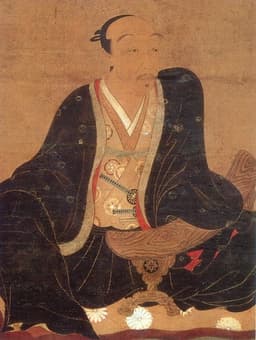
Maeda Toshiie
General · Modern
60.1Total

Napoleon Bonaparte
General · Modern
70.9Total
Basic Information
Born
1538
1769
Died
1599
1821
Era
Modern
Modern
Nationality
Japan
France
Occupation
General
General
Civilization
Eastern
Western
Score Comparison
Military (10%)
70.0
94.0
Political (20%)
68.0
72.0
Influence (20%)
56.4
40.0
Legacy (20%)
49.2
80.0
Leadership (15%)
72.0
78.0
Strategy (15%)
57.5
90.0
TOTAL
60.1
70.9
Maeda Toshiie — Complete Timeline
1583 AD
Battle of ShizugatakeWar◆ Major
Maeda Toshiie fought for Toyotomi Hideyoshi against Shibata Katsuie at the Battle of Shizugatake. His performance contributed to Hideyoshi's victory, which solidified Hideyoshi's control over Japan after the death of Oda Nobunaga.
Sengoku periodBattle
Impact: national
1590 AD
Siege of OdawaraWar
Maeda Toshiie participated in Toyotomi Hideyoshi's campaign against the Hojo clan at Odawara Castle. The siege ended with the Hojo surrender, leading to the unification of Japan under Hideyoshi.
Unification of JapanCampaign
Impact: national
1598 AD
Appointed as one of the Five EldersPolitical Action◆ Major
Toyotomi Hideyoshi appointed Maeda Toshiie as one of the Five Elders to govern Japan during the minority of his son Hideyori. This placed Toshiie among the highest-ranking officials in the Toyotomi administration, responsible for collective rule.
Toyotomi administrationRegency
Impact: national
1599 AD
Conflict with Tokugawa IeyasuPolitical Action◆ Major
After Hideyoshi's death, Maeda Toshiie opposed Tokugawa Ieyasu's growing influence. Tensions escalated, but Toshiie died before open conflict erupted. His death removed a key obstacle to Ieyasu's rise.
Power struggleTokugawa
Impact: national
Napoleon Bonaparte — Complete Timeline
1799 AD
Coup of 18 BrumaireOther◆ Major
Napoleon Bonaparte, with support from his brother Lucien and key political figures, overthrew the Directory in a bloodless coup. He established the Consulate with himself as First Consul, effectively becoming the ruler of France. This event ended the French Revolution's most unstable period.
French RevolutionCoupRise to Power
Impact: regional
1804 AD
Promulgation of the Napoleonic CodeOther◆ Major
Napoleon enacted the Civil Code of the French, known as the Napoleonic Code, a comprehensive set of laws that replaced the fragmented feudal legal systems. The code established legal equality, protected property rights, and secularized law. It became the basis for legal systems in many European and world countries.
Legal ReformNapoleonic CodeCivil Law
Impact: globalconstructive
1805 AD
Battle of AusterlitzWar◆ Major
Napoleon's Grande Arm
Napoleonic WarsBattleDecisive Victory
Impact: global
1812 AD
Invasion of RussiaWar◆ Major
Napoleon led the Grande Arm
Napoleonic WarsInvasionDisaster
Impact: globaldestructive
1815 AD
Battle of WaterlooWar◆ Major
Napoleon's French army was defeated by the combined forces of the Duke of Wellington's Anglo-Allied army and Gebhard Leberecht von Bl
Napoleonic WarsBattleFinal Defeat
Impact: globaldestructive
Expert Analysis
maeda-toshiie-vs-napoleon-bonaparte
### The Conqueror and the Keeper
In the winter of 1812, Napoleon Bonaparte watched his Grande Armée disintegrate in the snows of Russia, a catastrophe born of overreach. Seventeen years earlier, in the spring of 1599, Maeda Toshiie lay on his deathbed in Osaka, having spent his final months trying to prevent a similar implosion among the warlords of Japan. Both men were generals who rose to the apex of power in their respective worlds, yet their stories could not have ended more differently. One sought to reshape the world in his image; the other, to hold a fragile peace together. What drove these two warriors to such divergent fates?
### Origins
Napoleon was born in 1769 on the Mediterranean island of Corsica, a place recently annexed by France. His family was minor nobility, but his education at French military schools was a crucible of ambition. The French Revolution shattered the old order, creating a vacuum where talent, not birth, could rule. Napoleon was a child of this chaos, his mind forged in the fire of revolutionary ideology and the cold logic of artillery.
Maeda Toshiie, born in 1538, came of age in the blood-soaked landscape of the Sengoku period—Japan’s “Warring States” era. His clan was a retainer family in the service of the Oda, and his path was one of survival through loyalty. While Napoleon studied at the École Militaire, Toshiie learned his trade in the field, earning the nickname “Spear” for his ferocity in battle. His world was not one of sweeping ideals but of clan honor and the brutal calculus of local power.
### Rise to Power
Napoleon’s ascent was meteoric. In 1796, at just 26, he was given command of the French army in Italy. His 1796-1797 Italian campaign was a masterpiece of speed and maneuver, turning a ragged force into a conquering army. He capitalized on the Revolution’s chaos, positioning himself as the man who could restore order. The 1799 Coup of 18 Brumaire made him First Consul, and by 1804, he crowned himself Emperor. His power was built on victory.
Toshiie’s rise was slower, a ladder of incremental trust. He served Oda Nobunaga as a page, then a commander. In 1583, at the Battle of Shizugatake, he fought for Toyotomi Hideyoshi, securing his reputation. His participation in the 1590 Siege of Odawara further cemented his standing. He was not a revolutionary but a pillar of the new order. In 1598, Hideyoshi, dying, appointed Toshiie as one of the Five Elders, a council meant to govern for his infant son. Toshiie’s power came not from conquest but from being chosen.
### Leadership & Governance
Napoleon ruled with a pen as sharp as his sword. His Napoleonic Code, enacted in 1804, standardized French law, enshrined meritocracy, and influenced legal systems across Europe. He built roads, reorganized education, and centralized the state. Yet his governance was a dictatorship of genius—efficient, but brittle. His military strategy, rated 93 out of 100, was based on rapid movement and decisive battle, crushing enemies at Austerlitz in 1805 and Jena in 1806. But he never built sustainable alliances; he only demanded submission.
Toshiie’s leadership, scoring an 89.8 in leadership, was the opposite. He was a consolidator, not a conqueror. As one of the Five Elders, his role was to balance the ambitions of other lords, especially the rising Tokugawa Ieyasu. Where Napoleon issued decrees, Toshiie negotiated. His political score of 67.4 reflects the limitations of his authority; he was a regent, not a sovereign. His strategy, rated 72.0, was defensive and diplomatic, aimed at preserving the peace Hideyoshi had forged.
### Triumph & Tragedy
Napoleon’s greatest triumph was the Battle of Austerlitz in 1805, where he destroyed a combined Russian and Austrian army, a victory so complete it dissolved the Holy Roman Empire. His tragedy was the 1812 invasion of Russia. He marched 600,000 men into the vastness of winter and returned with fewer than 100,000. It was a failure of imagination—he could conquer territory but not the weather or the will of a people. His final defeat at Waterloo in 1815 was the end of an empire built on a single man’s ambition.
Toshiie’s triumph was quieter. In 1598, he was entrusted with the future of Japan. His tragedy was the conflict with Tokugawa Ieyasu that erupted after Hideyoshi’s death. Tensions escalated into a potential civil war, but Toshiie died in 1599 before it could be resolved. His death left the path clear for Ieyasu, who defeated his rivals at the 1600 Battle of Sekigahara and established the Tokugawa shogunate. Toshiie’s greatest failure was that he could not hold the peace long enough.
### Character & Destiny
Napoleon was driven by an insatiable hunger for glory. “I am not a man,” he once said, “I am a thing—a force.” His personality—brilliant, arrogant, restless—shaped every decision. He could not stop because stopping meant irrelevance. This hubris led him to invade Russia, to reject peace offers, and to exile himself to St. Helena. His destiny was to rise like a comet and burn out.
Toshiie was a man of duty. He served three masters—Nobunaga, Hideyoshi, and Hideyori—and died trying to serve the last. His character was that of a loyal retainer in a world where loyalty was rare. He did not seek to rule Japan; he sought to keep it from tearing itself apart. His destiny was to be a bridge between eras, a role that ensured his name would be honored but not legendary.
### Legacy
Napoleon’s legacy is global. He reshaped Europe’s borders, inspired nationalism, and left a legal and administrative blueprint that endures. His memory is a mix of admiration and caution—a symbol of both human potential and human folly. He is remembered as the man who put a crown on his own head and dared the world to stop him.
Maeda Toshiie is remembered primarily in Japan, as a model of loyalty and restraint. His son became a powerful lord, but Toshiie himself is a footnote in the epic of Sekigahara. Yet his legacy is no less real: he was one of the few who tried to prevent the war that followed. In a land of swords, he chose the shield.
### Conclusion
Napoleon and Toshiie stand as opposite poles of military leadership. One was a force of nature, a man who bent history to his will until it broke him. The other was a steward, a man who stood in the currents of history and tried to guide them. Napoleon’s story teaches us the danger of unchecked ambition; Toshiie’s, the quiet nobility of service. In the end, both were defeated—Napoleon by his own pride, Toshiie by his own mortality. But perhaps the more tragic figure is not the one who fell from the heights, but the one who spent his life holding the ground for others, only to see it wash away.
Rankings
🥇
Napoleon BonaparteLeader
Mil: 94.0Pol: 72.0Inf: 40.0
70.9
🥈
Maeda Toshiie
Mil: 70.0Pol: 68.0Inf: 56.4
60.1
+10.8 behind
How This Comparison Works
Algorithm
Each figure is scored on 6 dimensions (0—100 scale) based on structured historical data: Military (10%), Political (20%), Influence (20%), Legacy (20%), Leadership (15%), Strategy (15%). The weighted total produces the final ranking.
Data Sources
Scores are computed from structured sub-indicators in the database. Scale factors adjust for era (Ancient ×0.85, Modern ×1.0) and civilization size (Eastern ×1.05, Other ×0.80) to account for differences in population and military scale.
Maximum 3 Figures
Comparisons are limited to 2—3 figures to ensure readability and statistical meaningfulness.
Error Margins
±5 points per dimension — Sub-scores are derived from historical records with inherent uncertainty. Two figures within 5 points on a dimension should be considered roughly equivalent in that area.
Total Score Accuracy
±3 points overall — The weighted combination of 6 dimensions produces a total score with approximately ±3 points of uncertainty. Differences of less than 3 points are not statistically significant— the figures are effectively tied.
Known Limitations
- Historical records are incomplete and uneven across civilizations
- Figures from oral-tradition societies may be underrepresented
- Occupation labels can misclassify multi-role figures
- Scores measure capability and impact, not moral character
- Quantitative scoring is a comparison tool, not absolute truth
Capability Radar
Military (10%) — Battles & Warfare
Battles
65
95
Win Rate
60
90
Expansion
50
95
Political (20%) — Governance & Reform
Reform
30
95
Diplomacy
50
80
Economy
40
85
Influence (20%) — Cultural & Global Reach
Cultural
40
85
Global
30
90
Legacy (20%) — Historical Impact
Historical
45
95
Longevity
40
90
Leadership (15%) — Power & Stability
Tenure
55
85
Stability
45
70
Strategy (15%) — Tactics & Innovation
Strategy
60
95
Tactics
55
98
Reform
30
92
Similar Comparisons
Comments & Discussion
RETIRED ARTILLERYMAN6/17/2026
Comparing Toshiie to Napoleon is like comparing a castle gate to a cannonball. Napoleon revolutionized warfare with mass conscription and mobile artillery—Toshiie was a loyal spear-captain who never commanded more than a few thousand men in a single battle. One reshaped Europe, the other held rice fields in Kaga. The scale alone makes this laughable. Let's not inflate Sengoku generals into world-historical figures.
FROSTBITTEN HISTORIAN6/17/2026
Napoleon’s 1812 campaign killed over 400,000 French soldiers in six months. Toshiie died in bed after a lifetime of domestic power struggles. One man’s ambition annihilated an empire, the other’s caution preserved his clan’s territory for two hundred years. I know which version of leadership I respect more. The "Keeper" might not be flashy, but he didn’t leave his men frozen in a ditch outside Moscow.
黑田卫兵6/17/2026
把拿破仑和利家放一起比,真是侮辱了法国人的数学头脑。拿破仑打的是大陆级战争,调动几十万大军跨过半个欧洲——利家一辈子在尾张和加贺之间来回跑,最出名的事迹是跟柴田和猴子玩内斗。你要是真想对比,不如说说他历史上实际有多少兵马?我猜连拿破仑一个军的零头都不到。
读破《信史》6/17/2026
别拿拿破仑的现代官僚机器来压一个战国武将。利家的价值不在战场数量,而在政治头脑——关原前夕,他竭力维持丰臣家的平衡,死后不到一年天下就崩了。这就像你家里最后一个清醒的长辈咽气了,然后满屋子人开始打架。拿破仑呢?他死后法国还在瞎折腾几十年。谁更懂"守"字,一目了然。
刀法外行6/17/2026
我服了,拿炮兵将军对比枪兵队长,这跨维度也太离谱了。拿破仑要是在战国,估计被忍者毒死或者被杂兵冷箭射落;利家要是带队进北伐,估计因为军粮分配不均被手下宰了。两人放在各自体系里都算猛人,但强行横向对比就像拿围棋跟国际象棋比——规则都不一样,比个锤子?