Loading...
This comparison has not been analyzed yet.
One-time AI generation (~1 minute). Scores and timeline are already available below.
Mahmud of Ghazni vs Stephen III of Moldavia
Stephen III of Moldavia leads by 0.7 pts · 2 figures compared
…
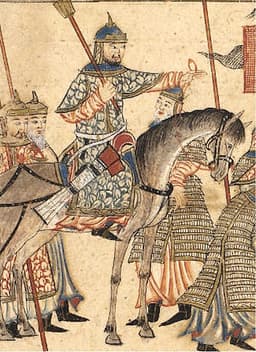
Mahmud of Ghazni
Emperor · Medieval
62.7Total

Stephen III of Moldavia
Emperor · Medieval
63.4Total
Basic Information
Born
971
1433
Died
1030
1504
Era
Medieval
Medieval
Nationality
Ghaznavid Empire
Moldavia
Occupation
Emperor
Emperor
Civilization
Middle Eastern
Western
Score Comparison
Military (10%)
82.0
67.5
Political (20%)
60.0
72.0
Influence (20%)
55.0
55.0
Legacy (20%)
52.0
55.0
Leadership (15%)
79.8
79.8
Strategy (15%)
68.0
63.8
TOTAL
62.7
63.4
Mahmud of Ghazni — Complete Timeline
1001 AD
Seventeen Raids into IndiaWar◆ Major
Mahmud of Ghazni conducted seventeen military campaigns into the Indian subcontinent between 1001 and 1027. He plundered wealthy Hindu temples and kingdoms, including Somnath, Mathura, and Kannauj, amassing enormous wealth and spreading Ghaznavid influence.
Indian RaidsPlunderTemple Destruction
Impact: regionaldestructive
1006 AD
Battle of CharkhWar◆ Major
Mahmud defeated the Hindu Shahi king Jayapala at the Battle of Charkh near Peshawar. Jayapala committed suicide after the defeat, and Mahmud annexed the Hindu Shahi kingdom, establishing Ghaznavid rule over the Punjab region.
BattleHindu ShahiPunjab
Impact: regional
1010 AD
Patronage of Persian CultureCultural◆ Major
Mahmud patronized Persian poets, scholars, and artists at his court in Ghazni. He commissioned the Persian poet Ferdowsi to write the Shahnameh, though they later quarreled over payment. His court became a center of Persian literature and Islamic learning.
PatronagePersian LiteratureShahnameh
Impact: regionalconstructive
1025 AD
Sack of Somnath TempleWar◆ Major
Mahmud led a raid to the Somnath temple in Gujarat, one of the wealthiest Hindu temples. He destroyed the temple and carried away its treasures, including the famous lingam, which he sent to Ghazni. This event became legendary in both Islamic and Hindu traditions.
Temple DestructionSomnathPlunder
Impact: regionaldestructive
Stephen III of Moldavia — Complete Timeline
1475 AD
Battle of VasluiWar◆ Major
Stephen III defeated a large Ottoman army under Had
BattleOttoman-Moldavian WarMilitary Victory
Impact: regionalconstructive
1476 AD
Battle of Valea AlbăWar◆ Major
Stephen III was defeated by the Ottoman army led by Sultan Mehmed II at Valea Alb
BattleOttoman InvasionDefeat
Impact: regionaltragic
1488 AD
Built the Voroneț MonasteryCultural◆ Major
Stephen III commissioned the construction of the Vorone
MonasteryArchitectureUNESCO
Impact: regionalconstructive
1499 AD
Signed the Treaty of Suceava with PolandPolitical Action◆ Major
Stephen III signed a treaty with King John I Albert of Poland at Suceava, establishing an alliance against the Ottoman Empire and the Teutonic Knights. The treaty secured Moldavia's western border and provided for mutual military assistance.
TreatyAlliancePoland-Moldavia Relations
Impact: regionalconstructive
This comparison has not been analyzed yet.
One-time AI generation (~1 minute). Scores and timeline are already available below.
Rankings
🥇
Stephen III of MoldaviaLeader
Mil: 67.5Pol: 72.0Inf: 55.0
63.4
🥈
Mahmud of Ghazni
Mil: 82.0Pol: 60.0Inf: 55.0
62.7
+0.7 behind
How This Comparison Works
Algorithm
Each figure is scored on 6 dimensions (0—100 scale) based on structured historical data: Military (10%), Political (20%), Influence (20%), Legacy (20%), Leadership (15%), Strategy (15%). The weighted total produces the final ranking.
Data Sources
Scores are computed from structured sub-indicators in the database. Scale factors adjust for era (Ancient ×0.85, Modern ×1.0) and civilization size (Eastern ×1.05, Other ×0.80) to account for differences in population and military scale.
Maximum 3 Figures
Comparisons are limited to 2—3 figures to ensure readability and statistical meaningfulness.
Error Margins
±5 points per dimension — Sub-scores are derived from historical records with inherent uncertainty. Two figures within 5 points on a dimension should be considered roughly equivalent in that area.
Total Score Accuracy
±3 points overall — The weighted combination of 6 dimensions produces a total score with approximately ±3 points of uncertainty. Differences of less than 3 points are not statistically significant— the figures are effectively tied.
Known Limitations
- Historical records are incomplete and uneven across civilizations
- Figures from oral-tradition societies may be underrepresented
- Occupation labels can misclassify multi-role figures
- Scores measure capability and impact, not moral character
- Quantitative scoring is a comparison tool, not absolute truth
Capability Radar
Military (10%) — Battles & Warfare
Battles
85
65
Win Rate
90
70
Expansion
85
55
Political (20%) — Governance & Reform
Reform
70
65
Diplomacy
65
75
Economy
75
60
Influence (20%) — Cultural & Global Reach
Cultural
60
65
Global
60
55
Legacy (20%) — Historical Impact
Historical
70
70
Longevity
65
60
Leadership (15%) — Power & Stability
Tenure
80
80
Stability
70
70
Strategy (15%) — Tactics & Innovation
Strategy
85
72
Tactics
80
75
Reform
75
60
Similar Comparisons
Comments & Discussion
No comments yet. Be the first to share your thoughts!