Loading...
Maria I of Portugal vs Napoleon Bonaparte
Napoleon Bonaparte leads by 25.0 pts · 2 figures compared
…
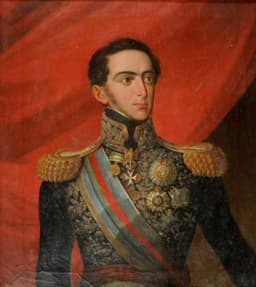
Maria I of Portugal
Emperor · Modern
45.9Total

Napoleon Bonaparte
General · Modern
70.9Total
Basic Information
Born
1734
1769
Died
1816
1821
Era
Modern
Modern
Nationality
Portugal
France
Occupation
Emperor
General
Civilization
Western
Western
Score Comparison
Military (10%)
10.6
94.0
Political (20%)
39.4
72.0
Influence (20%)
53.3
40.0
Legacy (20%)
43.3
80.0
Leadership (15%)
58.8
78.0
Strategy (15%)
60.0
90.0
TOTAL
45.9
70.9
Maria I of Portugal — Complete Timeline
1777 AD
Accession as first undisputed queen regnant of PortugalPolitical Action◆ Major
Maria I ascended the throne upon the death of her father, King Joseph I. She became the first undisputed queen regnant of Portugal, immediately dismissing the powerful Marquis of Pombal and reversing many of his reforms, signaling a shift in policy.
SuccessionPolitical ChangeMonarchy
Impact: national
Dismissal of the Marquis of PombalPolitical Action◆ Major
One of Maria I's first acts as queen was to dismiss the powerful and controversial Marquis of Pombal. She ordered an investigation into his administration, leading to his exile and the reversal of many of his Enlightenment reforms, restoring power to the aristocracy and Church.
Political PurgeReversal of ReformsAristocracy
Impact: national
1792 AD
Onset of religious mania and mental illnessOther◆ Major
Maria I began exhibiting severe symptoms of religious mania and mental illness, including delusions and anxiety. This condition, possibly exacerbated by the French Revolution and the death of her husband and son, rendered her incapable of ruling, leading to her son John becoming regent.
Mental HealthRegencyRoyal Illness
Impact: nationaltragic
1807 AD
Transfer of the Portuguese court to BrazilPolitical Action
As Napoleon's forces invaded Portugal, the incapacitated Queen Maria I was transported with the royal family and court to Brazil under British escort. She spent the remainder of her life in Rio de Janeiro, where she died, never returning to Portugal.
Napoleonic WarsRoyal FlightExile
Impact: global
Napoleon Bonaparte — Complete Timeline
1799 AD
Coup of 18 BrumaireOther◆ Major
Napoleon Bonaparte, with support from his brother Lucien and key political figures, overthrew the Directory in a bloodless coup. He established the Consulate with himself as First Consul, effectively becoming the ruler of France. This event ended the French Revolution's most unstable period.
French RevolutionCoupRise to Power
Impact: regional
1804 AD
Promulgation of the Napoleonic CodeOther◆ Major
Napoleon enacted the Civil Code of the French, known as the Napoleonic Code, a comprehensive set of laws that replaced the fragmented feudal legal systems. The code established legal equality, protected property rights, and secularized law. It became the basis for legal systems in many European and world countries.
Legal ReformNapoleonic CodeCivil Law
Impact: globalconstructive
1805 AD
Battle of AusterlitzWar◆ Major
Napoleon's Grande Arm
Napoleonic WarsBattleDecisive Victory
Impact: global
1812 AD
Invasion of RussiaWar◆ Major
Napoleon led the Grande Arm
Napoleonic WarsInvasionDisaster
Impact: globaldestructive
1815 AD
Battle of WaterlooWar◆ Major
Napoleon's French army was defeated by the combined forces of the Duke of Wellington's Anglo-Allied army and Gebhard Leberecht von Bl
Napoleonic WarsBattleFinal Defeat
Impact: globaldestructive
Expert Analysis
maria-i-of-portugal-vs-napoleon-bonaparte
# The Emperor and the Queen: Two Crowns, One Storm
In the autumn of 1807, as Napoleon Bonaparte’s Grand Army marched toward Lisbon, a bizarre procession snaked through the cobbled streets of the Portuguese capital. Royal carriages, laden with jewels, archives, and the nearly catatonic Queen Maria I, fled for the coast. Meanwhile, in Paris, Napoleon studied maps of the Iberian Peninsula with the cold precision of a chess master. Within months, he would place his own brother on the Spanish throne. The contrast between these two figures—one a conqueror of empires, the other a queen who lost her mind—tells a deeper story about the forces that shaped their era: ambition versus duty, revolution versus tradition, and the terrifying price of power.
Origins
Napoleon Bonaparte was born in 1769 on the island of Corsica, a place newly French and fiercely independent. His family was minor nobility, poor enough to know hunger but proud enough to resent the mainland. From childhood, he absorbed the Enlightenment ideals of meritocracy and the brutal realities of military hierarchy. He was short, intense, and driven by a hunger that never left him.
Maria I of Portugal, born in 1734, came from an older world. She was the eldest daughter of King Joseph I, raised in the shadow of the Marquis of Pombal, the ruthless reformer who rebuilt Lisbon after the 1755 earthquake. Her education emphasized piety, obedience, and the preservation of royal bloodlines. Where Napoleon learned to command armies, Maria learned to endure the suffocating rituals of court life. She was, by all accounts, kind-hearted and devout—qualities that would prove both her strength and her undoing.
Rise to Power
Napoleon’s ascent was a masterpiece of speed and violence. At 26, he crushed the royalist uprising in Paris with a “whiff of grapeshot.” At 30, he crowned himself Emperor of the French, snatching the crown from the Pope’s hands. His path was forged by the chaos of the French Revolution, which had cleared away the old aristocracy and opened doors to talent, ambition, and ruthlessness.
Maria I’s rise was quieter, but no less significant. She became queen in 1777 at age 43, upon the death of her father. Her first major act was to dismiss the Marquis of Pombal, the powerful minister who had dominated Portugal for decades. She ordered an investigation into his abuses, signaling a return to more traditional, religious governance. It was a political gamble—Pombal had modernized Portugal but had also made enemies. Maria chose mercy over efficiency, piety over progress. In doing so, she won the loyalty of the Church and the nobility, but she also inherited a kingdom ill-prepared for the coming storm.
Leadership & Governance
Napoleon governed like a storm. He reorganized France into departments, centralized the tax system, and created the Napoleonic Code—a legal framework that enshrined equality before the law, property rights, and secular authority. His military campaigns were exercises in logistical genius and psychological warfare. He moved armies faster than his enemies could think, striking at the seams of their alliances. His leadership score of 80 reflects a man who could inspire soldiers to die for him, but who also alienated allies through arrogance and overreach.
Maria I governed like a mother protecting a fragile home. She was not a military leader—her military score of 45 is telling—but she understood the limits of her power. She supported public works, patronized the arts, and tried to steer Portugal away from the revolutionary currents that were tearing apart the rest of Europe. Her political score of 72 suggests a competent, cautious ruler. But her greatest challenge lay not in politics, but in the mind.
Triumph & Tragedy
Napoleon’s triumph was Austerlitz in 1805, where he destroyed the combined armies of Austria and Russia. His empire stretched from Spain to Poland. His tragedy was the invasion of Russia in 1812—a campaign that bled his Grande Armée white in the snow. His final defeat at Waterloo in 1815 was a masterpiece of miscalculation, a battle he could have won if he had listened to his generals.
Maria’s triumph was more subtle. She preserved Portuguese independence during the most turbulent decades of European history. Her tragedy was far more personal. In 1792, she began exhibiting symptoms of religious mania and mental illness—delusions, anxiety, fits of screaming. She believed she was damned, that her soul was already in hell. The woman who had dismissed Pombal now could not govern. Her son, Prince John, took over as regent. When Napoleon’s forces invaded in 1807, she was carried onto a ship, uncomprehending, as her kingdom fled to Brazil.
Character & Destiny
Napoleon’s character was his destiny. His relentless ambition, his belief that he could impose order on chaos, drove him to conquer Europe—but also to overreach. He could not stop. “Power is my mistress,” he once said. The same will that made him a genius made him a prisoner of his own success.
Maria’s character was also her destiny. Her piety, her gentleness, her reliance on faith—these were virtues in a stable age. But in an era of revolution and war, they became liabilities. The queen who sought to rule with compassion was crushed by the weight of a world she could not control. Her madness was not a failure of character, but a surrender to a reality too brutal for her soul to bear.
Legacy
Napoleon’s legacy is vast and contested. He is remembered as a military genius, a reformer, and a tyrant. The Napoleonic Code still influences legal systems across Europe and the Americas. His scores—military 94, strategy 93, influence 82—reflect a man who reshaped the modern world.
Maria I’s legacy is quieter, but no less real. She is remembered as the first undisputed queen regnant of Portugal, a woman who ruled with dignity until illness took her. Her flight to Brazil planted the seeds of Brazilian independence. Her legacy score of 59.5 reflects a ruler who did not change the world, but who preserved a world from change.
Conclusion
Standing at the edge of the modern age, Napoleon and Maria I represent two faces of power. One was a force of nature, reshaping continents through will and war. The other was a keeper of tradition, trying to hold back the tide. Both were swept away—Napoleon to exile on a remote island, Maria to madness and exile in Brazil. Their stories remind us that history judges not only by victories, but by the quiet dignity of those who endure when the world burns around them.
Rankings
🥇
Napoleon BonaparteLeader
Mil: 94.0Pol: 72.0Inf: 40.0
70.9
🥈
Maria I of Portugal
Mil: 10.6Pol: 39.4Inf: 53.3
45.9
+25.0 behind
How This Comparison Works
Algorithm
Each figure is scored on 6 dimensions (0—100 scale) based on structured historical data: Military (10%), Political (20%), Influence (20%), Legacy (20%), Leadership (15%), Strategy (15%). The weighted total produces the final ranking.
Data Sources
Scores are computed from structured sub-indicators in the database. Scale factors adjust for era (Ancient ×0.85, Modern ×1.0) and civilization size (Eastern ×1.05, Other ×0.80) to account for differences in population and military scale.
Maximum 3 Figures
Comparisons are limited to 2—3 figures to ensure readability and statistical meaningfulness.
Error Margins
±5 points per dimension — Sub-scores are derived from historical records with inherent uncertainty. Two figures within 5 points on a dimension should be considered roughly equivalent in that area.
Total Score Accuracy
±3 points overall — The weighted combination of 6 dimensions produces a total score with approximately ±3 points of uncertainty. Differences of less than 3 points are not statistically significant— the figures are effectively tied.
Known Limitations
- Historical records are incomplete and uneven across civilizations
- Figures from oral-tradition societies may be underrepresented
- Occupation labels can misclassify multi-role figures
- Scores measure capability and impact, not moral character
- Quantitative scoring is a comparison tool, not absolute truth
Capability Radar
Military (10%) — Battles & Warfare
Battles
37
95
Win Rate
42
90
Expansion
42
95
Political (20%) — Governance & Reform
Reform
20
95
Diplomacy
25
80
Economy
30
85
Influence (20%) — Cultural & Global Reach
Cultural
30
85
Global
20
90
Legacy (20%) — Historical Impact
Historical
35
95
Longevity
25
90
Leadership (15%) — Power & Stability
Tenure
40
85
Stability
15
70
Strategy (15%) — Tactics & Innovation
Strategy
45
95
Tactics
46
98
Reform
49
92
Similar Comparisons
Comments & Discussion
数据敲钟人6/17/2026
吹拿破仑的军事天才?看看数字吧:1807年入侵葡萄牙时法军约3万人,但葡萄牙皇室带走了整个国库——6万册图书、全套国家档案、还有价值连城的珠宝。拿破仑得到了什么?一个空壳首都和七年游击战。对比下:玛丽亚一世至少保住了巴西殖民地,到1815年葡萄牙帝国面积反而扩大了两倍。谁在真正经营国家?|zh|别被拿破仑的传奇故事骗了——用战损比和领土净增减说话,玛丽亚的“逃跑”实际是巴西帝国的前奏,而拿破仑的“征服”只是西班牙独立战争的导火索。
老江湖吐槽6/17/2026
拿疯王后和战争狂人比?这局我站玛丽亚。拿破仑打下一堆欧洲城市,最后被流放孤岛;玛丽亚丢了葡萄牙本土,但人家在巴西建了人类历史上第一个欧洲王朝的热带分支。1808年里约热内卢成为葡萄牙首都时,拿破仑还在马德里街头被人扔石头呢。更关键的是——她至少没把自家兄弟硬塞给别国当国王。|zh|历史评价不能只看眼前战果。玛丽亚的"逃跑主义"其实是一盘大棋:把帝国重心战略转移至巴西,让葡萄牙在拿破仑
Historian2936/17/2026
The comparison misses the core irony: Napoleon’s invasion of Portugal was less about conquering a nation than about enforcing a paper blockade. His "chess master" approach crumbled because he underestimated how guerrilla warfare and British sea power could bleed his armies dry. Maria’s flight wasn’t cowardice—it was the only move that saved the Braganza dynasty from annihilation. Portugal survived, exiling itself to Brazil; Napoleon’s empire vaporized in six years. She outlasted him. Period.|en|
Historian8106/17/2026
One ruled by divine right, the other by revolutionary upheaval—yet both were prisoners of their epochs. Maria’s "madness" (diagnosed as melancholia or porphyria) mirrored the crisis of absolute monarchy itself: when the old order breaks, even the sovereign can fracture. Napoleon, who crowned himself emperor in Notre Dame, was equally bound by the logic of conquest he inherited from the Jacobins. Neither was free; they were just symptoms of a world in violent transition.|en|Their personal tragedi