Loading...
Marie-Jeanne Lamartiniere vs Napoleon Bonaparte
Napoleon Bonaparte leads by 32.1 pts · 2 figures compared
…
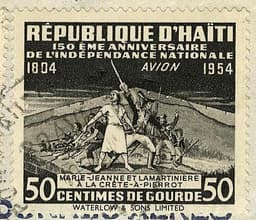
Marie-Jeanne Lamartiniere
General · Modern
38.8Total

Napoleon Bonaparte
General · Modern
70.9Total
Basic Information
Born
1770
1769
Died
1820
1821
Era
Modern
Modern
Nationality
Haiti
France
Occupation
General
General
Civilization
Other
Western
Score Comparison
Military (10%)
22.6
94.0
Political (20%)
27.9
72.0
Influence (20%)
49.4
40.0
Legacy (20%)
40.8
80.0
Leadership (15%)
40.9
78.0
Strategy (15%)
36.8
90.0
TOTAL
38.8
70.9
Marie-Jeanne Lamartiniere — Complete Timeline
1802 AD
Fought at Battle of Crête-à-PierrotWar◆ Major
Marie-Jeanne Lamartiniere fought as a soldier at the Battle of Cr
BattleFemale SoldierRevolution
Impact: regional
Napoleon Bonaparte — Complete Timeline
1799 AD
Coup of 18 BrumaireOther◆ Major
Napoleon Bonaparte, with support from his brother Lucien and key political figures, overthrew the Directory in a bloodless coup. He established the Consulate with himself as First Consul, effectively becoming the ruler of France. This event ended the French Revolution's most unstable period.
French RevolutionCoupRise to Power
Impact: regional
1804 AD
Promulgation of the Napoleonic CodeOther◆ Major
Napoleon enacted the Civil Code of the French, known as the Napoleonic Code, a comprehensive set of laws that replaced the fragmented feudal legal systems. The code established legal equality, protected property rights, and secularized law. It became the basis for legal systems in many European and world countries.
Legal ReformNapoleonic CodeCivil Law
Impact: globalconstructive
1805 AD
Battle of AusterlitzWar◆ Major
Napoleon's Grande Arm
Napoleonic WarsBattleDecisive Victory
Impact: global
1812 AD
Invasion of RussiaWar◆ Major
Napoleon led the Grande Arm
Napoleonic WarsInvasionDisaster
Impact: globaldestructive
1815 AD
Battle of WaterlooWar◆ Major
Napoleon's French army was defeated by the combined forces of the Duke of Wellington's Anglo-Allied army and Gebhard Leberecht von Bl
Napoleonic WarsBattleFinal Defeat
Impact: globaldestructive
Expert Analysis
Origins
Marie-Jeanne Lamartiniere was born in Haiti, likely around the 1770s, though exact dates are unrecorded. As a free woman of color in Saint-Domingue, she grew up in a society rigidly stratified by race and class. Little is known of her early life, but she emerged as a soldier during the Haitian Revolution, a conflict driven by enslaved Africans and free people of color seeking freedom from French colonial rule. Her participation reflects the broad mobilization of women in the revolution, who served as fighters, nurses, and spies.
Napoleon Bonaparte was born on August 15, 1769, in Ajaccio, Corsica, to Carlo Buonaparte and Letizia Ramolino. His family was minor Corsican nobility, and he studied at military schools in Brienne and Paris, graduating as a second lieutenant in the artillery. His early life was marked by Corsica's struggle for independence, which shaped his ambition. He rose rapidly through the ranks during the French Revolution, capitalizing on the chaos to advance his career.
Rise to Power
Lamartiniere's rise was not through political maneuvering but through direct action. She is recorded as fighting at the Battle of Crête-à-Pierrot in March 1802, a key engagement of the Haitian Revolution. The battle saw Haitian forces under Jean-Jacques Dessalines and others defend a fort against French troops sent by Napoleon to re-establish slavery. Lamartiniere reportedly fought in uniform, wielding a rifle and encouraging the troops. Her actions, though not leading to personal power, exemplified the grassroots resistance that ultimately forced the French to withdraw.
Napoleon's rise was meteoric. After distinguishing himself at the Siege of Toulon in 1793, he became a general and led successful campaigns in Italy and Egypt. His political acumen culminated in the Coup of 18 Brumaire (November 9, 1799), where he overthrew the Directory and established the Consulate, with himself as First Consul. By 1804, he crowned himself Emperor of the French, consolidating power through military victories and political reforms.
Leadership & Governance
Lamartiniere's leadership was on a small scale, directly in combat. She led by example, fighting alongside her comrades at Crête-à-Pierrot. Her governance role was nonexistent; she was a soldier, not a ruler. However, her actions contributed to the collective leadership of the Haitian revolutionaries, who eventually defeated the French and established Haiti as the first independent Black republic in 1804.
Napoleon's leadership was vast. He reorganized France's legal system with the Napoleonic Code, which emphasized meritocracy, property rights, and secular authority. He centralized the government, reformed education, and established the Bank of France. Militarily, he commanded the Grande Armée with innovative tactics, achieving victories at Austerlitz (1805) and Jena (1806). However, his governance also included authoritarian measures, censorship, and the restoration of slavery in French colonies in 1802, which directly contradicted the ideals of the revolution.
Triumph & Tragedy
Lamartiniere's triumph was her role in the Battle of Crête-à-Pierrot. The Haitian forces, though ultimately forced to abandon the fort, inflicted heavy casualties on the French and delayed their advance. Her personal courage is celebrated in Haitian history. Her tragedy is the lack of historical records; after the battle, she disappears from the narrative. She likely died in obscurity, as the revolution's leaders took power while women's contributions were marginalized.
Napoleon's triumphs are numerous: he conquered most of Europe, reformed France's laws, and established a legacy that influenced legal systems worldwide. His military prowess scored 94.0 in military capability. His tragedies include the disastrous Invasion of Russia in 1812, where his army of over 600,000 was decimated by winter and scorched-earth tactics, with only about 100,000 surviving. He was exiled to Elba in 1814, returned for the Hundred Days, and was finally defeated at Waterloo in 1815, leading to his exile on Saint Helena, where he died in 1821.
Character & Destiny
Lamartiniere's character is inferred from her actions: bravery, dedication to the cause of freedom, and willingness to defy gender norms. Her destiny was shaped by the revolution; she was a foot soldier in a fight for independence, not a leader. Her lack of political ambition or strategic role limited her influence.
Napoleon's character was ambitious, strategic, and ruthless. He was a brilliant tactician (strategy score 90.0) but also arrogant and overreaching. His destiny was to rise from Corsican obscurity to dominate Europe, but his hubris led to his downfall. He famously said, "Power is my mistress," and his inability to compromise or accept limits ultimately led to his defeats.
Legacy
Lamartiniere's legacy is symbolic. She is remembered as a symbol of women's participation in the Haitian Revolution and a hero of Crête-à-Pierrot. Her influence score is 65.0, reflecting her cultural impact in Haiti. However, she has little global recognition.
Napoleon's legacy is immense. His Napoleonic Code influenced legal systems in Europe and beyond. His military tactics are studied in war colleges. He reshaped the map of Europe, ending the Holy Roman Empire and spreading nationalist ideas. His legacy is mixed: he is both a reformer and a tyrant. His legacy score is 80.0, and his overall total score of 70.9 far exceeds Lamartiniere's 47.1.
Conclusion
Marie-Jeanne Lamartiniere and Napoleon Bonaparte operated on vastly different scales. Lamartiniere's impact was localized and symbolic, while Napoleon's was global and structural. The 23.8-point score gap reflects this: Napoleon's military (94.0 vs 20.7) and strategy (90.0 vs 48.1) dominate. However, in the context of the Haitian Revolution, Lamartiniere's role was crucial: she helped defend a cause that led to the only successful slave revolt in history. Napoleon's attempt to re-enslave Haitians failed, partly due to resistance from people like Lamartiniere. Yet, on a historical impact scale, Napoleon's achievements and failures have shaped the modern world far more. The clear position is that Napoleon had greater impact, but Lamartiniere's legacy remains a powerful testament to individual courage against overwhelming odds.
Rankings
🥇
Napoleon BonaparteLeader
Mil: 94.0Pol: 72.0Inf: 40.0
70.9
🥈
Marie-Jeanne Lamartiniere
Mil: 22.6Pol: 27.9Inf: 49.4
38.8
+32.1 behind
How This Comparison Works
Algorithm
Each figure is scored on 6 dimensions (0—100 scale) based on structured historical data: Military (10%), Political (20%), Influence (20%), Legacy (20%), Leadership (15%), Strategy (15%). The weighted total produces the final ranking.
Data Sources
Scores are computed from structured sub-indicators in the database. Scale factors adjust for era (Ancient ×0.85, Modern ×1.0) and civilization size (Eastern ×1.05, Other ×0.80) to account for differences in population and military scale.
Maximum 3 Figures
Comparisons are limited to 2—3 figures to ensure readability and statistical meaningfulness.
Error Margins
±5 points per dimension — Sub-scores are derived from historical records with inherent uncertainty. Two figures within 5 points on a dimension should be considered roughly equivalent in that area.
Total Score Accuracy
±3 points overall — The weighted combination of 6 dimensions produces a total score with approximately ±3 points of uncertainty. Differences of less than 3 points are not statistically significant— the figures are effectively tied.
Known Limitations
- Historical records are incomplete and uneven across civilizations
- Figures from oral-tradition societies may be underrepresented
- Occupation labels can misclassify multi-role figures
- Scores measure capability and impact, not moral character
- Quantitative scoring is a comparison tool, not absolute truth
Capability Radar
Military (10%) — Battles & Warfare
Battles
10
95
Win Rate
10
90
Expansion
5
95
Political (20%) — Governance & Reform
Reform
5
95
Diplomacy
5
80
Economy
5
85
Influence (20%) — Cultural & Global Reach
Cultural
15
85
Global
10
90
Legacy (20%) — Historical Impact
Historical
20
95
Longevity
15
90
Leadership (15%) — Power & Stability
Tenure
5
85
Stability
5
70
Strategy (15%) — Tactics & Innovation
Strategy
10
95
Tactics
15
98
Reform
5
92
Similar Comparisons
Comments & Discussion
No comments yet. Be the first to share your thoughts!