Loading...
Mary of Guise vs Napoleon Bonaparte
Napoleon Bonaparte leads by 19.2 pts · 2 figures compared
…
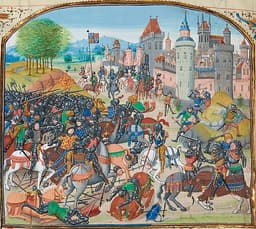
Mary of Guise
Emperor · Modern
51.7Total

Napoleon Bonaparte
General · Modern
70.9Total
Basic Information
Born
1515
1769
Died
1560
1821
Era
Modern
Modern
Nationality
Scotland
France
Occupation
Emperor
General
Civilization
Western
Western
Score Comparison
Military (10%)
35.0
94.0
Political (20%)
68.0
72.0
Influence (20%)
51.8
40.0
Legacy (20%)
43.3
80.0
Leadership (15%)
65.0
78.0
Strategy (15%)
45.0
90.0
TOTAL
51.7
70.9
Mary of Guise — Complete Timeline
1554 AD
Regency of Mary of GuisePolitical Action◆ Major
Mary of Guise became regent of Scotland for her daughter Mary, Queen of Scots. She governed with French support, increasing French influence in Scottish affairs and alienating Protestant lords. Her rule saw growing tension between Catholic and Protestant factions.
RegencyFrench InfluenceReligious Conflict
Impact: national
1560 AD
Siege of LeithWar◆ Major
Mary of Guise defended Leith against a combined force of Scottish Protestant lords and English troops. The siege ended with the Treaty of Edinburgh, which removed French troops from Scotland. Mary of Guise died during the siege.
SiegeReligious WarFrench Withdrawal
Impact: nationaltragic
Napoleon Bonaparte — Complete Timeline
1799 AD
Coup of 18 BrumaireOther◆ Major
Napoleon Bonaparte, with support from his brother Lucien and key political figures, overthrew the Directory in a bloodless coup. He established the Consulate with himself as First Consul, effectively becoming the ruler of France. This event ended the French Revolution's most unstable period.
French RevolutionCoupRise to Power
Impact: regional
1804 AD
Promulgation of the Napoleonic CodeOther◆ Major
Napoleon enacted the Civil Code of the French, known as the Napoleonic Code, a comprehensive set of laws that replaced the fragmented feudal legal systems. The code established legal equality, protected property rights, and secularized law. It became the basis for legal systems in many European and world countries.
Legal ReformNapoleonic CodeCivil Law
Impact: globalconstructive
1805 AD
Battle of AusterlitzWar◆ Major
Napoleon's Grande Arm
Napoleonic WarsBattleDecisive Victory
Impact: global
1812 AD
Invasion of RussiaWar◆ Major
Napoleon led the Grande Arm
Napoleonic WarsInvasionDisaster
Impact: globaldestructive
1815 AD
Battle of WaterlooWar◆ Major
Napoleon's French army was defeated by the combined forces of the Duke of Wellington's Anglo-Allied army and Gebhard Leberecht von Bl
Napoleonic WarsBattleFinal Defeat
Impact: globaldestructive
Expert Analysis
mary-of-guise-vs-napoleon-bonaparte
# The Regent and the Emperor
On a rainy June morning in 1815, Napoleon Bonaparte watched his dreams of empire dissolve into the mud of Waterloo. Thirty-two years earlier, in the drafty stone halls of Edinburgh Castle, Mary of Guise had watched her own ambitions crumble as English cannons pounded the walls of Leith. Both fought against impossible odds. Both shaped their nations. One changed the world forever. The other is nearly forgotten. What makes the difference between a legend and a footnote?
Origins
Napoleon was born in 1769 on the rugged island of Corsica, a place that had only become French the year before. His family was minor nobility, poor and resentful of French domination. Young Napoleon spoke Italian, not French, and was mocked for his accent at military school. He grew up with something to prove—to France, to Europe, to history itself. His era was the French Revolution, a time when old structures collapsed and a brilliant young man could rise on talent alone.
Mary of Guise was born in 1515 into one of the most powerful families in France. The Guises were princes of Lorraine, wealthy, connected, and Catholic to the bone. She was educated in the French court, trained in diplomacy, and married at nineteen to the elderly Duke of Longueville. When he died, she was sent to Scotland as the bride of King James V, a rough kingdom on the edge of Europe. Her era was the Reformation, when religious war was tearing Christendom apart. She had everything Napoleon lacked—birth, connections, security—and nothing that would make her name survive the centuries.
Rise to Power
Napoleon’s rise was a cannon shot. At twenty-four, he drove the British out of Toulon and became a general. At twenty-six, he crushed a royalist uprising in Paris with what he called “a whiff of grapeshot.” At twenty-seven, he led a ragged army into Italy and destroyed the Austrian Empire’s finest forces. By thirty, he had conquered Egypt, overthrown the French government, and made himself First Consul. Every step was audacious, calculated, and personal. He wrote to his wife Josephine, “I am tired of human nature. I need solitude and isolation. Greatness bores me.” But he never stopped reaching for more.
Mary of Guise rose slowly, through patience and grief. Her husband King James V died in 1542, days after their daughter Mary was born. She watched her infant daughter become queen, then watched Scottish nobles squabble over power. For twelve years, she maneuvered, waiting for her moment. In 1554, she finally became regent. It was not a conquest but a compromise—the Scottish lords accepted her because they could not agree on anyone else. She governed with French troops and French money, always aware that her authority rested on the goodwill of men who despised her.
Leadership & Governance
Napoleon governed like a force of nature. He centralized the state, created the Bank of France, and reformed education. His Napoleonic Code swept away feudal laws and established equality before the law, religious toleration, and protection of property. It was a masterpiece of clarity and logic, and it spread across Europe wherever his armies marched. But his genius was also his flaw: he could not stop. He conquered Prussia, Austria, Spain, and Russia, always demanding more, always believing his will could overcome reality.
Mary of Guise governed like a chess player in a losing game. She faced a country divided between Catholic and Protestant, French and English loyalties. She supported Catholic reforms, brought French craftsmen to Scotland, and tried to modernize the economy. But her greatest struggle was the Protestant lords—the “Lords of the Congregation”—who saw her as a French puppet. In 1559, they rose in rebellion. Mary retreated to Leith, fortified the port, and waited for French reinforcements. She was a woman in a man’s world, a Catholic in a Protestant storm.
Triumph & Tragedy
Napoleon’s greatest moment was Austerlitz in 1805, when he destroyed the combined armies of Russia and Austria. It was a battle of perfect execution—he lured his enemies into a trap, crushed their center, and captured their flags. The Holy Roman Empire dissolved. Napoleon crowned himself master of Europe. His tragedy was Russia in 1812. He invaded with 600,000 men and returned with fewer than 100,000. The Russian winter, the scorched earth, his own refusal to compromise—all combined to destroy the Grand Army.
Mary of Guise’s greatest moment was simply surviving as long as she did. For six years as regent, she held Scotland together against internal rebellion and English invasion. Her tragedy was the Siege of Leith in 1560. English ships blockaded the port. Scottish rebels surrounded the walls. French reinforcements never arrived. Mary watched her cause die slowly, trapped in a fortress that became her prison. She died in June 1560, probably of dropsy, alone and exhausted. The Treaty of Edinburgh, signed weeks later, removed French troops from Scotland and sealed the Protestant victory.
Character & Destiny
Napoleon was driven by an immense will. He worked eighteen hours a day, dictated letters to multiple secretaries simultaneously, and believed that “impossible is a word to be found only in the dictionary of fools.” His confidence was his strength and his ruin. He could not share power, could not accept limits, could not stop. When his marshals begged him to make peace after Russia, he refused. When the allies offered him terms in 1814, he demanded more. He was defeated not by his enemies but by his own nature.
Mary of Guise was driven by duty. She wrote to her daughter Mary, Queen of Scots, “I would rather see you dead than dishonored.” She fought not for glory but for her family’s legacy and her Catholic faith. Her caution was her strength and her limitation. She moved slowly, built alliances carefully, and avoided open battle. But in a time of revolution, caution was not enough. She could not match the passion of John Knox’s sermons or the determination of Elizabeth I’s agents. She was outrun by history.
Legacy
Napoleon left behind a transformed Europe. The Napoleonic Code still shapes laws from France to Louisiana to Japan. He destroyed the Holy Roman Empire and created the conditions for German and Italian unification. He spread nationalism, secularism, and meritocracy across the continent. Even his enemies adopted his reforms. Wellington said of him, “His presence on the field made the difference of forty thousand men.” He is remembered as a genius, a tyrant, and the man who rode an eagle into the modern world.
Mary of Guise left behind a daughter and a lost cause. Mary, Queen of Scots would be executed by Elizabeth I twenty-seven years later. Scotland would become Protestant, then join with England in 1707. Mary of Guise’s fortifications at Leith are buried under modern streets. Her name appears in history books as a prelude to her daughter’s tragedy. She is remembered, if at all, as a competent regent who fought a losing battle against the Reformation.
Conclusion
The difference between Napoleon and Mary of Guise is not talent or effort. Both were brilliant. Both were dedicated. Both fought for what they believed. The difference is the scale of the stage. Napoleon rode the wave of the French Revolution, a force that remade the world. Mary of Guise was caught in the undertow of the Reformation, a force that remade nations but not continents. Napoleon had armies, resources, and a unified France behind him. Mary had a divided kingdom, a foreign power’s support, and the suspicion of her own people.
History remembers the winners, yes—but it also remembers the ones who played on the largest stage. Mary of Guise governed Scotland for six years. Napoleon governed Europe for a decade. One is a footnote, the other a legend. Both did what they could with what they had. And both, in the end, were defeated by forces larger than themselves.
Rankings
🥇
Napoleon BonaparteLeader
Mil: 94.0Pol: 72.0Inf: 40.0
70.9
🥈
Mary of Guise
Mil: 35.0Pol: 68.0Inf: 51.8
51.7
+19.2 behind
How This Comparison Works
Algorithm
Each figure is scored on 6 dimensions (0—100 scale) based on structured historical data: Military (10%), Political (20%), Influence (20%), Legacy (20%), Leadership (15%), Strategy (15%). The weighted total produces the final ranking.
Data Sources
Scores are computed from structured sub-indicators in the database. Scale factors adjust for era (Ancient ×0.85, Modern ×1.0) and civilization size (Eastern ×1.05, Other ×0.80) to account for differences in population and military scale.
Maximum 3 Figures
Comparisons are limited to 2—3 figures to ensure readability and statistical meaningfulness.
Error Margins
±5 points per dimension — Sub-scores are derived from historical records with inherent uncertainty. Two figures within 5 points on a dimension should be considered roughly equivalent in that area.
Total Score Accuracy
±3 points overall — The weighted combination of 6 dimensions produces a total score with approximately ±3 points of uncertainty. Differences of less than 3 points are not statistically significant— the figures are effectively tied.
Known Limitations
- Historical records are incomplete and uneven across civilizations
- Figures from oral-tradition societies may be underrepresented
- Occupation labels can misclassify multi-role figures
- Scores measure capability and impact, not moral character
- Quantitative scoring is a comparison tool, not absolute truth
Capability Radar
Military (10%) — Battles & Warfare
Battles
35
95
Win Rate
30
90
Expansion
15
95
Political (20%) — Governance & Reform
Reform
40
95
Diplomacy
50
80
Economy
35
85
Influence (20%) — Cultural & Global Reach
Cultural
30
85
Global
20
90
Legacy (20%) — Historical Impact
Historical
40
95
Longevity
30
90
Leadership (15%) — Power & Stability
Tenure
55
85
Stability
25
70
Strategy (15%) — Tactics & Innovation
Strategy
45
95
Tactics
40
98
Reform
20
92
Similar Comparisons
Comments & Discussion
Leith's Fury6/17/2026
One fact gets lost in the glamour of Waterloo: Mary of Guise faced a full-scale English invasion with a tiny, starving garrison—and still held Leith for six months. Napoleon lost in one day. The English had to starve her out, burning crops for miles. That's not a footnote, that's a military stubbornness that would impress any siege commander. She just didn't get her own hagiography.
数据鹰6/17/2026
拿破仑输了滑铁卢,但历史课本把那一页涂得金灿灿。玛丽·盖斯被英国人围困在利斯港,城外炮火连天,城内饿殍满地,她却扛了半年。没赢就是没赢?她让敌人付出了比滑铁卢更高的代价。数据不会撒谎:一场防御战的持久度,远超一场进攻战的溃败。
The Cannon's Poet6/17/2026
Mary of Guise is not 'nearly forgotten'—she's systematically buried by a British-centric narrative that prefers clear defeats to messy Eastern European regency politics. Napoleon romanticised himself; Mary just ruled. She rebuilt Scottish defences, managed French subsidies, and held a nation together while her daughter grew up. That's not a footnote. That's a different kind of victory, and it doesn't need cannon smoke to prove itself.
纸上将帅6/17/2026
拿破仑是传奇,因为他败得壮烈,死得响亮。玛丽·盖斯呢?她死在爱丁堡城堡的床上,穿着法兰西的丝绸,身边只有侍女。她输得安静,赢也安静。可别忘了:她女儿玛丽·斯图亚特能当上法国王后,全靠她那些年苦撑苏格兰。而拿破仑的兄弟们呢?散了。传奇不能只看结局,要看谁留下了什么。
Scots in the Mud6/17/2026
The comparison itself is a trick: Napoleon's era gave him a stage, a printing press, and a cult of personality. Mary of Guise got a damp kingdom, a Reformation mob, and a daughter too young to rule. I respect the Napoleon myth—it's magnificent. But Mary's regency is more impressive because she had no grand narrative to sell, just survival. And survival is the hardest history of all.