Loading...
Max Hoffmann vs Napoleon Bonaparte
Napoleon Bonaparte leads by 15.2 pts · 2 figures compared
…
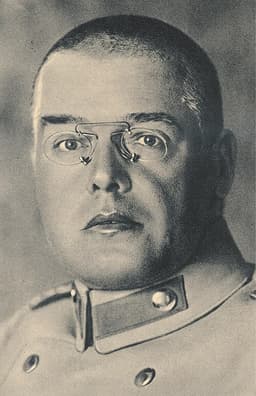
Max Hoffmann
General · Modern
55.7Total

Napoleon Bonaparte
General · Modern
70.9Total
Basic Information
Born
1869
1769
Died
1927
1821
Era
Modern
Modern
Nationality
Germany
France
Occupation
General
General
Civilization
Western
Western
Score Comparison
Military (10%)
82.0
94.0
Political (20%)
42.2
72.0
Influence (20%)
58.0
40.0
Legacy (20%)
54.0
80.0
Leadership (15%)
43.8
78.0
Strategy (15%)
66.3
90.0
TOTAL
55.7
70.9
Max Hoffmann — Complete Timeline
1914 AD
Battle of TannenbergWar
As Chief of Operations for the German Eighth Army, Hoffmann played a key role in planning the encirclement of the Russian Second Army at Tannenberg. The battle resulted in the destruction of the Russian army and the capture of its commander, Samsonov. This victory established Hindenburg and Ludendorff's reputations.
World War IEastern FrontBattle
Impact: regional
Battle of the Masurian LakesWar◆ Major
Hoffmann helped plan the follow-up battle to Tannenberg, the First Battle of the Masurian Lakes. German forces drove the Russian First Army out of East Prussia, inflicting heavy casualties. This cleared German territory of Russian troops and secured the eastern border for the remainder of 1914.
World War IEastern FrontBattle
Impact: regional
1918 AD
Treaty of Brest-LitovskPolitical Action
Hoffmann was the chief German military negotiator at Brest-Litovsk. He dictated harsh terms to Soviet Russia, forcing the cession of vast territories including Poland, the Baltic states, and Ukraine. The treaty ended the war on the Eastern Front but was later annulled by the Armistice.
World War IPeace TreatyEastern Europe
Impact: globaldestructive
Napoleon Bonaparte — Complete Timeline
1799 AD
Coup of 18 BrumaireOther◆ Major
Napoleon Bonaparte, with support from his brother Lucien and key political figures, overthrew the Directory in a bloodless coup. He established the Consulate with himself as First Consul, effectively becoming the ruler of France. This event ended the French Revolution's most unstable period.
French RevolutionCoupRise to Power
Impact: regional
1804 AD
Promulgation of the Napoleonic CodeOther◆ Major
Napoleon enacted the Civil Code of the French, known as the Napoleonic Code, a comprehensive set of laws that replaced the fragmented feudal legal systems. The code established legal equality, protected property rights, and secularized law. It became the basis for legal systems in many European and world countries.
Legal ReformNapoleonic CodeCivil Law
Impact: globalconstructive
1805 AD
Battle of AusterlitzWar◆ Major
Napoleon's Grande Arm
Napoleonic WarsBattleDecisive Victory
Impact: global
1812 AD
Invasion of RussiaWar◆ Major
Napoleon led the Grande Arm
Napoleonic WarsInvasionDisaster
Impact: globaldestructive
1815 AD
Battle of WaterlooWar◆ Major
Napoleon's French army was defeated by the combined forces of the Duke of Wellington's Anglo-Allied army and Gebhard Leberecht von Bl
Napoleonic WarsBattleFinal Defeat
Impact: globaldestructive
Expert Analysis
max-hoffmann-vs-napoleon-bonaparte
# The Strategist and the Emperor: Why Napoleon Conquered a Continent While Hoffmann Changed a War
In the summer of 1914, as millions of men marched toward the slaughter of the Marne, a relatively obscure German colonel named Max Hoffmann sat in a railway carriage in East Prussia, sketching out an encirclement that would annihilate a Russian army. A century earlier, a young Corsican artillery officer had stood before the walls of Toulon, calculating the angle of cannon fire that would break a British siege and launch him toward an empire. Both men were masters of war, yet one became a legend whose name echoes through the ages, while the other remains a footnote, known only to military historians. The difference between them is not merely one of talent, but of timing, temperament, and the terrible gravity of ambition.
Origins
Napoleon Bonaparte was born in 1769 on the island of Corsica, a place that had only recently become French. He grew up speaking Italian, the son of minor nobility, perpetually an outsider in the French world he would one day rule. The French Revolution shattered the old order just as he entered military school, creating a vacuum of opportunity for those with talent and ruthlessness. Max Hoffmann, born exactly a century later in 1869, came from a very different world. He was a Prussian Junker, born into the military aristocracy that had dominated German life for generations. Where Napoleon’s world was one of chaos and possibility, Hoffmann’s was one of order and rigid hierarchy. The Corsican had to seize his destiny; the Prussian had only to follow the path laid before him.
Rise to Power
Napoleon’s ascent was meteoric, a series of gambles that paid off in spectacular fashion. At age twenty-four, he drove the British from Toulon and became a brigadier general. By twenty-six, he had saved the revolutionary government from a royalist uprising with a “whiff of grapeshot.” At thirty, he was First Consul of France; at thirty-five, Emperor. Each step was a calculated risk, a bet on his own genius against the caution of his peers. Hoffmann’s rise was far more conventional. He entered the Prussian War Academy, served on the General Staff, and by 1914 had become Chief of Operations for the German Eighth Army, a position of influence but not command. His moment came not through revolution but through the collapse of his superior’s nerve.
Leadership & Governance
As a ruler, Napoleon was a force of nature. He reorganized French law into the Napoleonic Code, centralized the administration, and created a system of education that still shapes France today. He was a master of propaganda, presenting himself as the embodiment of the Revolution while crushing its democratic impulses. His military genius lay in speed and concentration—he moved armies faster than his enemies thought possible and struck at the decisive point. Hoffmann’s genius was more subtle. At the Battle of Tannenberg in 1914, he recognized that the Russian army had blundered into a trap and persuaded his superiors, Paul von Hindenburg and Erich Ludendorff, to execute an encirclement that destroyed the Russian Second Army. The victory made Hindenburg a national hero and ultimately president of Germany, while Hoffmann remained the clever staff officer in the background. At the Treaty of Brest-Litovsk in 1918, he dictated terms to Soviet Russia that stripped it of a third of its territory, a peace far more punitive than the one Germany would later be forced to accept at Versailles. Yet Hoffmann lacked the political instinct or ambition to translate these triumphs into lasting power.
Triumph & Tragedy
Napoleon’s greatest moment was Austerlitz in 1805, where he crushed the combined armies of Austria and Russia in a battle so perfect it became the model of Napoleonic warfare. His tragedy was the invasion of Russia in 1812, a campaign that destroyed his Grand Army and shattered the myth of his invincibility. He died in exile on Saint Helena in 1821, a prisoner of the British, still plotting his return. Hoffmann’s triumph was Tannenberg, a victory that saved East Prussia and set the stage for Germany’s Eastern successes. His tragedy was that he was overshadowed by the very commanders he served. He died in 1927, remembered by specialists but not by the public, his name absent from the pantheon of great captains.
Character & Destiny
Napoleon was driven by an insatiable hunger for glory. “I am not a man,” he once said, “I am a thing—a thing to be used.” He saw himself as an instrument of destiny, and his relentless ambition consumed everything around him. Hoffmann was more sardonic, more cynical. He understood the absurdity of war and the mediocrity of many of his superiors, but he lacked the fire to break free of his role. Napoleon’s character drove him to conquer Europe; Hoffmann’s character kept him in the shadows, a brilliant technician rather than a ruler of men.
Legacy
Napoleon’s legacy is imprinted on the world. The Napoleonic Code influences legal systems across Europe and the Americas. His military campaigns are studied in every war college. He reshaped the map of Europe and set the stage for the nationalism that would define the nineteenth century. Hoffmann’s legacy is narrower. He is remembered as the architect of Tannenberg, a classic victory of encirclement, and as the man who imposed Brest-Litovsk, a peace that sowed the seeds of future conflict. His strategic insights influenced German planning in both world wars, but his name does not inspire awe.
Conclusion
In the end, the difference between Napoleon and Hoffmann is the difference between a man who creates his own age and a man who serves it. Napoleon was born into a revolution that shattered all constraints, and he had the audacity to fill the void with his own will. Hoffmann was born into a system that valued order above all, and he lacked both the opportunity and the desire to break free. One became the measure of ambition; the other, the measure of competence. History remembers the emperor who dared everything, not the colonel who did his duty brilliantly. And perhaps that is as it should be, for the world is shaped not by those who follow the rules, but by those who have the courage to rewrite them.
Rankings
🥇
Napoleon BonaparteLeader
Mil: 94.0Pol: 72.0Inf: 40.0
70.9
🥈
Max Hoffmann
Mil: 82.0Pol: 42.2Inf: 58.0
55.7
+15.2 behind
How This Comparison Works
Algorithm
Each figure is scored on 6 dimensions (0—100 scale) based on structured historical data: Military (10%), Political (20%), Influence (20%), Legacy (20%), Leadership (15%), Strategy (15%). The weighted total produces the final ranking.
Data Sources
Scores are computed from structured sub-indicators in the database. Scale factors adjust for era (Ancient ×0.85, Modern ×1.0) and civilization size (Eastern ×1.05, Other ×0.80) to account for differences in population and military scale.
Maximum 3 Figures
Comparisons are limited to 2—3 figures to ensure readability and statistical meaningfulness.
Error Margins
±5 points per dimension — Sub-scores are derived from historical records with inherent uncertainty. Two figures within 5 points on a dimension should be considered roughly equivalent in that area.
Total Score Accuracy
±3 points overall — The weighted combination of 6 dimensions produces a total score with approximately ±3 points of uncertainty. Differences of less than 3 points are not statistically significant— the figures are effectively tied.
Known Limitations
- Historical records are incomplete and uneven across civilizations
- Figures from oral-tradition societies may be underrepresented
- Occupation labels can misclassify multi-role figures
- Scores measure capability and impact, not moral character
- Quantitative scoring is a comparison tool, not absolute truth
Capability Radar
Military (10%) — Battles & Warfare
Battles
75
95
Win Rate
80
90
Expansion
60
95
Political (20%) — Governance & Reform
Reform
20
95
Diplomacy
50
80
Economy
15
85
Influence (20%) — Cultural & Global Reach
Cultural
30
85
Global
50
90
Legacy (20%) — Historical Impact
Historical
65
95
Longevity
40
90
Leadership (15%) — Power & Stability
Tenure
30
85
Stability
10
70
Strategy (15%) — Tactics & Innovation
Strategy
90
95
Tactics
85
98
Reform
40
92
Similar Comparisons
Comments & Discussion
JuggernautJudge6/17/2026
Napoleon wasn’t just a general—he was a political meteor who rewrote laws, crowned himself, and terrorized dynasties across a continent. Hoffmann’s Tannenberg plan was brilliant, sure, but he played the hand Ludendorff and Hindenburg dealt. Napoleon built the deck, the table, and the casino. One reshaped Europe’s destiny; the other optimized a single battle. That’s the difference between a footnote and a legend.
HoffmannFanboy6/17/2026
Stop overhyping Napoleon’s “genius” when Hoffmann crushed an entire Russian army at Tannenberg with just a few railway timetables—and no casualties worth mentioning. Napoleon’s 1812 retreat killed hundreds of thousands of his own men through sheer arrogance. Hoffmann never had the luxury of a multi-front war; he optimized logistics under insane pressure. If he’d had Napoleon’s resources, we’d be calling Moscow “Hoffmannburg.”
大炮之眼6/17/2026
拿破仑在土伦算准了每一门炮的仰角,这不假。但马克斯·霍夫曼在东普鲁士的铁路车厢里画出的合围圈,面对的可是沙俄的百万大军。拿破仑靠的是革命洪流推他上位,霍夫曼却在体制内凭纸和笔改写了一战态势。论纯粹的战略硬功夫,霍夫曼不输,只是没碰上法国大革命那样的历史风口。
历史幸存者6/17/2026
别拿拿破仑的帝国梦来比霍夫曼的铁路调度。拿破仑那种赌上国家命运的豪赌,霍夫曼想都不敢想——他是普鲁士军官,得听命于两个更蠢的上司。但正是这种约束逼他成了“时间大师”:纳夫河战役,他用一个师拖住整个俄国第十二集团军,就靠伪造的命令和铁路班次。这不是将军,是战争黑客。
火药书虫6/17/2026
拿破仑的军靴踏遍了欧洲教堂,霍夫曼连柏林日报头版都没上过。但霍夫曼是唯一在战后敢写回忆录骂鲁登道夫和兴登堡抢功的德国将领。拿破仑也有滑铁卢,但至少他的败仗是被联军群殴。霍夫曼的计划被上司篡改成“东线奇迹”,自己却只落了个“铁路军官”的绰号。历史不公平的地方就在于此:赢家写书,输家写日记。