Loading...
Mehmed II vs Qaitbay
Mehmed II leads by 8.1 pts · 2 figures compared
…
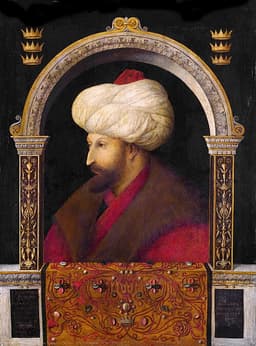
Mehmed II
Emperor · Medieval
66.8Total
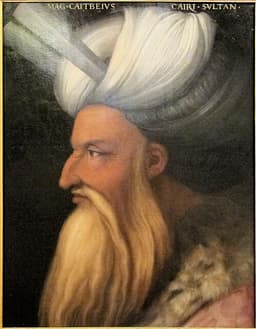
Qaitbay
Emperor · Medieval
58.7Total
Basic Information
Born
1432
1416
Died
1481
1496
Era
Medieval
Medieval
Nationality
Ottoman Empire
Egypt
Occupation
Emperor
Emperor
Civilization
Middle Eastern
Middle Eastern
Score Comparison
Military (10%)
77.5
50.0
Political (20%)
70.3
68.0
Influence (20%)
40.0
58.0
Legacy (20%)
75.0
50.0
Leadership (15%)
78.0
66.0
Strategy (15%)
80.3
66.3
TOTAL
66.8
58.7
Mehmed II — Complete Timeline
1453 AD
Siege of ConstantinopleWar
Mehmed II led the Ottoman army in a 53-day siege of Constantinople, the capital of the Byzantine Empire. The city fell on May 29, 1453, after Ottoman forces breached the walls. This conquest ended the Byzantine Empire and established Constantinople as the Ottoman capital, later renamed Istanbul.
ConquestByzantine EmpireOttoman Expansion
Impact: global
1456 AD
Siege of BelgradeWar◆ Major
Mehmed II led a large Ottoman army to besiege Belgrade, a key Hungarian fortress. The siege was broken by a Christian relief force led by John Hunyadi. The Ottoman army suffered heavy losses and was forced to retreat. This defeat halted Ottoman expansion into Hungary for decades.
SiegeDefeatHungary
Impact: regional
1461 AD
Conquest of the Empire of TrebizondWar◆ Major
Mehmed II led a military campaign against the Empire of Trebizond, the last major Byzantine Greek successor state. After a siege of the capital, Emperor David Megas Komnenos surrendered. This conquest eliminated the final remnant of Byzantine authority in Anatolia.
ConquestAnatoliaByzantine Successor
Impact: regional
1478 AD
Codification of Ottoman Law (Kanunname)Reform◆ Major
Mehmed II issued the Kanunname, a comprehensive legal code that systematized Ottoman criminal, administrative, and land law. This code defined the powers of the sultan, the structure of the bureaucracy, and the rights of subjects. It provided a legal framework for the expanding empire.
Legal ReformOttoman LawAdministration
Impact: nationalconstructive
1480 AD
Invasion of OtrantoWar
Mehmed II ordered an Ottoman fleet to invade the Italian city of Otranto. Ottoman forces captured the city and massacred many inhabitants. This invasion established a temporary Ottoman foothold in Italy, causing alarm among Italian states. The occupation ended after Mehmed's death.
InvasionItalyOttoman Expansion
Impact: regionaldestructive
Qaitbay — Complete Timeline
1468 AD
Suppression of the Revolt of the Emir of AleppoWar
Early in his reign, Qaitbay suppressed a revolt by the Emir of Aleppo, who had refused to recognize his authority. The sultan's forces marched to Aleppo, defeated the rebels, and executed the emir, securing his position as sultan.
Mamluk SultanateRevoltAleppo
Impact: regional
1477 AD
Construction of the Qaitbay Citadel in AlexandriaCultural◆ Major
Qaitbay ordered the construction of a fortress on the site of the ancient Lighthouse of Alexandria, one of the Seven Wonders of the Ancient World. The citadel was built using stones from the ruined lighthouse and served as a key defensive fortification for the city.
Mamluk SultanateArchitectureFortificationAlexandria
Impact: regionalconstructive
1482 AD
Restoration of the Dome of the RockCultural◆ Major
Qaitbay funded a major restoration of the Dome of the Rock in Jerusalem, including repairs to the dome's mosaics and the addition of a marble facing. This project demonstrated Mamluk patronage of Islamic architecture and religious sites.
Mamluk SultanateArchitectureJerusalemRestoration
Impact: regionalconstructive
1485 AD
War with the Ottoman Empire (1485-1491)War◆ Major
Qaitbay fought a protracted war against the Ottoman Empire over control of Cilicia and the buffer state of Dulkadir. The conflict ended with a peace treaty that maintained the status quo, with the Mamluks retaining their northern borders.
Mamluk SultanateOttoman EmpireWarCilicia
Impact: regional
Expert Analysis
Origins
Mehmed II, born in 1432 in Edirne, was the son of Sultan Murad II and Hüma Hatun. He received a rigorous education in Islamic sciences, history, and military tactics from renowned scholars like Molla Gürani and Akşemseddin. His early exposure to the throne came when his father abdicated briefly in 1444, making Mehmed sultan at age 12, though a Janissary revolt forced Murad's return. This instability shaped Mehmed's resolve to secure absolute power.
Qaitbay, born around 1416 in Circassia, was purchased as a slave and rose through the Mamluk military hierarchy. He served as a junior officer under Sultan Barsbay and later became a high-ranking emir. His early life in the Mamluk system—a slave-soldier aristocracy—emphasized martial training and political maneuvering. He married the daughter of Sultan Inal, cementing his ties to the ruling elite.
Rise to Power
Mehmed II became sultan permanently in 1451 after Murad II's death. His first act was to consolidate power by ordering the execution of his infant half-brother, Ahmed, to eliminate rivals. He then focused on his grand ambition: capturing Constantinople. He built the fortress of Rumelihisarı on the Bosphorus in 1452 to control the strait, and assembled a massive army of 100,000 men and a fleet of 320 ships. The 53-day siege culminated on May 29, 1453, when Ottoman forces breached the walls. Mehmed's use of massive cannons, including the 27-ton 'Great Bombard,' and his strategic deployment of troops were decisive.
Qaitbay ascended the Mamluk throne in 1468 after the death of Sultan Khushqadam, amid factional strife. He was chosen by the senior emirs as a compromise candidate. Early in his reign, he faced a revolt from the Emir of Aleppo, who refused to recognize his authority. Qaitbay marched to Aleppo in 1469, defeated the rebels, and executed the emir, securing his rule. His legitimacy was further bolstered by his patronage of religious institutions and his focus on fortifying the Mamluk state against the rising Ottoman threat.
Leadership & Governance
Mehmed II ruled with absolute authority, centralizing the Ottoman state. He codified the Kanunname, a legal code that defined the duties of officials, regulated land tenure, and established criminal laws. This systematized the empire's governance and reduced the power of feudal lords. He also established the devshirme system, recruiting Christian boys for military and administrative roles, creating a loyal elite. In conquered territories, he implemented a policy of tolerance, allowing Christians and Jews to maintain their religions in exchange for higher taxes.
Qaitbay's governance was more decentralized, relying on the Mamluk emirs. He focused on restoring the empire's economic stability through trade and construction. He funded the restoration of the Dome of the Rock in Jerusalem, adding marble facing and repairing mosaics. His most famous project was the Qaitbay Citadel in Alexandria, built on the site of the ancient Lighthouse, which served as a defensive fortress and symbol of Mamluk power. However, his military reforms lagged, as Mamluks resisted adopting gunpowder weapons, which hindered their effectiveness against the Ottomans.
Triumph & Tragedy
Mehmed II's greatest triumph was the conquest of Constantinople, which ended the Byzantine Empire and made him a legendary figure. He then expanded the empire into Serbia, Bosnia, and the Morea, and conquered the Empire of Trebizond in 1461. His military score of 77.5 reflects these successes. However, his siege of Belgrade in 1456 failed due to the resistance of John Hunyadi and the Hungarian forces. His invasion of Otranto in 1480 was a short-lived victory; after his death, the city was reclaimed by Christian forces.
Qaitbay's major triumph was his long reign of 28 years, a period of relative stability for the Mamluks. He successfully fought the Ottoman war of 1485-1491, securing a peace treaty that maintained Mamluk control over Cilicia. His restoration of the Dome of the Rock enhanced his religious prestige. However, his military score of 50.0 reflects the Mamluk army's decline; they failed to adapt to Ottoman artillery and tactics. The war drained the treasury, and his later years saw economic troubles and plague.
Character & Destiny
Mehmed II was known for his intellectual curiosity and ruthless pragmatism. He studied philosophy, science, and history, and spoke multiple languages including Greek and Latin. He was decisive and often cruel, ordering the execution of rivals and the massacre of prisoners. His personality drove him to pursue conquest relentlessly, but also led to paranoia: he had his grand vizier executed for corruption. His death in 1481, possibly from poison, left the empire in a succession crisis.
Qaitbay was described as pious and cautious, a contrast to Mehmed's aggression. He prioritized diplomacy and construction over expansion. His reign was marked by internal stability, but his reluctance to modernize the military left the Mamluks vulnerable. His character—conservative and risk-averse—shaped the Mamluk state's eventual decline. He died in 1496, likely from natural causes, after a reign that preserved but did not strengthen the sultanate.
Legacy
Mehmed II's legacy is profound: he transformed the Ottoman Empire into a major power, opened the age of cannon warfare, and his conquest of Constantinople reshaped world history. The city became Istanbul, the Ottoman capital, and his legal code influenced Ottoman governance for centuries. His military score of 77.5 and strategy score of 80.3 underscore his tactical genius. He is remembered as a conqueror who bridged medieval and early modern eras.
Qaitbay's legacy is more localized. His citadel in Alexandria remains a landmark, and his restoration of the Dome of the Rock preserved an Islamic holy site. However, his inability to reform the Mamluk military and economy contributed to the empire's eventual conquest by the Ottomans in 1517. His influence score of 58.0 reflects his impact within the Mamluk world, but his overall legacy is overshadowed by the Ottomans' rise.
Conclusion
Mehmed II had a greater impact on history. His conquest of Constantinople altered the balance of power in Europe and the Middle East, while Qaitbay's achievements were primarily defensive and short-lived. With a total score of 66.8 against Qaitbay's 58.7, Mehmed II's military, strategic, and political dominance is clear. While Qaitbay maintained stability, he failed to adapt to changing warfare, sealing the Mamluks' fate. Mehmed II's vision and ruthlessness created an empire that lasted centuries, making him the more significant figure.
Rankings
🥇
Mehmed IILeader
Mil: 77.5Pol: 70.3Inf: 40.0
66.8
🥈
Qaitbay
Mil: 50.0Pol: 68.0Inf: 58.0
58.7
+8.1 behind
How This Comparison Works
Algorithm
Each figure is scored on 6 dimensions (0—100 scale) based on structured historical data: Military (10%), Political (20%), Influence (20%), Legacy (20%), Leadership (15%), Strategy (15%). The weighted total produces the final ranking.
Data Sources
Scores are computed from structured sub-indicators in the database. Scale factors adjust for era (Ancient ×0.85, Modern ×1.0) and civilization size (Eastern ×1.05, Other ×0.80) to account for differences in population and military scale.
Maximum 3 Figures
Comparisons are limited to 2—3 figures to ensure readability and statistical meaningfulness.
Error Margins
±5 points per dimension — Sub-scores are derived from historical records with inherent uncertainty. Two figures within 5 points on a dimension should be considered roughly equivalent in that area.
Total Score Accuracy
±3 points overall — The weighted combination of 6 dimensions produces a total score with approximately ±3 points of uncertainty. Differences of less than 3 points are not statistically significant— the figures are effectively tied.
Known Limitations
- Historical records are incomplete and uneven across civilizations
- Figures from oral-tradition societies may be underrepresented
- Occupation labels can misclassify multi-role figures
- Scores measure capability and impact, not moral character
- Quantitative scoring is a comparison tool, not absolute truth
Capability Radar
Military (10%) — Battles & Warfare
Battles
95
55
Win Rate
90
60
Expansion
95
45
Political (20%) — Governance & Reform
Reform
90
55
Diplomacy
85
60
Economy
80
55
Influence (20%) — Cultural & Global Reach
Cultural
85
50
Global
90
40
Legacy (20%) — Historical Impact
Historical
95
55
Longevity
90
50
Leadership (15%) — Power & Stability
Tenure
85
70
Stability
75
65
Strategy (15%) — Tactics & Innovation
Strategy
95
60
Tactics
95
65
Reform
85
50
Similar Comparisons
Comments & Discussion
No comments yet. Be the first to share your thoughts!