Loading...
Mehmed II vs Suleiman I
Suleiman I leads by 12.0 pts · 2 figures compared
…
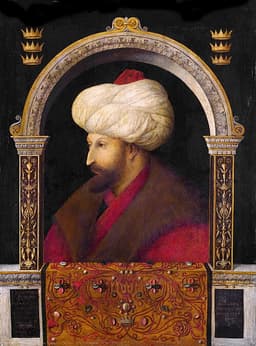
Mehmed II
Emperor · Medieval
66.8Total
Suleiman I
Emperor · Medieval
78.8Total
Basic Information
Born
1432
1494
Died
1481
1566
Era
Medieval
Medieval
Nationality
Ottoman Empire
Ottoman Empire
Occupation
Emperor
Emperor
Civilization
Middle Eastern
Middle Eastern
Score Comparison
Military (10%)
77.5
78.5
Political (20%)
70.3
82.0
Influence (20%)
40.0
85.0
Legacy (20%)
75.0
70.8
Leadership (15%)
78.0
81.7
Strategy (15%)
80.3
74.4
TOTAL
66.8
78.8
Mehmed II — Complete Timeline
1453 AD
Siege of ConstantinopleWar
Mehmed II led the Ottoman army in a 53-day siege of Constantinople, the capital of the Byzantine Empire. The city fell on May 29, 1453, after Ottoman forces breached the walls. This conquest ended the Byzantine Empire and established Constantinople as the Ottoman capital, later renamed Istanbul.
ConquestByzantine EmpireOttoman Expansion
Impact: global
1456 AD
Siege of BelgradeWar◆ Major
Mehmed II led a large Ottoman army to besiege Belgrade, a key Hungarian fortress. The siege was broken by a Christian relief force led by John Hunyadi. The Ottoman army suffered heavy losses and was forced to retreat. This defeat halted Ottoman expansion into Hungary for decades.
SiegeDefeatHungary
Impact: regional
1461 AD
Conquest of the Empire of TrebizondWar◆ Major
Mehmed II led a military campaign against the Empire of Trebizond, the last major Byzantine Greek successor state. After a siege of the capital, Emperor David Megas Komnenos surrendered. This conquest eliminated the final remnant of Byzantine authority in Anatolia.
ConquestAnatoliaByzantine Successor
Impact: regional
1478 AD
Codification of Ottoman Law (Kanunname)Reform◆ Major
Mehmed II issued the Kanunname, a comprehensive legal code that systematized Ottoman criminal, administrative, and land law. This code defined the powers of the sultan, the structure of the bureaucracy, and the rights of subjects. It provided a legal framework for the expanding empire.
Legal ReformOttoman LawAdministration
Impact: nationalconstructive
1480 AD
Invasion of OtrantoWar
Mehmed II ordered an Ottoman fleet to invade the Italian city of Otranto. Ottoman forces captured the city and massacred many inhabitants. This invasion established a temporary Ottoman foothold in Italy, causing alarm among Italian states. The occupation ended after Mehmed's death.
InvasionItalyOttoman Expansion
Impact: regionaldestructive
Suleiman I — Complete Timeline
1522 AD
Siege of RhodesWar◆ Major
Suleiman I led a massive Ottoman army and fleet to besiege the island of Rhodes, held by the Knights Hospitaller. After a six-month siege, the knights surrendered and were allowed to leave. This victory secured Ottoman control over the eastern Mediterranean.
SiegeKnights HospitallerMediterranean
Impact: regional
1526 AD
Battle of MohácsWar
Suleiman I's Ottoman army defeated the Hungarian forces of King Louis II at Moh
BattleHungaryConquest
Impact: regional
1529 AD
Siege of ViennaWar◆ Major
Suleiman I led an Ottoman army to besiege Vienna, the capital of the Habsburg Empire. The siege failed due to supply problems and the onset of winter. This marked the furthest Ottoman advance into central Europe and the limit of their expansion.
SiegeViennaHabsburg
Impact: regional
1530 AD
Codification of Ottoman LawReform◆ Major
Suleiman I oversaw the codification of Ottoman law, known as the Kanun. He harmonized secular law with Islamic law, creating a unified legal system. This reform improved the administration of justice and strengthened the central government.
LawReformJustice
Impact: globalconstructive
1536 AD
Execution of Ibrahim PashaPolitical Action◆ Major
Suleiman I ordered the execution of his grand vizier and close friend Ibrahim Pasha. Ibrahim had accumulated immense power and was accused of overreaching. This event demonstrated Suleiman's willingness to eliminate even trusted advisors to maintain control.
ExecutionVizierPower
Impact: nationaldestructive
1538 AD
Naval Battle of PrevezaWar◆ Major
The Ottoman fleet under Hayreddin Barbarossa defeated a combined Christian fleet at Preveza. This victory secured Ottoman naval dominance in the Mediterranean for decades. It allowed the Ottomans to control trade routes and raid coastal areas.
Naval BattleBarbarossaMediterranean
Impact: regional
Expert Analysis
Origins
Mehmed II, born in 1432 in Edirne, was the son of Sultan Murad II and a slave concubine. He received a rigorous education in Islamic sciences, history, and military tactics. His father abdicated briefly, placing Mehmed on the throne at age 12, but a Janissary revolt forced Murad's return. This early lesson in political instability shaped Mehmed's ruthless pragmatism. Suleiman I, born in 1494 in Trabzon, was the son of Selim I and Hafsa Sultan. He was educated in Istanbul by the finest scholars, including the poet Baki. Unlike Mehmed, Suleiman's succession was smooth after Selim's death in 1520. His early exposure to law and administration, coupled with his father's conquests in the East, gave him a stable base for expansion.
Rise to Power
Mehmed II ascended the throne for the second time in 1451 after his father's death. His primary goal was the capture of Constantinople, which he achieved in 1453 after a 53-day siege. This victory, using massive cannon and naval blockade, eliminated the Byzantine Empire and made him a legendary conqueror. He then consolidated control over Anatolia and the Balkans, conquering the Empire of Trebizond in 1461 and subduing the Karamanids. Suleiman's rise was less dramatic: he inherited an empire that already stretched from the Balkans to the Safavid border. His first major campaign was the capture of Belgrade in 1521, followed by the Siege of Rhodes in 1522, which expelled the Knights Hospitaller. The turning point came at the Battle of Mohács in 1526, where he crushed the Hungarian army and killed King Louis II, making Hungary a vassal state.
Leadership & Governance
Mehmed II was a centralizer and lawgiver. He issued the Kanunname, a comprehensive legal code that regulated criminal, administrative, and land law, reducing the power of the ulema and nobles. He established the devshirme system firmly, creating a loyal elite of converted slaves (Janissaries) who served the sultan. His governance was autocratic: he executed his grand vizier Halil Pasha for alleged corruption and confiscated land from religious foundations. Suleiman, by contrast, was a harmonizer. He codified Ottoman law (Kanun) alongside Islamic law, issuing the Kanun-i Osmani that balanced secular and religious justice. He relied on grand viziers like Ibrahim Pasha and later Rustem Pasha, delegating administration while maintaining ultimate authority. Suleiman's legal reforms earned him the title "the Lawgiver" in the Islamic world.
Triumph & Tragedy
Mehmed II's greatest triumph was the capture of Constantinople, which transformed the Ottoman state into an empire. He also conquered the Empire of Trebizond (1461) and invaded Italy (Otranto, 1480). His failures included the Siege of Belgrade (1456), where John Hunyadi repelled the Ottomans, and his inability to conquer the Venetian strongholds in the Aegean. Suleiman's triumphs include the conquest of Hungary (Mohács, 1526) and the capture of Baghdad (1534). His legal codification unified the empire. His tragedies include the failed Siege of Vienna (1529), which marked the limit of Ottoman expansion, and the execution of Ibrahim Pasha in 1536, a personal and political error that destabilized his court. Suleiman also ordered the execution of his son Mustafa in 1553, leading to succession crises.
Character & Destiny
Mehmed II was calculating and ruthless. He ordered the execution of his infant brother to prevent rebellion and poisoned his grand vizier. His obsession with conquest drove him to campaigns in Albania and Italy, but his early death at age 49 from illness cut short his plans. Suleiman was more introspective and legalistic. He wrote poetry under the pen name "Muhibbi" and oversaw a cultural golden age. His character led to a stable but increasingly bureaucratic empire. His reliance on favorites like Ibrahim and later Roxelana (Hurrem Sultan) led to the "Sultanate of Women" and palace intrigue. Suleiman's long reign (46 years) allowed consolidation but also sowed seeds of decline through overcentralization.
Legacy
Mehmed II's legacy is the conquest of Constantinople, which ended the medieval Byzantine Empire and cemented Ottoman power in the Eastern Mediterranean. His legal code (Kanunname) influenced subsequent sultans, and his architectural projects, like the Topkapi Palace and Fatih Mosque, defined Ottoman imperial style. Suleiman's legacy is the peak of Ottoman military, legal, and cultural achievement. He expanded the empire to its greatest territorial extent, from Hungary to Yemen. His legal reforms created a unified system that lasted into the 19th century. Culturally, his patronage spawned classical Ottoman architecture (Süleymaniye Mosque) and literature. Suleiman's scores reflect his broader impact: political 82.0 vs Mehmed's 70.3, influence 85.0 vs 40.0, legacy 70.8 vs 75.0.
Conclusion
While Mehmed II conquered the city that defined the empire, Suleiman I's longer reign and comprehensive reforms made him the more impactful ruler. Mehmed's military and strategic scores (77.5 and 80.3) are slightly higher than Suleiman's (78.5 and 74.4), but Suleiman's political and influence scores (82.0 and 85.0) dwarf Mehmed's (70.3 and 40.0). Suleiman's total score of 78.8 significantly exceeds Mehmed's 66.8. Mehmed was the architect of empire; Suleiman was the builder who expanded and sustained it. The Ottoman Empire reached its zenith under Suleiman, and his legal and cultural legacy outlasted Mehmed's conquests. Therefore, Suleiman I had greater overall impact.
Rankings
🥇
Suleiman ILeader
Mil: 78.5Pol: 82.0Inf: 85.0
78.8
🥈
Mehmed II
Mil: 77.5Pol: 70.3Inf: 40.0
66.8
+12.0 behind
How This Comparison Works
Algorithm
Each figure is scored on 6 dimensions (0—100 scale) based on structured historical data: Military (10%), Political (20%), Influence (20%), Legacy (20%), Leadership (15%), Strategy (15%). The weighted total produces the final ranking.
Data Sources
Scores are computed from structured sub-indicators in the database. Scale factors adjust for era (Ancient ×0.85, Modern ×1.0) and civilization size (Eastern ×1.05, Other ×0.80) to account for differences in population and military scale.
Maximum 3 Figures
Comparisons are limited to 2—3 figures to ensure readability and statistical meaningfulness.
Error Margins
±5 points per dimension — Sub-scores are derived from historical records with inherent uncertainty. Two figures within 5 points on a dimension should be considered roughly equivalent in that area.
Total Score Accuracy
±3 points overall — The weighted combination of 6 dimensions produces a total score with approximately ±3 points of uncertainty. Differences of less than 3 points are not statistically significant— the figures are effectively tied.
Known Limitations
- Historical records are incomplete and uneven across civilizations
- Figures from oral-tradition societies may be underrepresented
- Occupation labels can misclassify multi-role figures
- Scores measure capability and impact, not moral character
- Quantitative scoring is a comparison tool, not absolute truth
Capability Radar
Military (10%) — Battles & Warfare
Battles
95
95
Win Rate
90
92
Expansion
95
95
Political (20%) — Governance & Reform
Reform
90
90
Diplomacy
85
88
Economy
80
85
Influence (20%) — Cultural & Global Reach
Cultural
85
85
Global
90
85
Legacy (20%) — Historical Impact
Historical
95
88
Longevity
90
80
Leadership (15%) — Power & Stability
Tenure
85
95
Stability
75
80
Strategy (15%) — Tactics & Innovation
Strategy
95
90
Tactics
95
88
Reform
85
85
Similar Comparisons
Comments & Discussion
No comments yet. Be the first to share your thoughts!