Loading...
Osman I vs Suleiman I
Suleiman I leads by 22.7 pts · 2 figures compared
…
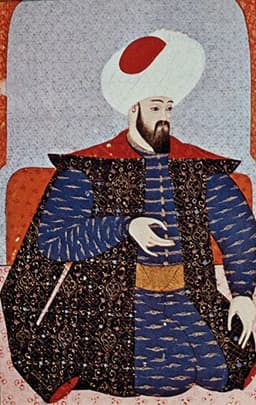
Osman I
Emperor · Medieval
56.1Total
Suleiman I
Emperor · Medieval
78.8Total
Basic Information
Born
1258
1494
Died
1326
1566
Era
Medieval
Medieval
Nationality
Ottoman Empire
Ottoman Empire
Occupation
Emperor
Emperor
Civilization
Middle Eastern
Middle Eastern
Score Comparison
Military (10%)
20.0
78.5
Political (20%)
45.1
82.0
Influence (20%)
65.0
85.0
Legacy (20%)
68.0
70.8
Leadership (15%)
65.0
81.7
Strategy (15%)
43.3
74.4
TOTAL
56.1
78.8
Osman I — Complete Timeline
1299 AD
Foundation of the Ottoman BeylikPolitical Action
Osman I declared independence from the Seljuk Sultanate of Rum, establishing his own beylik (principality) in northwestern Anatolia. This act is traditionally considered the founding of the Ottoman state, which would later grow into a vast empire.
FoundationOttoman EmpireIndependence
Impact: globalconstructive
1302 AD
Battle of BapheusWar◆ Major
Osman I led his forces to victory against a Byzantine army at Bapheus near Nicomedia. This battle established Osman's reputation as a ghazi warrior and marked the beginning of Ottoman expansion into Byzantine territory in northwestern Anatolia.
BattleByzantineGhazi
Impact: regional
1308 AD
Alliance with the Byzantine EmperorPolitical Action
Osman I formed a temporary alliance with the Byzantine emperor Andronikos II against the Catalan Company. This pragmatic relationship allowed Osman to gain resources and recognition while expanding his territory.
AllianceByzantineDiplomacy
1326 AD
Siege of BursaWar◆ Major
Osman I initiated the siege of the Byzantine city of Bursa, though it was captured by his son Orhan after Osman's death. The conquest of Bursa provided the Ottomans with their first major urban center and capital.
SiegeBursaCapital
Impact: regional
Suleiman I — Complete Timeline
1522 AD
Siege of RhodesWar◆ Major
Suleiman I led a massive Ottoman army and fleet to besiege the island of Rhodes, held by the Knights Hospitaller. After a six-month siege, the knights surrendered and were allowed to leave. This victory secured Ottoman control over the eastern Mediterranean.
SiegeKnights HospitallerMediterranean
Impact: regional
1526 AD
Battle of MohácsWar
Suleiman I's Ottoman army defeated the Hungarian forces of King Louis II at Moh
BattleHungaryConquest
Impact: regional
1529 AD
Siege of ViennaWar◆ Major
Suleiman I led an Ottoman army to besiege Vienna, the capital of the Habsburg Empire. The siege failed due to supply problems and the onset of winter. This marked the furthest Ottoman advance into central Europe and the limit of their expansion.
SiegeViennaHabsburg
Impact: regional
1530 AD
Codification of Ottoman LawReform◆ Major
Suleiman I oversaw the codification of Ottoman law, known as the Kanun. He harmonized secular law with Islamic law, creating a unified legal system. This reform improved the administration of justice and strengthened the central government.
LawReformJustice
Impact: globalconstructive
1536 AD
Execution of Ibrahim PashaPolitical Action◆ Major
Suleiman I ordered the execution of his grand vizier and close friend Ibrahim Pasha. Ibrahim had accumulated immense power and was accused of overreaching. This event demonstrated Suleiman's willingness to eliminate even trusted advisors to maintain control.
ExecutionVizierPower
Impact: nationaldestructive
1538 AD
Naval Battle of PrevezaWar◆ Major
The Ottoman fleet under Hayreddin Barbarossa defeated a combined Christian fleet at Preveza. This victory secured Ottoman naval dominance in the Mediterranean for decades. It allowed the Ottomans to control trade routes and raid coastal areas.
Naval BattleBarbarossaMediterranean
Impact: regional
Expert Analysis
Origins
Osman I, born around 1258 in the town of Söğüt in northwestern Anatolia, was the son of Ertuğrul, a tribal leader of the Kayı branch of the Oghuz Turks. Little is known of his early life, but his family held a small frontier beylik under the Seljuk Sultanate of Rum. Osman likely received a typical nomadic warrior upbringing, learning horsemanship and combat. In contrast, Suleiman I, born on November 6, 1494, in Trabzon, was the only surviving son of Sultan Selim I. He received an elite education in the palace school in Istanbul, studying history, literature, theology, and military tactics. His grandfather Bayezid II ensured he gained administrative experience as a provincial governor. Osman's humble beginnings versus Suleiman's privileged upbringing shaped their distinct paths.
Rise to Power
Osman I rose to power around 1281 after his father's death, becoming the leader of the Kayı tribe. He declared independence from the Seljuk Sultanate of Rum in 1299, marking the traditional foundation of the Ottoman Beylik. His early success came through ghazi raids against Byzantine territories, culminating in the Battle of Bapheus in 1302, where his forces defeated a Byzantine army near Nicomedia. This victory attracted more warriors to his cause. Osman's strategic alliances, such as with Byzantine Emperor Andronikos II against the Catalan Company, allowed him to expand his territory without overextending. Suleiman I ascended the throne in 1520 after his father Selim I's death. Unlike Osman, Suleiman inherited a vast, stable empire. His first major campaign was the capture of Belgrade in 1521, followed by the successful Siege of Rhodes in 1522, which expelled the Knights Hospitaller. The turning point came at the Battle of Mohács in 1526, where Suleiman's army crushed the Hungarians, killing King Louis II and leaving Hungary vulnerable to Ottoman control. Suleiman's rise was swift and based on military prowess, while Osman's rise was gradual and foundational.
Leadership & Governance
Osman I led as a frontier ghazi chief, relying on personal charisma and tribal loyalty. He governed through a simple council of tribal elders and maintained a nomadic lifestyle. His military strategy focused on hit-and-run raids and siege warfare, as seen in the prolonged Siege of Bursa, which he initiated but did not live to see captured. Osman's governance was decentralized, with local beys controlling conquered lands. In contrast, Suleiman I centralized authority and codified Ottoman law. He oversaw the creation of the Kanun, a legal code that harmonized secular and Islamic law, applied uniformly across the empire. Suleiman's leadership style was bureaucratic; he delegated power to grand viziers like Ibrahim Pasha but ultimately controlled policy. His military campaigns were large-scale, involving tens of thousands of troops and complex logistics. While Osman scored 45.1 in political skills, Suleiman scored 82.0, reflecting his administrative reforms. Suleiman's governance transformed the Ottoman state from a frontier principality into a centralized empire, whereas Osman's rule laid the groundwork but lacked institutional depth.
Triumph & Tragedy
Osman I's greatest triumph was establishing an independent beylik that would grow into the Ottoman Empire. His victory at Bapheus secured his reputation and attracted followers. However, his failure to capture Bursa, which fell only after his death, was a personal tragedy. Osman also faced internal conflicts with other Turkish beyliks, limiting his expansion. Suleiman I's triumphs include the conquests of Belgrade, Rhodes, and most of Hungary after Mohács. His legal codification and patronage of arts (the 'Golden Age' of Ottoman culture) are enduring achievements. Yet his siege of Vienna in 1529 failed due to supply issues and winter, marking the empire's furthest advance into Europe. The execution of his grand vizier Ibrahim Pasha in 1536, based on suspicions of overreach, was a tragic decision that undermined his court. Later, the execution of his son Mustafa in 1553 due to succession fears led to widespread grief. Suleiman's military score of 78.5 reflects his successes, but his strategic score of 74.4 is lowered by the Vienna failure. Osman's military score of 20.0 is low because his battles were small-scale, but his legacy score of 68.0 shows his foundational impact.
Character & Destiny
Osman I was a pragmatic and charismatic leader, known for his humility and dedication to the ghazi ideal. He reportedly wore simple clothes and ate with his soldiers. His character inspired loyalty, enabling him to unite disparate tribes. His destiny was to create a state that outlived him. Suleiman I, by contrast, was a complex figure—magnificent in his achievements but increasingly isolated and suspicious in later years. He was a poet and patron of the arts, but also capable of ruthless decisions, as with Ibrahim and Mustafa. His character led to a centralized but paranoid rule. Historians note that Suleiman's later campaigns were less successful due to his micromanagement. Osman's character, focused on survival and expansion, suited his frontier context, while Suleiman's grandeur fit an empire at its peak. Both men's personalities shaped their empires' trajectories.
Legacy
Osman I is revered as the founder of the Ottoman dynasty, which lasted over 600 years. His name became synonymous with the empire. However, his direct legacy is symbolic; the institutions that sustained the empire were developed by his successors. Suleiman I left a more tangible legacy: the codified legal system, architectural works like the Süleymaniye Mosque, and a model of imperial administration. He is remembered as 'the Magnificent' in the West and 'the Lawgiver' in the Islamic world. Suleiman's influence score of 85.0 versus Osman's 65.0 reflects his broader impact. Yet, Osman's legacy score of 68.0 is high for a founder, as he set the stage for everything that followed. The score gap of 22.7 points in Suleiman's favor suggests his concrete achievements outweigh Osman's foundational role.
Conclusion
While Osman I provided the spark, Suleiman I fueled the fire. Suleiman's military conquests, legal reforms, and cultural patronage expanded and solidified the Ottoman Empire, leaving a more measurable impact. His total score of 78.8 dwarfs Osman's 56.1, indicating greater effectiveness. Osman's role as founder is crucial, but without Suleiman's consolidation, the empire might have remained a minor beylik. Therefore, Suleiman I had greater historical impact, transforming a fledgling state into a world power.
Rankings
🥇
Suleiman ILeader
Mil: 78.5Pol: 82.0Inf: 85.0
78.8
🥈
Osman I
Mil: 20.0Pol: 45.1Inf: 65.0
56.1
+22.7 behind
How This Comparison Works
Algorithm
Each figure is scored on 6 dimensions (0—100 scale) based on structured historical data: Military (10%), Political (20%), Influence (20%), Legacy (20%), Leadership (15%), Strategy (15%). The weighted total produces the final ranking.
Data Sources
Scores are computed from structured sub-indicators in the database. Scale factors adjust for era (Ancient ×0.85, Modern ×1.0) and civilization size (Eastern ×1.05, Other ×0.80) to account for differences in population and military scale.
Maximum 3 Figures
Comparisons are limited to 2—3 figures to ensure readability and statistical meaningfulness.
Error Margins
±5 points per dimension — Sub-scores are derived from historical records with inherent uncertainty. Two figures within 5 points on a dimension should be considered roughly equivalent in that area.
Total Score Accuracy
±3 points overall — The weighted combination of 6 dimensions produces a total score with approximately ±3 points of uncertainty. Differences of less than 3 points are not statistically significant— the figures are effectively tied.
Known Limitations
- Historical records are incomplete and uneven across civilizations
- Figures from oral-tradition societies may be underrepresented
- Occupation labels can misclassify multi-role figures
- Scores measure capability and impact, not moral character
- Quantitative scoring is a comparison tool, not absolute truth
Capability Radar
Military (10%) — Battles & Warfare
Battles
35
95
Win Rate
40
92
Expansion
50
95
Political (20%) — Governance & Reform
Reform
40
90
Diplomacy
50
88
Economy
35
85
Influence (20%) — Cultural & Global Reach
Cultural
60
85
Global
65
85
Legacy (20%) — Historical Impact
Historical
70
88
Longevity
80
80
Leadership (15%) — Power & Stability
Tenure
55
95
Stability
45
80
Strategy (15%) — Tactics & Innovation
Strategy
45
90
Tactics
30
88
Reform
30
85
Similar Comparisons
Comments & Discussion
No comments yet. Be the first to share your thoughts!