Loading...
Mindon Min vs Napoleon Bonaparte
Napoleon Bonaparte leads by 12.4 pts · 2 figures compared
…
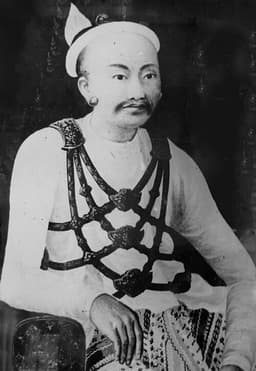
Mindon Min
Emperor · Modern
58.5Total

Napoleon Bonaparte
General · Modern
70.9Total
Basic Information
Born
1808
1769
Died
1878
1821
Era
Modern
Modern
Nationality
Myanmar
France
Occupation
Emperor
General
Civilization
Eastern
Western
Score Comparison
Military (10%)
50.0
94.0
Political (20%)
72.0
72.0
Influence (20%)
61.0
40.0
Legacy (20%)
49.2
80.0
Leadership (15%)
72.0
78.0
Strategy (15%)
43.3
90.0
TOTAL
58.5
70.9
Mindon Min — Complete Timeline
1853 AD
Modernization ReformsReform◆ Major
Mindon Min initiated a series of modernization reforms, including the establishment of a modern mint, the introduction of telegraph and postal systems, the construction of roads and canals, and the reorganization of the army along Western lines. He also invited European advisors to the court.
ModernizationReformBurma
Impact: nationalconstructive
Accession to the ThronePolitical Action◆ Major
Mindon Min ascended the throne after overthrowing his half-brother Pagan Min in a palace coup. He immediately sought peace with the British, ending the Second Anglo-Burmese War (which had started in 1852) and accepting the loss of Lower Burma.
CoupSuccessionBurma
Impact: nationalconstructive
1857 AD
Construction of Mandalay PalaceCultural◆ Major
Mindon Min founded the new royal capital of Mandalay and constructed the Mandalay Palace, a vast walled complex. The move from Amarapura to Mandalay was part of his efforts to create a modern capital and assert royal authority.
MandalayCapitalArchitecture
Impact: nationalconstructive
1867 AD
Treaty of 1867 with BritainPolitical Action◆ Major
Mindon Min signed a commercial treaty with the British, opening Burma to trade and allowing a British resident in Mandalay. The treaty recognized British control of Lower Burma and established a framework for diplomatic relations, but also increased British influence.
TreatyBritish RelationsTrade
Impact: regional
1871 AD
Holding of the Fifth Buddhist CouncilCultural
Mindon Min convened the Fifth Buddhist Council in Mandalay, a major religious event attended by thousands of monks. The council aimed to purify and standardize the Pali canon. The text was inscribed on 729 marble slabs at the Kuthodaw Pagoda, the world's largest book.
Buddhist CouncilReligionBurma
Impact: globalconstructive
Napoleon Bonaparte — Complete Timeline
1799 AD
Coup of 18 BrumaireOther◆ Major
Napoleon Bonaparte, with support from his brother Lucien and key political figures, overthrew the Directory in a bloodless coup. He established the Consulate with himself as First Consul, effectively becoming the ruler of France. This event ended the French Revolution's most unstable period.
French RevolutionCoupRise to Power
Impact: regional
1804 AD
Promulgation of the Napoleonic CodeOther◆ Major
Napoleon enacted the Civil Code of the French, known as the Napoleonic Code, a comprehensive set of laws that replaced the fragmented feudal legal systems. The code established legal equality, protected property rights, and secularized law. It became the basis for legal systems in many European and world countries.
Legal ReformNapoleonic CodeCivil Law
Impact: globalconstructive
1805 AD
Battle of AusterlitzWar◆ Major
Napoleon's Grande Arm
Napoleonic WarsBattleDecisive Victory
Impact: global
1812 AD
Invasion of RussiaWar◆ Major
Napoleon led the Grande Arm
Napoleonic WarsInvasionDisaster
Impact: globaldestructive
1815 AD
Battle of WaterlooWar◆ Major
Napoleon's French army was defeated by the combined forces of the Duke of Wellington's Anglo-Allied army and Gebhard Leberecht von Bl
Napoleonic WarsBattleFinal Defeat
Impact: globaldestructive
Expert Analysis
mindon-min-vs-napoleon-bonaparte
# The Emperor and the Conqueror: Two Paths Through the Storm of Modernity
In the summer of 1815, Napoleon Bonaparte stood on the muddy fields of Waterloo, watching his Imperial Guard crumble before British and Prussian fire. Half a world away and four decades later, King Mindon Min sat in his newly built Mandalay Palace, listening to Buddhist monks chant the sacred texts he had convened the Fifth Buddhist Council to preserve. One man had tried to conquer the world with cannon and cavalry; the other sought to save his kingdom through scripture and reform. Both faced the same relentless force—the rising tide of European imperialism—but their responses could not have been more different. Why did one end in exile on a remote Atlantic island, and the other in the quiet tragedy of a kingdom slowly strangled by colonial powers?
Origins
Napoleon Bonaparte was born in 1769 on the island of Corsica, a place that had only recently become French. His family was minor nobility, but poor. He spoke Italian-accented French and carried the chip of an outsider. The French Revolution, which erupted when he was twenty, shattered the old order and created opportunities for ambitious young men of talent. Napoleon seized them with both hands.
Mindon Min, born in 1808, was the son of King Tharrawaddy of the Konbaung dynasty, the last ruling house of independent Burma. He grew up in the opulent but isolated world of the Ava court, where astrology dictated policy and the king’s word was law. Yet he also witnessed the humiliating defeat of the First Anglo-Burmese War (1824–1826), which cost Burma its coastal provinces. The lesson was clear: the British were coming, and tradition alone would not stop them.
Their eras shaped them as surely as their bloodlines. Napoleon came of age in a Europe convulsed by revolution, where a brilliant general could rise to rule a continent. Mindon Min came of age in a Southeast Asia being devoured by colonial empires, where the best a king could hope for was to delay the inevitable.
Rise to Power
Napoleon’s ascent was a rocket’s trajectory. In 1793, at age twenty-four, he drove the British out of Toulon. By 1796, he commanded the Army of Italy and won stunning victories against the Austrians. In 1799, he overthrew the French government in a coup and made himself First Consul. By 1804, he crowned himself Emperor of the French. Each step was a gamble, a masterpiece of timing, audacity, and ruthlessness.
Mindon Min’s path was quieter but no less dramatic. In 1853, he overthrew his half-brother, King Pagan Min, in a palace coup. Pagan had mismanaged the Second Anglo-Burmese War, losing Lower Burma to the British. Mindon ascended the throne with a clear mandate: make peace with the British and reform the kingdom to survive. He immediately sought a truce, halting hostilities and accepting the loss of territory. It was not glory; it was survival.
Leadership & Governance
Napoleon governed as he conquered: with energy, brilliance, and an iron fist. He centralized the French state, created the Bank of France, and—most enduringly—promulgated the Napoleonic Code in 1804, a legal system that enshrined equality before the law, property rights, and secular administration. His military genius was staggering: he won sixty battles, from Austerlitz in 1805 to Wagram in 1809, using speed, deception, and overwhelming force at the decisive point. But his political wisdom had limits. He placed his brothers on European thrones, alienated potential allies, and refused to compromise.
Mindon Min governed as a reformer and a diplomat. He established a modern mint, introduced telegraph lines, and sponsored the first Burmese-language newspapers. He built Mandalay as a new capital in 1857, a city designed to symbolize both Buddhist piety and royal power. But his greatest achievement was the Fifth Buddhist Council in 1871, where thousands of monks recited and edited the Tripitaka, the Buddhist scriptures. It was a monumental act of cultural preservation—a kingdom asserting its soul against the encroaching West.
Yet Mindon’s military score of 43.0 reflects a painful truth: he never fought a major war. He chose peace over resistance, knowing that any conflict with the British would end in annihilation. Napoleon, with a military score of 94.0, never stopped fighting—and that ultimately destroyed him.
Triumph & Tragedy
Napoleon’s greatest moment was the Battle of Austerlitz in 1805, where he crushed the combined armies of Russia and Austria. It was a masterpiece of strategy, and it made him master of Europe. His greatest tragedy was the invasion of Russia in 1812. He marched 600,000 men into the vastness of the Russian winter; fewer than 100,000 returned. His refusal to accept limits—to stop, consolidate, and negotiate—led to his first abdication in 1814, then his final defeat at Waterloo in 1815. He died in 1821 on the remote island of Saint Helena, a prisoner of the British.
Mindon Min’s triumph was the Fifth Buddhist Council, a spiritual coronation that affirmed his legitimacy and his people’s faith. His tragedy was subtler: the Treaty of 1867 with Britain, which opened Burma to trade and allowed a British resident in Mandalay. It bought peace, but at the cost of sovereignty. Mindon died in 1878, having preserved his kingdom’s independence for his lifetime. Within seven years, his son Thibaw would lose it all to the British in the Third Anglo-Burmese War. The Mandalay Palace became a British garrison.
Character & Destiny
Napoleon was driven by ambition, energy, and an unshakable belief in his own destiny. “Impossible is a word to be found only in the dictionary of fools,” he once said. That conviction made him great—and blind. He could not stop, could not share power, could not accept defeat. His personality was his engine and his anchor.
Mindon Min was driven by caution, piety, and a clear-eyed assessment of reality. He understood that Burma could not defeat the British Empire, so he tried to reform from within, to buy time, to preserve culture. His leadership score of 83.3 reflects a king who ruled wisely, not gloriously. But wisdom could not stop the machine of imperialism. His destiny was to be the last great king of an independent Burma.
Legacy
Napoleon’s legacy is written in law, in borders, in the very shape of modern Europe. The Napoleonic Code influenced legal systems from Italy to Latin America. His military campaigns are still studied in war colleges. He is remembered as both a liberator and a tyrant, a genius and a madman. His total score of 82.4 reflects a figure of enormous impact, for good and ill.
Mindon Min’s legacy is quieter but no less profound. He is remembered in Myanmar as a reformer and a protector of the faith. The Fifth Buddhist Council remains a touchstone of national identity. But his kingdom fell, and his reforms were undone. His total score of 70.2 reflects a leader who did everything right—and still lost.
Conclusion
Napoleon and Mindon Min lived in the same century, but in different worlds. One commanded armies that shook the earth; the other presided over a kingdom that slipped quietly into the jaws of empire. One died in exile, the other in his palace. Yet both faced the same question: How does a ruler respond when the old order is dying? Napoleon answered with conquest, and was consumed by it. Mindon Min answered with reform, and was overwhelmed by forces beyond his control.
Perhaps the deepest lesson is this: greatness is not always measured in victories. Sometimes it is measured in the quiet dignity of a king who, knowing he cannot win, chooses to preserve what can be saved—a scripture, a culture, a people’s soul. Napoleon built an empire that crumbled. Mindon Min built a council that still echoes. Which legacy endures longer? That is a question for the ages.
Rankings
🥇
Napoleon BonaparteLeader
Mil: 94.0Pol: 72.0Inf: 40.0
70.9
🥈
Mindon Min
Mil: 50.0Pol: 72.0Inf: 61.0
58.5
+12.4 behind
How This Comparison Works
Algorithm
Each figure is scored on 6 dimensions (0—100 scale) based on structured historical data: Military (10%), Political (20%), Influence (20%), Legacy (20%), Leadership (15%), Strategy (15%). The weighted total produces the final ranking.
Data Sources
Scores are computed from structured sub-indicators in the database. Scale factors adjust for era (Ancient ×0.85, Modern ×1.0) and civilization size (Eastern ×1.05, Other ×0.80) to account for differences in population and military scale.
Maximum 3 Figures
Comparisons are limited to 2—3 figures to ensure readability and statistical meaningfulness.
Error Margins
±5 points per dimension — Sub-scores are derived from historical records with inherent uncertainty. Two figures within 5 points on a dimension should be considered roughly equivalent in that area.
Total Score Accuracy
±3 points overall — The weighted combination of 6 dimensions produces a total score with approximately ±3 points of uncertainty. Differences of less than 3 points are not statistically significant— the figures are effectively tied.
Known Limitations
- Historical records are incomplete and uneven across civilizations
- Figures from oral-tradition societies may be underrepresented
- Occupation labels can misclassify multi-role figures
- Scores measure capability and impact, not moral character
- Quantitative scoring is a comparison tool, not absolute truth
Capability Radar
Military (10%) — Battles & Warfare
Battles
20
95
Win Rate
20
90
Expansion
10
95
Political (20%) — Governance & Reform
Reform
75
95
Diplomacy
55
80
Economy
60
85
Influence (20%) — Cultural & Global Reach
Cultural
65
85
Global
40
90
Legacy (20%) — Historical Impact
Historical
60
95
Longevity
45
90
Leadership (15%) — Power & Stability
Tenure
60
85
Stability
50
70
Strategy (15%) — Tactics & Innovation
Strategy
25
95
Tactics
25
98
Reform
30
92
Similar Comparisons
Comments & Discussion
No comments yet. Be the first to share your thoughts!