Loading...
This comparison has not been analyzed yet.
One-time AI generation (~1 minute). Scores and timeline are already available below.
Modibo Keita vs Morgan Tsvangirai
Morgan Tsvangirai leads by 4.0 pts · 2 figures compared
…
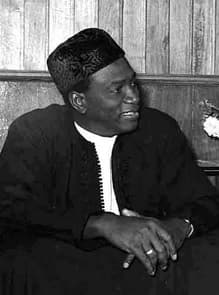
Modibo Keita
Politician · Modern
52.5Total

Morgan Tsvangirai
Politician · Modern
56.5Total
Basic Information
Born
1915
1952
Died
1977
—
Era
Modern
Modern
Nationality
Mali
Zimbabwe
Occupation
Politician
Politician
Civilization
Other
Other
Score Comparison
Military (10%)
10.0
37.5
Political (20%)
68.0
68.0
Influence (20%)
57.2
59.0
Legacy (20%)
48.3
49.2
Leadership (15%)
74.0
74.0
Strategy (15%)
38.3
43.7
TOTAL
52.5
56.5
Modibo Keita — Complete Timeline
1960 AD
Adoption of Socialist PoliciesReform◆ Major
Keita implemented a socialist economic program, nationalizing key industries, collectivizing agriculture, and establishing state-run enterprises. These policies aimed to reduce dependence on France and promote self-sufficiency but led to economic inefficiency and shortages.
SocialismEconomic PolicyMali
Impact: national
First President of Independent MaliPolitical Action◆ Major
Modibo Keita became the first President of Mali on September 22, 1960, after the country gained independence from France. He led the Sudanese Republic (formerly French Sudan) in breaking away from the short-lived Mali Federation with Senegal.
IndependenceFoundingMali
Impact: nationalconstructive
1963 AD
Promotion of Pan-AfricanismPolitical Action◆ Major
Keita was a leading pan-Africanist and co-founder of the Organization of African Unity (OAU) in 1963. He advocated for African unity and anti-colonialism, hosting the OAU's first summit in Addis Ababa and supporting liberation movements across the continent.
Pan-AfricanismOAUDiplomacy
Impact: regionalconstructive
1968 AD
Overthrown in Military CoupPolitical Action◆ Major
On November 19, 1968, Keita was overthrown in a military coup led by Lieutenant Moussa Traore. The coup was fueled by economic decline, popular discontent with austerity measures, and political repression. Keita was imprisoned and died in detention in 1977.
CoupOverthrowMali
Impact: nationaldestructive
Morgan Tsvangirai — Complete Timeline
1999 AD
Founded Movement for Democratic ChangePolitical Action◆ Major
Tsvangirai founded the MDC as a trade union-backed opposition party to challenge Robert Mugabe's ZANU-PF. The party quickly became the main opposition in Zimbabwe.
Political PartyOpposition
Impact: nationalconstructive
2008 AD
Won First Round of Presidential ElectionPolitical Action
Tsvangirai won the first round of the presidential election with 47.9% of the vote against Mugabe's 43.2%. However, he withdrew from the runoff due to widespread violence against his supporters.
ElectionViolenceRunoff
Impact: national
2009 AD
Became Prime Minister of ZimbabwePolitical Action◆ Major
Tsvangirai became Prime Minister in a power-sharing government with Robert Mugabe, following the disputed 2008 election. The Government of National Unity aimed to resolve the political and economic crisis.
Prime MinisterUnity Government
Impact: national
2013 AD
Lost 2013 Presidential ElectionPolitical Action◆ Major
Tsvangirai lost the presidential election to Robert Mugabe, receiving 34% of the vote against Mugabe's 61%. The MDC alleged widespread fraud, but the result was upheld by the courts.
ElectionDefeat
Impact: national
2018 AD
Died of CancerOther◆ Major
Tsvangirai died of colon cancer at the age of 65. His death was a major blow to the opposition movement in Zimbabwe, leaving a leadership vacuum in the MDC.
DeathOpposition
Impact: nationaltragic
This comparison has not been analyzed yet.
One-time AI generation (~1 minute). Scores and timeline are already available below.
Rankings
🥇
Morgan TsvangiraiLeader
Mil: 37.5Pol: 68.0Inf: 59.0
56.5
🥈
Modibo Keita
Mil: 10.0Pol: 68.0Inf: 57.2
52.5
+4.0 behind
How This Comparison Works
Algorithm
Each figure is scored on 6 dimensions (0—100 scale) based on structured historical data: Military (10%), Political (20%), Influence (20%), Legacy (20%), Leadership (15%), Strategy (15%). The weighted total produces the final ranking.
Data Sources
Scores are computed from structured sub-indicators in the database. Scale factors adjust for era (Ancient ×0.85, Modern ×1.0) and civilization size (Eastern ×1.05, Other ×0.80) to account for differences in population and military scale.
Maximum 3 Figures
Comparisons are limited to 2—3 figures to ensure readability and statistical meaningfulness.
Error Margins
±5 points per dimension — Sub-scores are derived from historical records with inherent uncertainty. Two figures within 5 points on a dimension should be considered roughly equivalent in that area.
Total Score Accuracy
±3 points overall — The weighted combination of 6 dimensions produces a total score with approximately ±3 points of uncertainty. Differences of less than 3 points are not statistically significant— the figures are effectively tied.
Known Limitations
- Historical records are incomplete and uneven across civilizations
- Figures from oral-tradition societies may be underrepresented
- Occupation labels can misclassify multi-role figures
- Scores measure capability and impact, not moral character
- Quantitative scoring is a comparison tool, not absolute truth
Capability Radar
Military (10%) — Battles & Warfare
Battles
0
23
Win Rate
0
23
Expansion
0
26
Political (20%) — Governance & Reform
Reform
65
60
Diplomacy
60
65
Economy
40
40
Influence (20%) — Cultural & Global Reach
Cultural
45
45
Global
40
50
Legacy (20%) — Historical Impact
Historical
50
55
Longevity
40
40
Leadership (15%) — Power & Stability
Tenure
60
55
Stability
30
30
Strategy (15%) — Tactics & Innovation
Strategy
0
30
Tactics
0
33
Reform
10
34
Similar Comparisons
Comments & Discussion
No comments yet. Be the first to share your thoughts!