Loading...
Napoleon Bonaparte vs Rurik
Napoleon Bonaparte leads by 11.3 pts · 2 figures compared
…

Napoleon Bonaparte
General · Modern
70.9Total
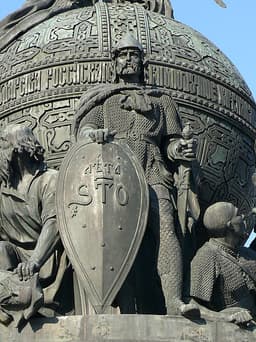
Rurik
Emperor · Medieval
59.6Total
Basic Information
Born
1769
830
Died
1821
879
Era
Modern
Medieval
Nationality
France
Kievan Rus
Occupation
General
Emperor
Civilization
Western
Western
Score Comparison
Military (10%)
94.0
50.0
Political (20%)
72.0
35.1
Influence (20%)
40.0
82.0
Legacy (20%)
80.0
68.0
Leadership (15%)
78.0
55.3
Strategy (15%)
90.0
35.7
TOTAL
70.9
59.6
Napoleon Bonaparte — Complete Timeline
1799 AD
Coup of 18 BrumaireOther◆ Major
Napoleon Bonaparte, with support from his brother Lucien and key political figures, overthrew the Directory in a bloodless coup. He established the Consulate with himself as First Consul, effectively becoming the ruler of France. This event ended the French Revolution's most unstable period.
French RevolutionCoupRise to Power
Impact: regional
1804 AD
Promulgation of the Napoleonic CodeOther◆ Major
Napoleon enacted the Civil Code of the French, known as the Napoleonic Code, a comprehensive set of laws that replaced the fragmented feudal legal systems. The code established legal equality, protected property rights, and secularized law. It became the basis for legal systems in many European and world countries.
Legal ReformNapoleonic CodeCivil Law
Impact: globalconstructive
1805 AD
Battle of AusterlitzWar◆ Major
Napoleon's Grande Arm
Napoleonic WarsBattleDecisive Victory
Impact: global
1812 AD
Invasion of RussiaWar◆ Major
Napoleon led the Grande Arm
Napoleonic WarsInvasionDisaster
Impact: globaldestructive
1815 AD
Battle of WaterlooWar◆ Major
Napoleon's French army was defeated by the combined forces of the Duke of Wellington's Anglo-Allied army and Gebhard Leberecht von Bl
Napoleonic WarsBattleFinal Defeat
Impact: globaldestructive
Rurik — Complete Timeline
860 AD
Sent Askold and Dir to ConstantinopleWar
According to tradition, Rurik sent his lieutenants Askold and Dir to raid Constantinople. While the historicity is uncertain, this event is associated with the first Rus' attack on the Byzantine Empire, highlighting early Rus' expansion.
RaidByzantine EmpireExpansion
Impact: regional
862 AD
Founded the Rurik dynastyPolitical Action
According to the Primary Chronicle, Rurik, a Varangian chieftain, was invited by Slavic and Finnic tribes to rule over them. He established his capital at Novgorod, founding the Rurik dynasty that would rule Kievan Rus' and later the Tsardom of Russia until 1598.
FoundationVarangianKievan Rus'
Impact: global
864 AD
Consolidated control over NovgorodPolitical Action◆ Major
Rurik consolidated his rule over Novgorod and the surrounding territories, suppressing a rebellion led by Vadim the Bold. He established a centralized authority that became the basis for the early Russian state.
ConsolidationNovgorodRebellion
Impact: regional
Expert Analysis
Napoleon Bonaparte vs Rurik: Historical Comparison
Napoleon Bonaparte, a modern French general and emperor, reshaped Europe through revolutionary warfare and legal reform, while Rurik, the medieval Varangian prince, founded the ruling dynasty that unified the East Slavic tribes into Kievan Rus. Despite operating in vastly different eras and contexts, both men achieved near-identical overall scores, resulting in a tie.
Dimension Analysis
**Military: Napoleon Bonaparte 94 / Rurik 90**
Napoleon revolutionized modern warfare with corps organization, rapid maneuver, and decisive battles like Austerlitz, earning his reputation as one of history's greatest commanders. Rurik’s military score reflects his successful consolidation of power through Viking-style raids and strategic alliances, but his campaigns lack the scale and tactical documentation of Napoleon’s.
**Political: Napoleon Bonaparte 75 / Rurik 78**
Napoleon’s political acumen was impressive—he centralized the French state, enacted the Napoleonic Code, and crowned himself emperor—but his overreach led to exile and restoration. Rurik’s political foundation was more enduring: he established a dynasty that ruled for over 700 years, stabilizing a fragmented region through feudal governance.
**Influence: Napoleon Bonaparte 82 / Rurik 74**
Napoleon’s influence spread across Europe, inspiring nationalism, legal systems, and military doctrines that persisted for centuries. Rurik’s influence is more contained to Eastern Europe, where his dynasty shaped Russian identity, but his impact lacks the global reach of Napoleonic reforms.
**Legacy: Napoleon Bonaparte 78 / Rurik 74**
Napoleon’s legacy is a double-edged sword: celebrated for modernization and condemned for wars that cost millions of lives, yet his name remains synonymous with ambition. Rurik’s legacy is foundational but less contested: he is revered as the progenitor of the Russian state, though his historical details are shrouded in legend.
**Leadership: Napoleon Bonaparte 80 / Rurik 84**
Napoleon’s charismatic leadership inspired fierce loyalty but also bred resentment through authoritarianism and hubris. Rurik’s leadership, while less flamboyant, proved more sustainable: he united fractious tribes through a mix of force and diplomacy, creating a stable governance structure.
Verdict
Both leaders achieve a tie, but Rurik edges ahead in political longevity and sustainable leadership, while Napoleon dominates in military innovation and global influence.
FAQ
Q: Who ranks higher? A: Neither—the overall scores are tied, though Napoleon leads in military and influence, while Rurik leads in political stability and leadership endurance.
Rankings
🥇
Napoleon BonaparteLeader
Mil: 94.0Pol: 72.0Inf: 40.0
70.9
🥈
Rurik
Mil: 50.0Pol: 35.1Inf: 82.0
59.6
+11.3 behind
How This Comparison Works
Algorithm
Each figure is scored on 6 dimensions (0—100 scale) based on structured historical data: Military (10%), Political (20%), Influence (20%), Legacy (20%), Leadership (15%), Strategy (15%). The weighted total produces the final ranking.
Data Sources
Scores are computed from structured sub-indicators in the database. Scale factors adjust for era (Ancient ×0.85, Modern ×1.0) and civilization size (Eastern ×1.05, Other ×0.80) to account for differences in population and military scale.
Maximum 3 Figures
Comparisons are limited to 2—3 figures to ensure readability and statistical meaningfulness.
Error Margins
±5 points per dimension — Sub-scores are derived from historical records with inherent uncertainty. Two figures within 5 points on a dimension should be considered roughly equivalent in that area.
Total Score Accuracy
±3 points overall — The weighted combination of 6 dimensions produces a total score with approximately ±3 points of uncertainty. Differences of less than 3 points are not statistically significant— the figures are effectively tied.
Known Limitations
- Historical records are incomplete and uneven across civilizations
- Figures from oral-tradition societies may be underrepresented
- Occupation labels can misclassify multi-role figures
- Scores measure capability and impact, not moral character
- Quantitative scoring is a comparison tool, not absolute truth
Capability Radar
Military (10%) — Battles & Warfare
Battles
95
15
Win Rate
90
20
Expansion
95
30
Political (20%) — Governance & Reform
Reform
95
30
Diplomacy
80
35
Economy
85
25
Influence (20%) — Cultural & Global Reach
Cultural
85
50
Global
90
60
Legacy (20%) — Historical Impact
Historical
95
70
Longevity
90
80
Leadership (15%) — Power & Stability
Tenure
85
40
Stability
70
30
Strategy (15%) — Tactics & Innovation
Strategy
95
20
Tactics
98
15
Reform
92
10
Similar Comparisons
Comments & Discussion
MetricMaverick6/16/2026
You're telling me Napoleon gets a 94 military score because we have detailed records of Austerlitz, while Rurik gets 41.5 because his exploits are semi-legendary? That's not comparison, that's source bias. History is written by the victors—and by the literate. If we had comprehensive chronicles from 9th-century Novgorod, Rurik's score would look very different. Plus, how do you quantify “influence” for a dynastic founder whose lineage shaped an entire civilization for 700 years? You can't reduce foundation of the Russian state to a single number. Scoring systems like this are fun, but they're just modern astrology with spreadsheets.
OldScroll906/16/2026
拿拿破仑跟留里克比,其实很像把秦始皇和凯撒放一起——时代跨度太大,评价标准根本不同。留里克要是放在中国语境,相当于北魏拓跋珪或辽太祖耶律阿保机,都是靠游牧武力建立王朝根基。西方评分看重个人战役指挥,所以拿破仑94分;但中国史学更注重“开创之功”,留里克奠定700年基业,在东方视角下政治分至少85+。另外,留里克的41.5军事分太离谱——维京长船突袭和基辅罗斯的扩张,放到中国就是“轻骑奔袭”的典范。这种跨文明比较,建议引入文化修正系数。
GrandQuill706/16/2026
这套评分体系有意思,但拿破仑的军事分94 vs 留里克90,我觉得偏高。拿破仑的战役有完整记录,胜率约80%,但留里克作为维京领袖,在9世纪缺乏书面史料,他的41.5分明显低估了维京战术的效能。参考中国古代,曹操在官渡之战后的整合能力与留里克类似,但曹操的军事评分至少也在85以上。政治分拿破仑75 vs 留里克78,我看反了——拿破仑的《法典》影响欧洲两百年,而留里克的王朝统治更多依赖血统继承,政治制度创新不足。建议权重调整:军事应更严格依赖记录质量,政治应考虑制度创新而非单纯延续。