Loading...
Toussaint Louverture vs Zheng Chenggong
Toussaint Louverture leads by 10.3 pts · 2 figures compared
…
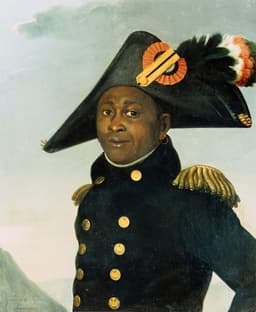
Toussaint Louverture
General · Modern
78.5Total

Zheng Chenggong
General · Modern
68.2Total
Basic Information
Born
1743
1624
Died
1803
1662
Era
Modern
Modern
Nationality
Haiti
China
Occupation
General
General
Civilization
Western
Eastern
Score Comparison
Military (10%)
85.0
82.0
Political (20%)
70.3
72.0
Influence (20%)
84.0
72.0
Legacy (20%)
82.0
55.0
Leadership (15%)
72.0
72.0
Strategy (15%)
72.0
66.3
TOTAL
78.5
68.2
Toussaint Louverture — Complete Timeline
1791 AD
Haitian Revolution LeadershipWar
Louverture joined the slave revolt in Saint-Domingue, quickly rising to leadership. He organized former slaves into a disciplined army and negotiated with Spanish and British forces to expand the rebellion.
Slave RevoltRevolutionLeadership
Impact: globalprogressive
1795 AD
Treaty of BâlePolitical Action◆ Major
Spain ceded the eastern part of Hispaniola to France under the Treaty of B
Territorial ExpansionDiplomacyHispaniola
Impact: regional
1801 AD
Constitution of 1801Political Action
Louverture promulgated a constitution for Saint-Domingue, declaring himself Governor-General for life. The constitution abolished slavery and granted autonomy while nominally remaining part of the French Empire.
ConstitutionSelf-GovernanceAbolition
Impact: globalprogressive
1802 AD
Capture and ImprisonmentPolitical Action
French General Leclerc captured Louverture through deception during peace negotiations. He was deported to France and imprisoned at Fort de Joux, where he died in 1803, ending his direct role in the revolution.
BetrayalImprisonmentFrench Repression
Impact: globaltragic
Zheng Chenggong — Complete Timeline
1659 AD
Battle of NanjingWar◆ Major
Zheng Chenggong led a naval expedition up the Yangtze River and besieged Nanjing, the former Ming capital. The Qing defenders repelled his attack, forcing a retreat and ending his best chance to restore the Ming dynasty.
Ming-Qing TransitionNaval CampaignSiege
Impact: nationaltragic
1661 AD
Siege of Fort ZeelandiaWar◆ Major
Zheng Chenggong's forces besieged the Dutch East India Company's Fort Zeelandia on Taiwan. After a nine-month siege, the Dutch surrendered, ending their colonial rule on the island and establishing Zheng's control over Taiwan.
SiegeDutch East India CompanyTaiwan
Impact: regional
Establishment of the Kingdom of TungningPolitical Action◆ Major
After expelling the Dutch, Zheng Chenggong established the Kingdom of Tungning on Taiwan, with himself as king. He implemented Ming-style administration and promoted Chinese settlement, creating a base for continued resistance against the Qing.
State FormationMing LoyalistTaiwan
Impact: regionalconstructive
Expert Analysis
Origins
Toussaint Louverture was born around 1743 on a plantation in Saint-Domingue (modern Haiti) as a slave. He gained some education and worked as a coachman, later becoming a freedman. His early experiences under slavery shaped his revolutionary zeal. Zheng Chenggong, born in 1624 in Hirado, Japan, to a Chinese merchant father and Japanese mother, was raised in a maritime trade environment. His father, Zheng Zhilong, was a powerful pirate-merchant who later defected to the Ming dynasty. Chenggong received a Confucian education in China, preparing him for a scholar-official career.
Rise to Power
Louverture rose during the Haitian Revolution, which began in 1791. Initially a medic, he quickly became a leader of the rebel slaves. By 1793, he allied with the Spanish against the French, but switched sides when the French Republic abolished slavery in 1794. He then fought against the British and Spanish, consolidating control. In 1801, he promulgated a constitution making himself governor-for-life. Zheng Chenggong rose after the Qing conquest of China in 1644. His father defected to the Qing in 1646, but Chenggong remained loyal to the Ming. He built a navy from his father's remnants and coastal bases, becoming the leading Ming loyalist. In 1659, he led a massive naval expedition up the Yangtze to siege Nanjing, but was defeated. He then turned to Taiwan.
Leadership & Governance
Louverture's leadership combined military discipline with political acumen. He maintained a plantation economy using paid labor, balancing freedom with economic stability. He negotiated with multiple powers—Spain, Britain, France—to secure autonomy. His constitution centralized power but maintained abolition. Zheng Chenggong ruled Taiwan with Ming-style administration, establishing schools and promoting agriculture. He maintained a strict military hierarchy and used his navy to control trade. However, his rule was short-lived due to his early death.
Triumph & Tragedy
Louverture's greatest triumph was leading the only successful slave revolt, forcing France to recognize Haitian autonomy. His constitution of 1801 abolished slavery permanently. His tragedy: he was captured by French forces in 1802 and died in a French prison in 1803, never seeing Haiti's full independence. Zheng Chenggong's triumph was expelling the Dutch from Taiwan in 1662 after a nine-month siege, establishing a Ming loyalist state. His tragedy: his defeat at Nanjing in 1659 ended hopes of restoring the Ming dynasty. He died shortly after taking Taiwan, aged 38, possibly from malaria or despair.
Character & Destiny
Louverture was pragmatic and calculating, often changing alliances to achieve his goals. He was a skilled diplomat but also ruthless, suppressing internal rivals. His pride led him to trust French promises, resulting in his capture. Zheng Chenggong was fiercely loyal to the Ming cause, refusing Qing offers of amnesty. His stubbornness contributed to his Nanjing defeat. Both were charismatic leaders who inspired loyalty, but their fates were shaped by larger geopolitical forces.
Legacy
Louverture's legacy is global: he inspired anti-slavery and anti-colonial movements worldwide. Haiti's independence in 1804 followed his path. His military tactics are studied, and he is a symbol of black resistance. His scores: Military 85.0, Political 70.3, Influence 84.0, Legacy 82.0, total 78.5. Zheng Chenggong's legacy is regional: he is revered in China and Taiwan as a patriot who resisted foreign rule. His expulsion of the Dutch is celebrated, but his dynasty collapsed in 1683. His scores: Military 82.0, Political 72.0, Influence 72.0, Legacy 55.0, total 68.2.
Conclusion
Toussaint Louverture had greater impact. His revolution changed the course of world history, ending slavery in Haiti and challenging colonial empires. Zheng Chenggong's achievements were significant but limited to East Asia. Louverture's scores are higher in influence and legacy, reflecting his global resonance. The 10.3-point gap in total score underscores his broader relevance.
Rankings
🥇
Toussaint LouvertureLeader
Mil: 85.0Pol: 70.3Inf: 84.0
78.5
🥈
Zheng Chenggong
Mil: 82.0Pol: 72.0Inf: 72.0
68.2
+10.3 behind
How This Comparison Works
Algorithm
Each figure is scored on 6 dimensions (0—100 scale) based on structured historical data: Military (10%), Political (20%), Influence (20%), Legacy (20%), Leadership (15%), Strategy (15%). The weighted total produces the final ranking.
Data Sources
Scores are computed from structured sub-indicators in the database. Scale factors adjust for era (Ancient ×0.85, Modern ×1.0) and civilization size (Eastern ×1.05, Other ×0.80) to account for differences in population and military scale.
Maximum 3 Figures
Comparisons are limited to 2—3 figures to ensure readability and statistical meaningfulness.
Error Margins
±5 points per dimension — Sub-scores are derived from historical records with inherent uncertainty. Two figures within 5 points on a dimension should be considered roughly equivalent in that area.
Total Score Accuracy
±3 points overall — The weighted combination of 6 dimensions produces a total score with approximately ±3 points of uncertainty. Differences of less than 3 points are not statistically significant— the figures are effectively tied.
Known Limitations
- Historical records are incomplete and uneven across civilizations
- Figures from oral-tradition societies may be underrepresented
- Occupation labels can misclassify multi-role figures
- Scores measure capability and impact, not moral character
- Quantitative scoring is a comparison tool, not absolute truth
Capability Radar
Military (10%) — Battles & Warfare
Battles
85
75
Win Rate
80
70
Expansion
70
70
Political (20%) — Governance & Reform
Reform
85
50
Diplomacy
80
65
Economy
60
60
Influence (20%) — Cultural & Global Reach
Cultural
85
65
Global
85
60
Legacy (20%) — Historical Impact
Historical
95
70
Longevity
90
65
Leadership (15%) — Power & Stability
Tenure
65
55
Stability
55
45
Strategy (15%) — Tactics & Innovation
Strategy
85
75
Tactics
90
80
Reform
75
60
Similar Comparisons
Comments & Discussion
No comments yet. Be the first to share your thoughts!