Loading...
Ahmad Shah I Wali vs Leonardo da Vinci
Leonardo da Vinci leads by 10.4 pts · 2 figures compared
…
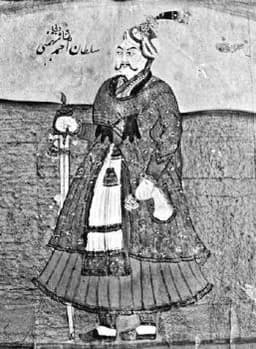
Ahmad Shah I Wali
Emperor · Medieval
51.7Total

Leonardo da Vinci
Artist · Medieval
62.1Total
Basic Information
Born
1422
1452
Died
1436
1519
Era
Medieval
Medieval
Nationality
India
Italy
Occupation
Emperor
Artist
Civilization
Indian
Western
Score Comparison
Military (10%)
40.0
34.9
Political (20%)
48.0
20.0
Influence (20%)
51.0
80.0
Legacy (20%)
42.5
90.0
Leadership (15%)
74.0
62.6
Strategy (15%)
60.0
37.0
TOTAL
51.7
62.1
Ahmad Shah I Wali — Complete Timeline
1424 AD
Relocation of the Bahmani capital to BidarPolitical Action
Ahmad Shah I Wali moved the Bahmani capital from Gulbarga to Bidar, a more defensible location. He constructed a new fort and palace complex in Bidar, which became the political center of the sultanate.
Capital MoveUrban Development
Impact: regionalconstructive
1425 AD
War against the Vijayanagara EmpireWar◆ Major
Ahmad Shah I Wali launched a successful campaign against the Vijayanagara Empire, capturing the fort of Mudgal. The victory expanded Bahmani territory in the Raichur Doab.
WarVijayanagaraTerritorial Expansion
Impact: regional
1428 AD
Construction of the Bidar FortCultural◆ Major
Ahmad Shah I Wali oversaw the construction of the Bidar Fort, a massive defensive structure with seven gates and extensive ramparts. The fort became the seat of Bahmani power for over a century.
ArchitectureFortification
Impact: regionalconstructive
1430 AD
Suppression of the rebellion of the Bahmani noblesPolitical Action
Ahmad Shah I Wali crushed a rebellion by powerful Bahmani nobles who opposed his centralization of authority. The rebels were defeated, and their leaders were executed or exiled.
RebellionInternal Conflict
Impact: nationaldestructive
Leonardo da Vinci — Complete Timeline
1482 AD
Commission for the Sforza HorseCultural
Leonardo was commissioned by Ludovico Sforza to create a colossal bronze equestrian statue, the Sforza Horse. He spent years on designs and a full-scale clay model, but the bronze was used for cannons, and the statue was never cast. The clay model was destroyed in 1499.
SculptureCommissionUnfinished
1488 AD
Design of Flying MachinesInvention
Leonardo designed several flying machines, including an ornithopter with flapping wings inspired by birds. He studied aerodynamics and bird flight, creating detailed sketches. While none were built or flown, his designs demonstrated advanced engineering concepts.
EngineeringFlightDesign
Impact: globalprogressive
1489 AD
Anatomical StudiesInvention◆ Major
Leonardo da Vinci conducted detailed anatomical dissections of human corpses, producing over 200 drawings of muscles, bones, and organs. His studies of the heart, brain, and fetus were centuries ahead of their time, though not published during his lifetime.
ScienceAnatomyDrawing
Impact: globalprogressive
1495 AD
Painting of The Last SupperCultural◆ Major
Leonardo painted The Last Supper on the wall of the refectory of the Convent of Santa Maria delle Grazie in Milan. The mural depicts the moment Jesus announces his betrayal. Its innovative composition and emotional depth made it a seminal work of Renaissance art.
ArtMuralReligious
Impact: globalconstructive
1503 AD
Painting of the Mona LisaCultural
Leonardo da Vinci began painting the Mona Lisa, a portrait of Lisa Gherardini. He used sfumato technique to create a subtle, enigmatic smile. The painting became the most famous artwork in the world, renowned for its composition and technical mastery.
ArtPortraitRenaissance
Impact: globalconstructive
Expert Analysis
Origins
Ahmad Shah I Wali (r. 1422–1436) was born into the Bahmani Sultanate, a medieval Islamic kingdom in the Deccan region of India. His father, Sultan Taj ud-Din Firuz Shah, provided him with a princely education in military tactics, administration, and courtly arts. Ahmad succeeded his brother Ahmad Shah I (confusingly, the same name) after a brief power struggle, inheriting a kingdom that was militarily strong but politically fragmented.
Leonardo da Vinci (1452–1519) was born out of wedlock in Vinci, Tuscany, to a notary and a peasant woman. He received little formal education but was apprenticed to the Florentine painter Andrea del Verrocchio at age 14. There he learned painting, sculpture, and technical skills. His illegitimacy barred him from a classical education, but his insatiable curiosity drove him to study nature, anatomy, and mechanics on his own.
Rise to Power
Ahmad Shah I Wali rose to power through dynastic succession, but his early reign was marked by a rebellion of powerful nobles who opposed his centralization efforts. He crushed this revolt in 1424, executing the rebel leaders and consolidating his authority. His decisive victory at the Battle of Mudgal (1426) against the Vijayanagara Empire further solidified his reputation as a capable military leader. By moving the capital to Bidar in 1429, he physically distanced himself from the old nobility and established a new power base.
Leonardo da Vinci's rise was more gradual. He became a master in the Guild of Saint Luke in 1478 and worked for Ludovico Sforza, Duke of Milan, from 1482. As court engineer and artist, he designed everything from weapons to pageants. His fame grew through commissions like the *Virgin of the Rocks* (1483–1486) and *The Last Supper* (1495–1498). Later, he worked for Cesare Borgia, the French king, and finally for King Francis I of France, who granted him a pension and a manor. His reputation as a genius was established during his lifetime, though his output was relatively small.
Leadership & Governance
Ahmad Shah I Wali governed as an absolute monarch, centralizing authority and reducing the power of regional nobles. He constructed the Bidar Fort, a massive defensive structure with seven gates, to secure his capital. He also patronized Persianate culture, inviting scholars and architects from Persia. His governance score of 48.0 reflects his moderate administrative success, though his military score of 40.0 indicates he was not a conqueror on the scale of his contemporaries.
Leonardo da Vinci never held formal political power. His leadership score of 62.6 comes from his ability to manage complex projects and teams, such as the Sforza Horse commission, which involved foundry workers, sculptors, and engineers. However, he often left works unfinished due to his perfectionism and shifting interests. His political score of 20.0 is low because he was a courtier, not a ruler.
Triumph & Tragedy
Ahmad Shah I Wali's greatest triumph was the relocation of the Bahmani capital to Bidar and the construction of its fort, which became the center of the sultanate for nearly a century. His victory over Vijayanagara at Mudgal also expanded Bahmani territory. However, his tragedy was the internal strife that continued after his reign; the centralization he enforced could not prevent the eventual fragmentation of the Bahmani Sultanate into five successor states (the Deccan sultanates) after his death.
Leonardo da Vinci's triumphs are legendary: the *Mona Lisa* (1503–1519) with its mysterious smile and sfumato technique, and *The Last Supper*, a masterpiece of composition and emotion. His anatomical studies, based on over 30 dissections, were centuries ahead of their time. Yet his tragedy was incompleteness: many of his inventions (flying machines, tanks) were never built, and his scientific work was unpublished in his lifetime. He died in France, leaving many projects unfinished.
Character & Destiny
Ahmad Shah I Wali was a pragmatic and decisive ruler, willing to crush opposition ruthlessly. His decision to move the capital was strategic, but it also alienated the old nobility. His character was shaped by the constant threats from Vijayanagara and internal rebellions. He scored 74.0 in leadership, reflecting his ability to maintain control, but his overall total of 51.7 is modest because his impact was regional and short-lived.
Leonardo da Vinci was a restless polymath, constantly flitting between art, science, and engineering. His perfectionism led to few completed works but extraordinary depth in those he finished. His character—curious, inventive, but easily distracted—shaped his destiny as a symbol of genius rather than a builder of lasting institutions. His total score of 62.1 is driven by high influence (80.0) and legacy (90.0).
Legacy
Ahmad Shah I Wali's legacy is tied to Bidar: the fort stands as a UNESCO World Heritage site candidate, and his architectural patronage influenced Deccani style. However, the Bahmani Sultanate collapsed within 50 years of his death, and his name is little known outside Indian history. His legacy score of 42.5 reflects this limited enduring impact.
Leonardo da Vinci's legacy is immense. The *Mona Lisa* is arguably the most famous painting in the world, and his anatomical drawings are still studied. His notebooks influenced generations of scientists and artists. He is the archetype of the Renaissance Man, with a legacy score of 90.0 that places him among the most influential figures in history.
Conclusion
While Ahmad Shah I Wali was a competent ruler who consolidated the Bahmani Sultanate and built a lasting fort, his impact was regional and temporal. Leonardo da Vinci, with a total score of 62.1 against Ahmad's 51.7, had far greater influence and legacy. His contributions to art, science, and human knowledge transcend cultures and centuries. The sultan moved a capital; the polymath moved the human spirit. Leonardo da Vinci is the more significant figure by a clear margin.
Rankings
🥇
Leonardo da VinciLeader
Mil: 34.9Pol: 20.0Inf: 80.0
62.1
🥈
Ahmad Shah I Wali
Mil: 40.0Pol: 48.0Inf: 51.0
51.7
+10.4 behind
How This Comparison Works
Algorithm
Each figure is scored on 6 dimensions (0—100 scale) based on structured historical data: Military (10%), Political (20%), Influence (20%), Legacy (20%), Leadership (15%), Strategy (15%). The weighted total produces the final ranking.
Data Sources
Scores are computed from structured sub-indicators in the database. Scale factors adjust for era (Ancient ×0.85, Modern ×1.0) and civilization size (Eastern ×1.05, Other ×0.80) to account for differences in population and military scale.
Maximum 3 Figures
Comparisons are limited to 2—3 figures to ensure readability and statistical meaningfulness.
Error Margins
±5 points per dimension — Sub-scores are derived from historical records with inherent uncertainty. Two figures within 5 points on a dimension should be considered roughly equivalent in that area.
Total Score Accuracy
±3 points overall — The weighted combination of 6 dimensions produces a total score with approximately ±3 points of uncertainty. Differences of less than 3 points are not statistically significant— the figures are effectively tied.
Known Limitations
- Historical records are incomplete and uneven across civilizations
- Figures from oral-tradition societies may be underrepresented
- Occupation labels can misclassify multi-role figures
- Scores measure capability and impact, not moral character
- Quantitative scoring is a comparison tool, not absolute truth
Capability Radar
Military (10%) — Battles & Warfare
Battles
45
0
Win Rate
50
0
Expansion
40
0
Political (20%) — Governance & Reform
Reform
50
10
Diplomacy
45
20
Economy
40
10
Influence (20%) — Cultural & Global Reach
Cultural
30
95
Global
15
95
Legacy (20%) — Historical Impact
Historical
35
95
Longevity
20
95
Leadership (15%) — Power & Stability
Tenure
55
0
Stability
50
0
Strategy (15%) — Tactics & Innovation
Strategy
45
20
Tactics
40
25
Reform
35
15
Similar Comparisons
Comments & Discussion
No comments yet. Be the first to share your thoughts!